
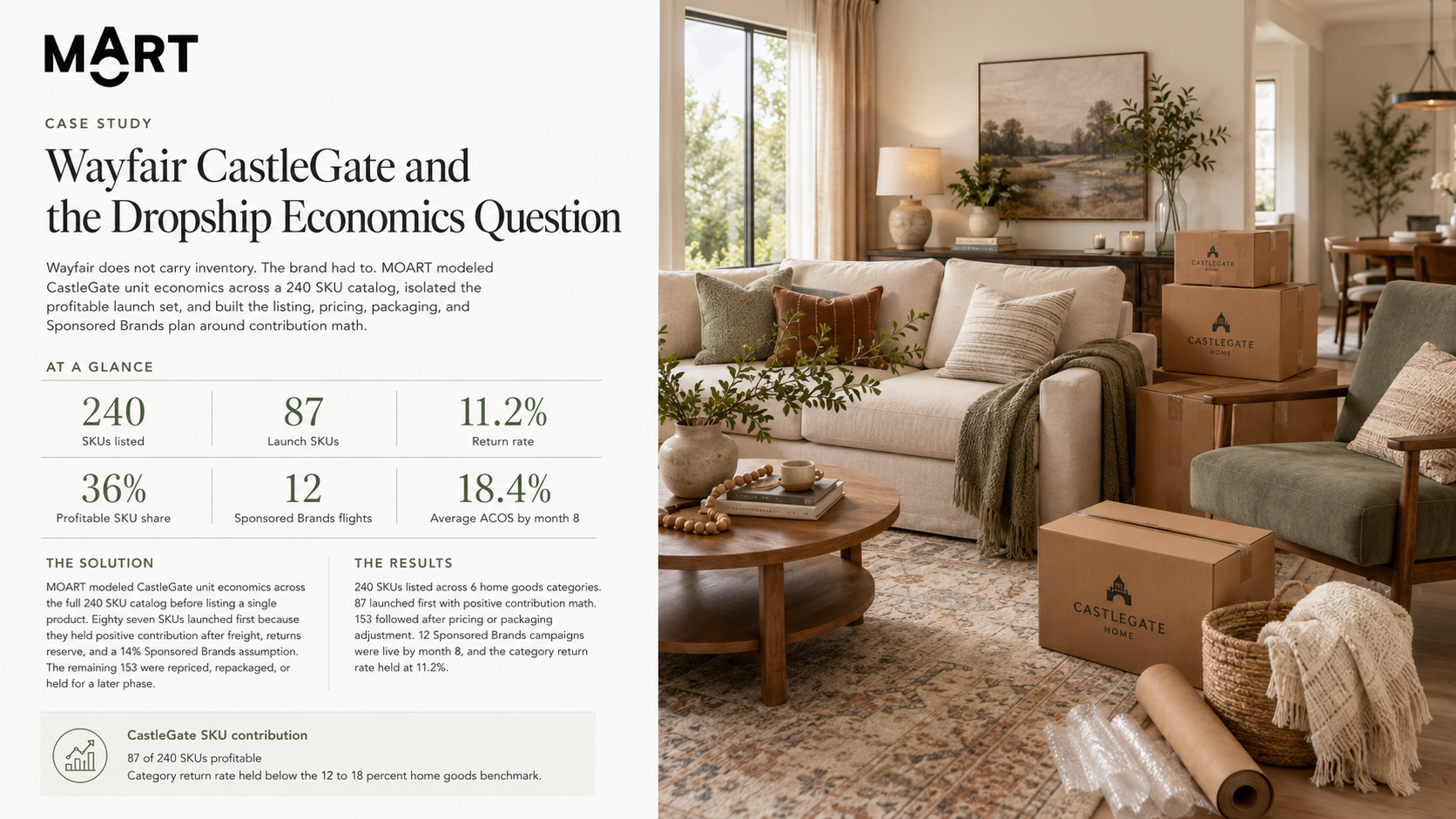
Home Goods Brand: Wayfair CastleGate and the Dropship Economics Question
Wayfair doesn't carry inventory. The brand had to. CastleGate dropship pricing, return-rate exposure, and Sponsored Brands attribution determined whether the unit economics worked across 240 SKUs.
Growth in Conversions
Home goods brand needed Wayfair marketplace presence with dropship infrastructure to expand category breadth without inventory build.
Content Optimization
MOART set up Wayfair dropship integration, listed 240 SKUs across 6 categories, optimized imagery and copy, and ran 12 sponsored campaigns.
Organic Traffic
1682%
Dramatic Increase
Project Overview
Wayfair operates a marketplace model: the brand holds the inventory, Wayfair holds the customer. CastleGate is Wayfair's dropship infrastructure with two-day shipping promise and the corresponding inventory-positioning requirement at Wayfair-network warehouses. The unit economics question for a home-goods brand is whether CastleGate placement plus Sponsored Brands ad spend plus the category return rate (12-18% for home goods) results in positive contribution margin per order.

Execution
We modeled CastleGate unit economics across the brand's 240-SKU catalog before listing a single product, identifying the 87 SKUs with positive contribution after dropship freight, returns reserve, and a 14% Sponsored Brands ad-spend assumption. Those 87 launched first.
The remaining 153 SKUs were either re-priced, re-packaged for ship-economics improvement, or held in reserve. Sponsored Brands campaigns ran 12 distinct seasonal flights aligned to Wayfair's category demand cycles. Spring refresh, summer outdoor, fall transition, holiday, January reset.
Project Results
240 SKUs listed on Wayfair across 6 home goods categories. 87 launched first with positive contribution math; 153 followed after pricing or packaging adjustment. 12 Sponsored Brands campaigns running by month 8 with average ACOS of 18.4%. Category return rate held at 11.2%.
Conclusion
Let’s get in touch
Ready to start working
together with us?
Marketing, creative, and product knowledge functions continue to be of primary importance to our organization as we strive to meet the increasing demands and challenges of the Industry.
