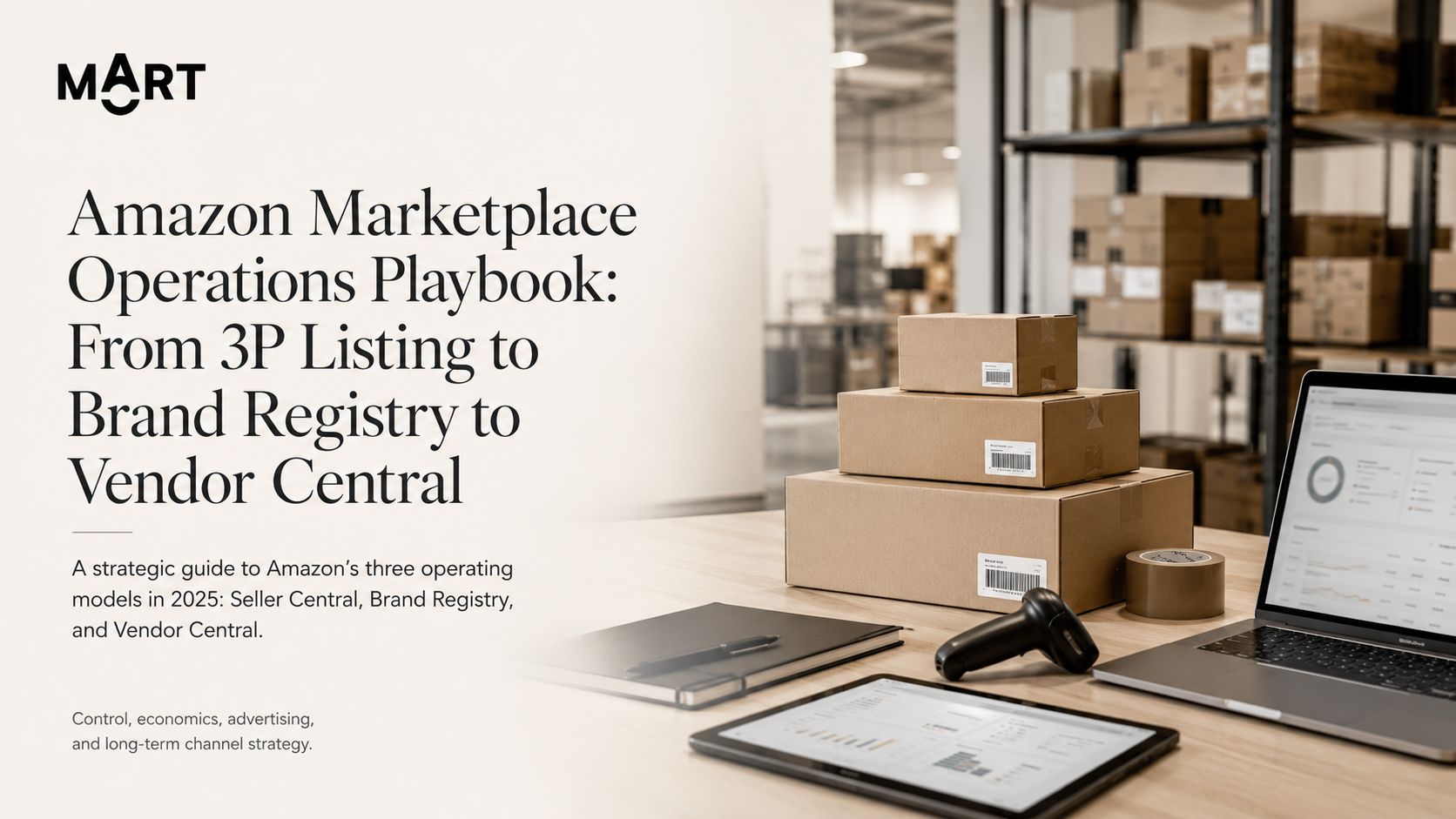
Amazon is no longer a single channel. For any brand selling on Amazon in 2025, three distinct account models coexist and frequently overlap: third party seller (3P) accounts on Seller Central, Brand Registry protected listings managed by the brand or an authorized partner, and Vendor Central (1P) relationships where Amazon purchases inventory from the brand and resells it. Each model has different economics, different controls, different reporting access, and different long term brand consequences. The strategic question for a brand in 2025 is not which model is best, but which sequence of models matches the brand's stage, category, and operating capability.
The economic comparison. 3P Seller economics depend on the FBA versus FBM choice, the referral fee for the category (typically 8 to 15 percent), and the storage and fulfillment fees for FBA. Brand Registry adds protection and content control but does not change the underlying transaction economics. Vendor Central transfers inventory risk to Amazon at a wholesale price typically 40 to 60 percent of MSRP, with the brand giving up direct control over retail price, promotional cadence, and content updates in exchange for the simplicity of selling to Amazon as a single customer.
3P Seller (FBA) referral fee~8 to 15 percent by category3P Seller FBA fulfillment fee$3 to $15 per unit depending on size and weightBrand Registry enrollment costNo fee; requires registered trademarkVendor Central typical cost of goods to Amazon~40 to 60 percent of MSRPVendor Central typical net co op and marketing commitments~5 to 15 percent of net salesTime to onboard 3P Seller (with brand approval)typically 1 to 4 weeksTime to onboard Vendor Central (Amazon invitation only)typically 3 to 9 months
The sequencing decision. Most brands should start with 3P Seller, build a strong Brand Registry posture, and consider Vendor Central only when scale, category dynamics, or specific Amazon program access (such as Subscribe and Save at scale) make 1P meaningfully more valuable than 3P. Brands that go straight to Vendor Central often discover that they have given up control of pricing, content, and promotion to gain a simpler customer relationship that does not deliver the projected revenue.
The brand consequences of the choice. 3P Seller preserves brand control and direct customer relationship, at the cost of operational complexity (inventory forecasting, ad management, multi-marketplace coverage). Vendor Central simplifies operations at the cost of brand control. The biggest single brand risk in 2025 for Amazon channel management is what is sometimes called the rogue 3P problem: unauthorized 3P sellers carrying authentic or grey market product who erode the brand's pricing architecture and customer experience. Strong Brand Registry posture combined with disciplined distribution controls is the only durable response.
Amazon Advertising as a required cost. Across all three account models, Amazon Advertising spend is a required cost of doing business, not an optional marketing line. Sponsored Products, Sponsored Brands, and Sponsored Display drive most of the discoverability for new and emerging items in 2025. The category-level cost per click rates are rising in the high single digits annually, and brands that under-invest in advertising lose detail page traffic and sales velocity quickly.
MOART recommendation. For an international brand entering the US market via Amazon in 2025, the operational sequence should be: register the trademark in the US, enroll in Brand Registry, set up a 3P Seller Central account, build the catalog and content with brand standard imagery and copy, invest in Amazon Advertising from launch, and use the 3P performance data to make the Vendor Central decision twelve to eighteen months later, only if the data clearly supports it. Brands that follow this sequence retain control, build the right operational capability, and preserve optionality across the channel evolution.