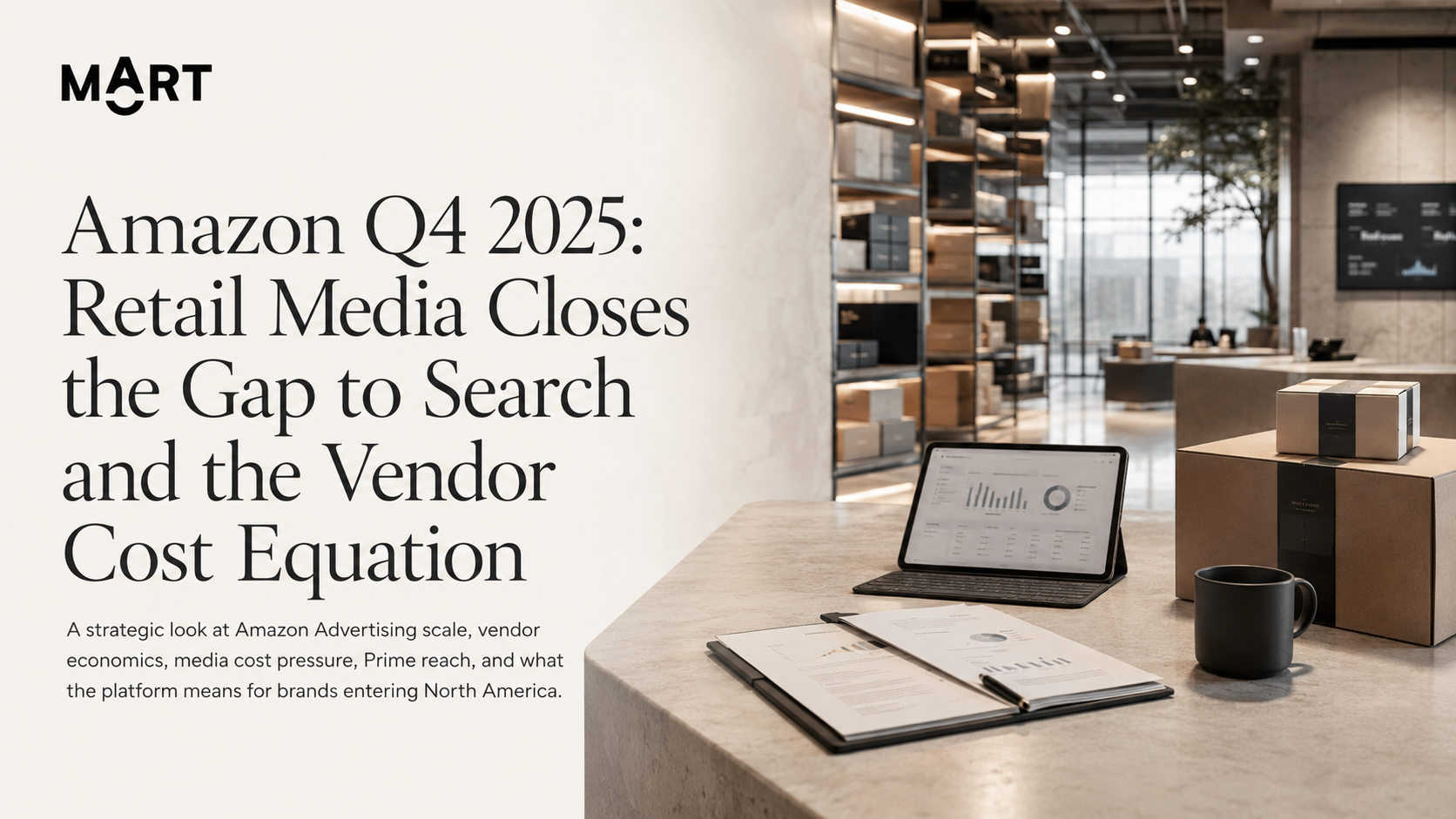
Amazon reported Q4 2025 results that confirmed retail media's continued role as the company's fastest growing high margin business, with Amazon Advertising approaching scale that places it in the same conversation as Google search and Meta advertising in absolute revenue and margin contribution. For brands selling on Amazon, the implications for cost economics, channel strategy, and competitive positioning are substantial.
The Amazon Advertising scale. Amazon Advertising's annualized revenue run rate now exceeds $60 billion globally, with continued growth in the high teens to low twenties annually. The business spans Sponsored Products and Sponsored Brands (the search and detail page ads that drive shopper conversion), Sponsored Display (programmatic display targeting Amazon shoppers), and the broader advertising and DSP capability. Each of these revenue lines grew meaningfully in Q4 2025, with the holiday shopping window driving particular strength.
Amazon Advertising annualized revenueover $60 billionAmazon Advertising YoY growthhigh teens to low twentiesAmazon Web Services (AWS) annualized revenueover $100 billionOnline stores (1P retail) growthlow single digitsThird party seller services growthmid to high single digitsPrime subscription estimated household reachover 180 million worldwide
The vendor cost equation. For brands selling on Amazon, the rising importance of advertising spend changes the unit economics meaningfully. A brand selling on Amazon in 2026 typically allocates 10 to 25 percent of revenue to Amazon Advertising, depending on category and competitive intensity. This advertising allocation is not optional spending, it is the cost of being discoverable in the Amazon search and detail page environment that drives most shopper conversion. Brands that under invest see weak detail page traffic, weak conversion, and weak velocity ramp.
The cost per click trajectory. Amazon Advertising cost per click has risen in the high single digits annually for several years, with the increase driven by both expanding advertiser adoption and category competitive intensity. The CPC environment is meaningfully more expensive in 2026 than five years ago, with certain categories (beauty, supplements, electronics) particularly competitive. Brands need to plan advertising budgets that scale with CPC inflation and growing competitive intensity, not budgets that remain flat year over year.
The measurement maturation. Amazon's measurement infrastructure has matured to support meaningful incrementality measurement, attribution across the funnel, and brand health metrics. Brands using Amazon Marketing Cloud (AMC) and the broader measurement capabilities can evaluate retail media ROI more rigorously than they could three years ago. The brands that engage with the measurement infrastructure typically optimize their spending more effectively than brands that operate on default ROAS metrics alone.
The Prime membership context. Amazon Prime continues to grow membership and member engagement, with the household reach now exceeding 180 million worldwide. Prime members shop more frequently, spend more per shopping occasion, and convert more reliably than non Prime shoppers. For brands selling on Amazon, the Prime member shopper is the disproportionately valuable shopper segment that increasingly shapes category strategy.
The 1P versus 3P dynamics. Amazon Q4 2025 results showed the third party seller services business continuing to grow faster than the first party online stores business, with marketplace volume continuing to outpace 1P inventory growth. For brands, the implication is that the platform increasingly favors the 3P seller economics, and the historical 1P relationships may face renegotiation pressure as Amazon rebalances the channel mix.
The implications for non Amazon channels. Amazon's retail media scale has implications beyond Amazon itself. Brands allocating 10 to 25 percent of revenue to Amazon Advertising have less budget available for non Amazon retail media (Walmart Connect, Target Roundel), and the cross channel allocation question becomes a real strategic decision rather than a default assumption.
MOART perspective. Amazon Q4 2025 confirms that retail media is now a structural cost of doing business at Amazon, not an optional marketing line. For brands selling on Amazon in 2026, the advertising investment should be planned as a core operating cost that scales with category competitive intensity and CPC inflation. For brands considering Amazon as a North American channel entry, the advertising commitment should be planned from day one, with the investment scaling alongside the brand's category share goals rather than emerging as a reactive response to weak velocity.