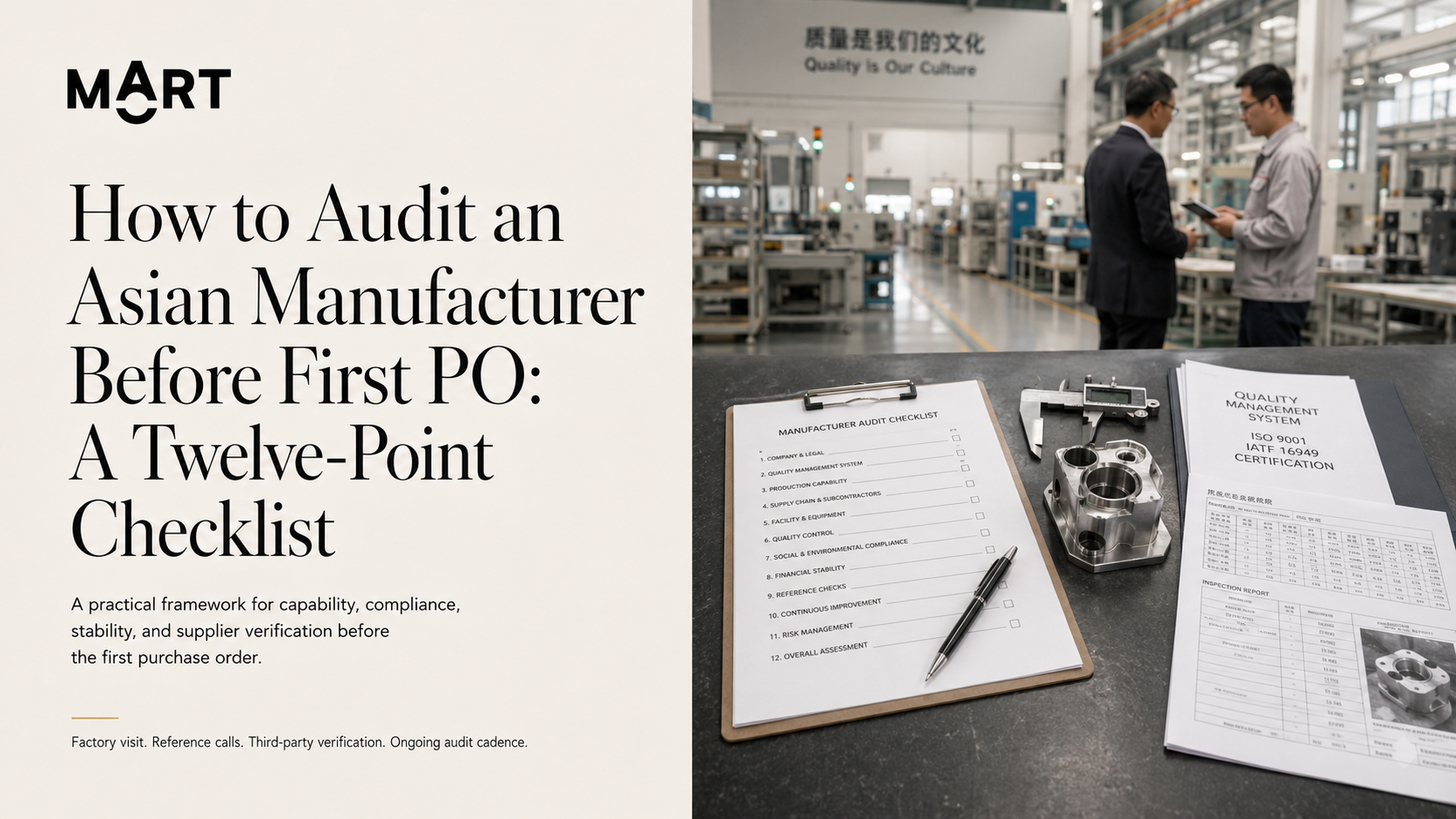
The decision to place a first purchase order with a new Asian manufacturer is one of the highest leverage decisions a brand makes. The relationship that follows shapes product quality, supply reliability, cost trajectory, and brand reputation for years. A structured audit before the first PO is the smallest investment a brand can make to materially reduce downstream risk. The framework below is the twelve point checklist that experienced sourcing teams use, adapted for brands evaluating new Asian manufacturers in 2025.
The twelve points, organized in four groups. Capability and capacity (points 1 to 3). Compliance and ethics (points 4 to 6). Financial and operational stability (points 7 to 9). Communication and references (points 10 to 12).
1. Physical capability for categoryMachinery, skilled labor, technical processes2. Capacity headroomReal availability in production calendar3. Quality systemsInline inspection, final QC, defect tracking4. Social audit certificationsSedex, BSCI, WRAP currency and scope5. Chemical complianceREACH, Prop 65, category specific testing6. Environmental and worker safetyISO 14001, OHSAS, factory walk through7. Financial stabilityYears in operation, banker relationships, ownership stability8. Customer concentration riskLargest customer share, customer mix diversity9. Operational track recordOn time delivery history, claims history, dispute history10. English communication capabilityManagement and technical team levels11. Brand referencesCurrent and former customers in similar categories12. Cultural fitOperating tempo, decision making style, relationship investment
The physical factory visit. No checklist substitutes for the factory visit. The brand team should plan a structured visit that walks the production floor, observes the inline inspection process, reviews the most recent quality records, meets the production manager and the customer service team, and tours the worker facilities (cafeteria, dormitory if applicable, restrooms). The information gathered in two hours of walking the floor often outweighs weeks of documentation review.
The reference call discipline. Brand references from the manufacturer should be verified directly, with conversations that go beyond pleasantries. The questions that reveal the most are about quality issues (how did the manufacturer handle the last quality issue), communication during a deadline crisis, cost negotiation behavior (how reasonable, how flexible), and the reference's actual willingness to recommend the manufacturer to a comparable brand.
The third party verification. Brands without on the ground capability in the manufacturing country should engage a third party inspection partner (SGS, BV, Intertek, TUV, or a specialized boutique firm) to conduct the audit. The cost of a thorough pre PO audit ranges from a few thousand to about ten thousand dollars depending on scope, and the protection it provides against downstream issues is meaningfully larger than the cost.
The first PO design. Even after a thorough audit, the first PO with a new manufacturer should be sized to test the relationship without betting the season on it. A first PO at twenty to forty percent of the season's intended volume, with a clear plan to evaluate the manufacturer's performance before placing the larger follow on PO, is a reasonable risk posture for most brands.
The ongoing audit cadence. The pre PO audit is the entry point, not the end of the audit work. Ongoing audit cadence should include third party social audits annually or bi annually, brand specific quality audits at agreed intervals, and the manufacturer's self reported scorecard against agreed metrics. The right cadence varies by manufacturer maturity and brand risk tolerance, but the principle of ongoing verification rather than one time gatekeeping is universal.
MOART perspective. The twelve point audit is the minimum diligence a brand should complete before placing a first PO with a new Asian manufacturer. The brands that skip or compress this work to save time consistently encounter the friction later, often at meaningful cost. For brands evaluating their sourcing program disciplines in 2025, the audit framework should be formalized and applied consistently, not improvised for each new manufacturer relationship.