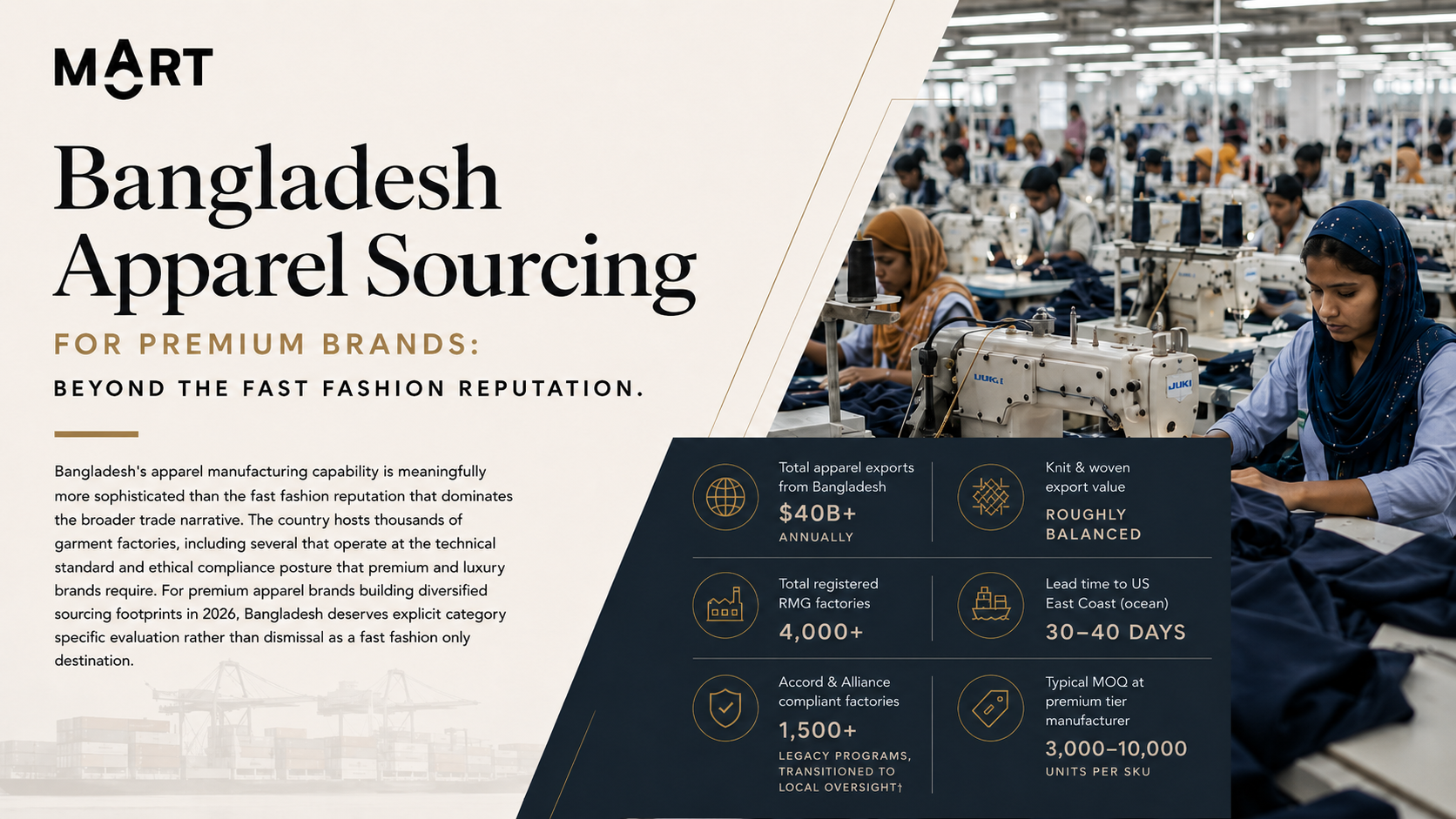
Bangladesh's apparel manufacturing capability is meaningfully more sophisticated than the fast fashion reputation that dominates the broader trade narrative. The country hosts thousands of garment factories, including several that operate at the technical standard and ethical compliance posture that premium and luxury brands require. For premium apparel brands building diversified sourcing footprints in 2026, Bangladesh deserves explicit category specific evaluation rather than dismissal as a fast fashion only destination.
The manufacturing landscape. Bangladesh's apparel manufacturing base is concentrated around Dhaka and Chittagong, with thousands of factories ranging from small contract manufacturers to large vertically integrated operations. The technical capability spans knit and woven products, with particular depth in t-shirts, polos, blouses, basic woven shirts, denim, and an expanding capability in technical apparel and outdoor products. The premium tier of the manufacturing base operates with technical capability comparable to leading destinations and with compliance infrastructure that has improved substantially since the 2013 Rana Plaza catastrophe.
Total apparel exports from Bangladeshover $40 billion annuallyTotal registered RMG factories~4,000+Accord and Alliance compliant factories~1,500+ (legacy programs, transitioned to local oversight)Knit and woven export valueroughly balancedLead time to US East Coast (ocean)~30 to 40 daysTypical MOQ at premium tier manufacturer~3,000 to 10,000 units per SKU
The compliance and ethical sourcing context. Bangladesh's compliance infrastructure has improved materially over the past decade, with the legacy Accord and Alliance programs establishing the framework that now operates through local oversight mechanisms. The premium tier of factories typically holds Sedex, BSCI, WRAP, and category specific certifications, with the audit cadence and the verification rigor matching the standards of any premium sourcing destination. Brands sourcing in Bangladesh should still conduct thorough due diligence, including factory visits and reference verification, but the framework for identifying compliant premium tier manufacturers is well established.
The category specific opportunity. Bangladesh excels in cotton rich apparel categories, including knit basics, woven shirts, and denim. The capability extends to embellished and embroidered products, particularly for women's apparel. Bangladesh's technical apparel capability is developing, with selected manufacturers producing performance apparel for global brands. For premium brands, the category opportunity is concentrated in cotton rich woven and knit products where Bangladesh's combination of capability and cost is competitive with Vietnam and India.
The cost positioning. Bangladesh remains one of the most cost competitive apparel manufacturing destinations globally, with labor cost meaningfully below Vietnam for comparable products. The cost advantage is real but should not drive the brand selection of manufacturer; the cost advantage is captured in the manufacturer's bid price, and the differentiation among premium tier manufacturers is in capability, reliability, and operational performance rather than incremental cost positioning.
The brand operating posture. Brands sourcing premium apparel in Bangladesh should plan a meaningful on the ground engagement, with regular factory visits, dedicated QA capability either in country or through a trusted partner, and the management bandwidth to support the relationship through development cycles. The premium tier manufacturers reward brand teams that engage seriously and build long term relationships. The brands that approach Bangladesh transactionally often discover the friction points after the first quality cycle.
The logistics and lead time considerations. Bangladesh to US lead times run longer than from Vietnam, typically 30 to 40 days ocean transit to East Coast and longer to West Coast. The logistics infrastructure has improved but still requires careful planning, with brand teams working with experienced freight forwarders to manage transit time variability. Air freight is available but expensive for the typical apparel cost structure, and brands generally plan production cycles that allow ocean transit as the primary mode.
The trade and tariff context. Bangladesh apparel imports to the US generally face MFN duty rates, with no preferential treatment program comparable to USMCA. The duty cost is a factor in the overall landed cost analysis and should be planned explicitly. Bangladesh is generally not affected by the China specific Section 301 tariffs, which preserves the competitive cost positioning.
MOART perspective. Bangladesh in 2026 is a more sophisticated apparel manufacturing destination than the broader narrative gives it credit for, with premium tier capability that serves the requirements of premium and luxury brands. For premium apparel brands building diversified Asian sourcing footprints in 2026, Bangladesh deserves a category specific evaluation alongside Vietnam, India, and Cambodia. The brands that build durable Bangladesh programs treat the country with the same operational discipline that applies to leading destinations, with the additional emphasis on compliance verification that the country's history makes appropriate.