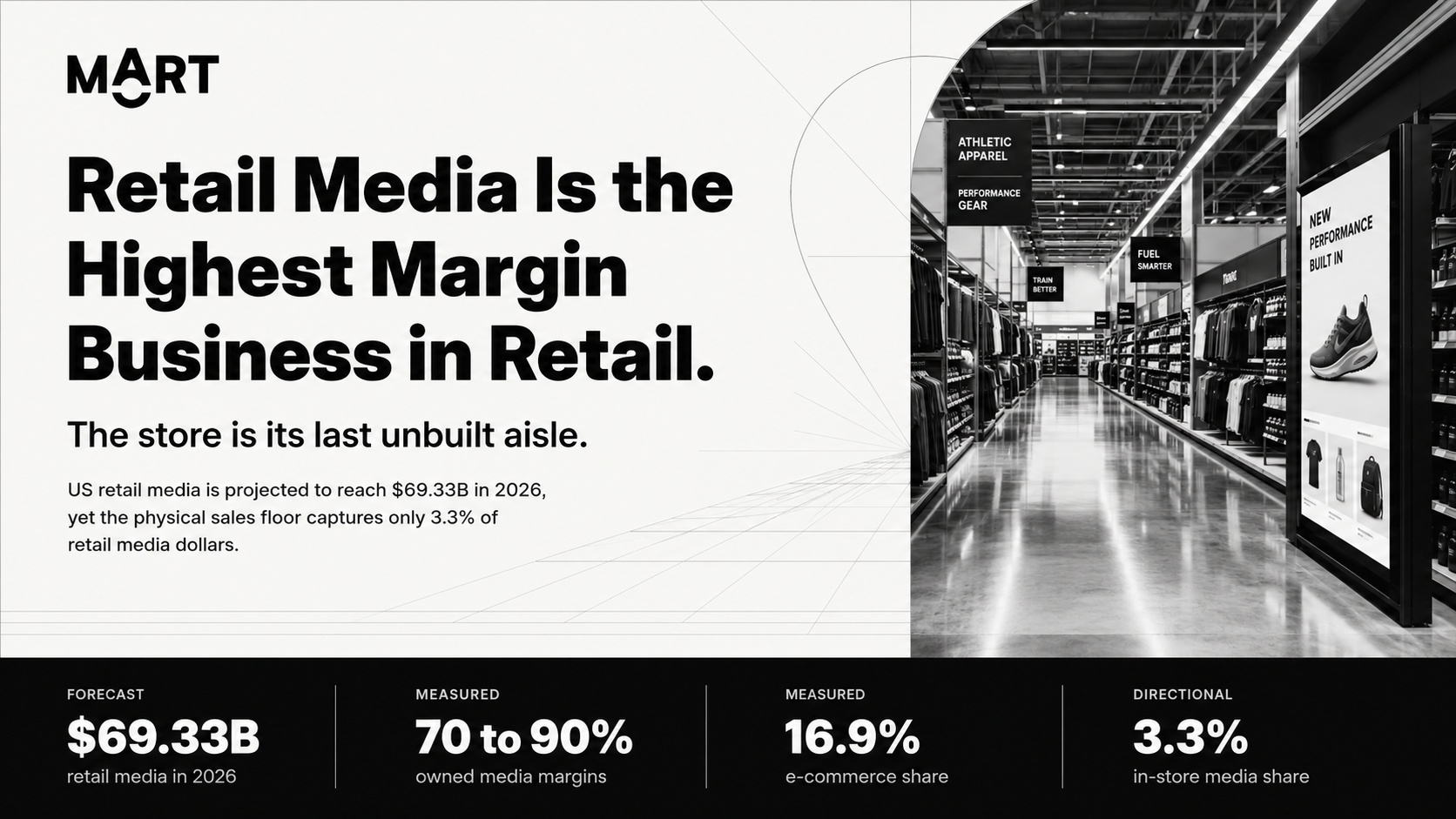
Retailer owned media platforms (Walmart Connect, Target Roundel, Kroger Precision Marketing, Amazon Advertising, Best Buy Ads, and others) have matured beyond performance advertising tools into credible brand storytelling environments. The 2026 capabilities span video, display, in store digital signage, audio, and connected TV, with measurement infrastructure that supports both performance and brand outcomes. For brands, the implication is that retailer media investment can now serve brand building objectives, not only conversion outcomes, with the right creative and program design.
The capability expansion. Retailer media platforms in 2026 typically offer several creative formats beyond the sponsored placement and detail page advertising that defined the early platforms. Display advertising across the retailer's owned digital properties. Video advertising, including connected TV inventory through retailer partnerships with major streaming platforms. In store digital signage in selected stores. Audio advertising through retailer apps. Sponsored brand content on the retailer's website and app. Influencer partnerships brokered through the retailer's platform.
Walmart Connect capability breadthDisplay, video, CTV, in store digital, audioTarget Roundel capability breadthDisplay, video, CTV, in store, audio, sponsored contentAmazon Advertising capability breadthSponsored, display, video (including Prime Video), DSPKroger Precision Marketing capabilityDisplay, video, in store digital, sponsored placementsTypical brand storytelling campaign budget$500k to $5M+ per platform per quarter
The creative implications. Brand storytelling on retailer media requires creative that differs from performance advertising creative. The audience is shopping or shopping adjacent, which means the creative should communicate brand and product context in ways that fit the shopping mindset. Length and format constraints (display sizes, video durations, audio time blocks) are typically more constrained than traditional brand advertising platforms, which requires creative that delivers impact quickly. The retailer's brand identity and the brand's brand identity need to coexist in the creative, which requires careful design that respects both.
The measurement implications. Brand storytelling outcomes on retailer media require measurement that goes beyond return on ad spend. The relevant metrics include brand lift (measured through pre and post campaign brand health surveys), incremental category trial (measured through retailer point of sale data), retailer specific share of voice, and longer term shopper acquisition cost. The brands that engage with retailer media for brand storytelling purposes typically partner with the retailer's measurement teams to design the measurement framework upfront, not reactively.
The integration with broader brand campaigns. Retailer media brand storytelling is most effective when integrated with the brand's broader campaign work rather than operating as a separate retailer specific initiative. The integration involves creative consistency across retailer media and other channels, message alignment across the funnel, and coordinated campaign timing that supports the broader campaign objectives. Brands that integrate retailer media into the broader campaign architecture typically deliver better outcomes than brands that treat retailer media as a separate channel with its own creative and timing.
The platform specific considerations. Each retailer media platform has distinctive capabilities and audience characteristics that shape the brand storytelling opportunity. Walmart Connect reaches a broad shopper audience with strong representation across income tiers and geographies, with creative that resonates with value oriented and family oriented shoppers. Target Roundel reaches a relatively more affluent and design oriented shopper audience, with creative that emphasizes brand and design values. Amazon Advertising, with Prime Video and the broader video infrastructure, increasingly supports brand campaigns at scale comparable to broader CTV platforms.
The connected TV evolution. Connected TV inventory available through retailer media platforms has scaled meaningfully, with Walmart Connect, Amazon Advertising, and selected other platforms offering CTV inventory that previously required separate buying through dedicated CTV platforms. The convergence of retailer audience targeting with CTV reach creates opportunities for brand campaigns that combine the upper funnel reach of CTV with the lower funnel conversion capability of retailer media in a single platform.
The budget allocation implications. Brand storytelling investment in retailer media is typically incremental to the performance advertising spend rather than a substitute for it. Brands that want to use retailer media for brand storytelling should plan additional budget allocation rather than reallocating performance advertising spend, with the understanding that brand storytelling investments produce different and longer term outcomes than performance investments.
MOART perspective. Retailer owned media platforms in 2026 deserve consideration for brand storytelling investment, not only performance advertising. For brands evaluating retailer media strategy in 2026, the right approach is to evaluate the brand storytelling capabilities alongside the performance capabilities, with the creative and measurement infrastructure designed for each objective. The brands that integrate retailer media brand storytelling into the broader campaign architecture typically discover the channel becomes a meaningful part of the brand building investment, not only a conversion driver.