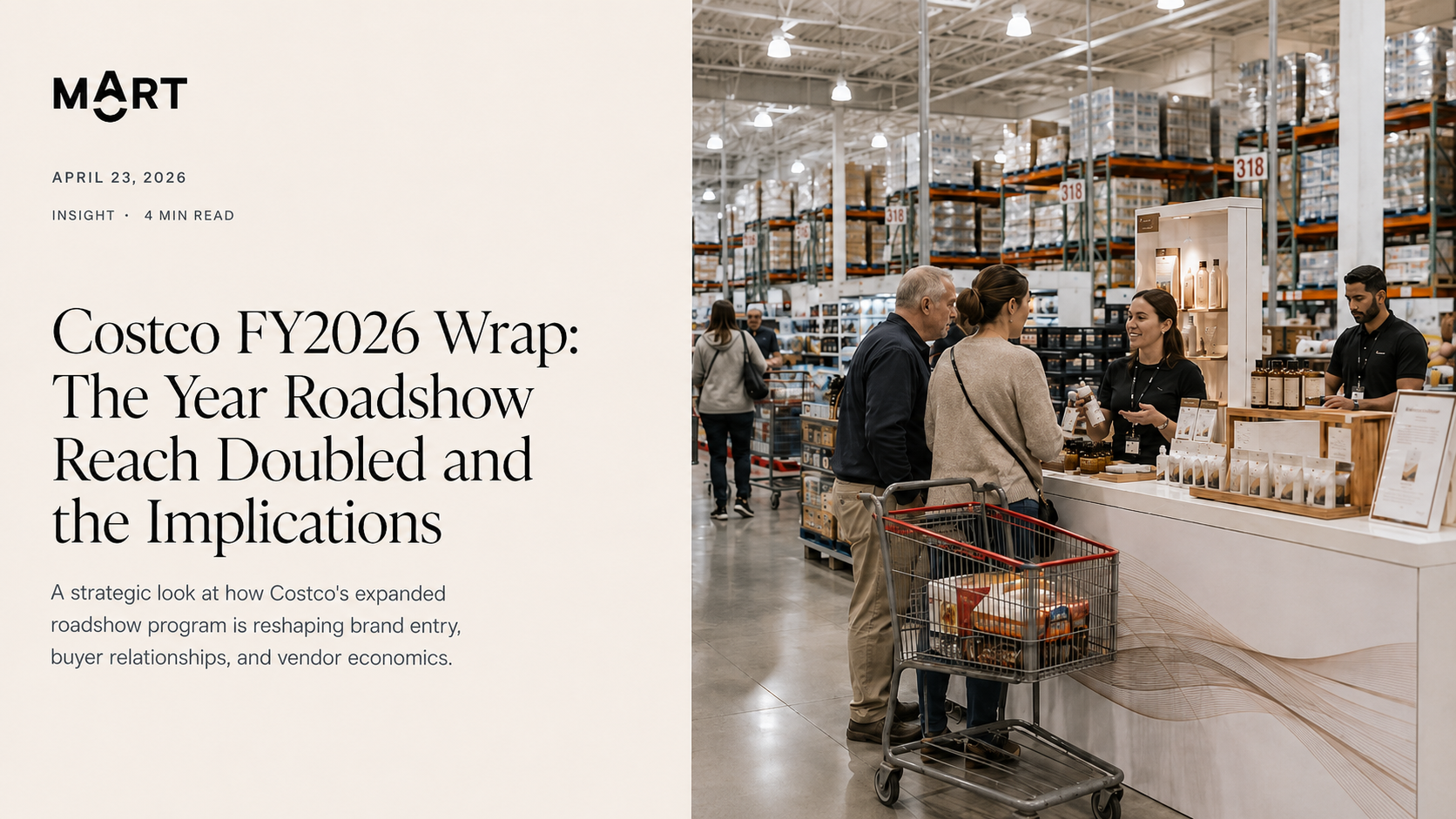
Costco's FY2026 closed with one of the more meaningful structural shifts in the channel's brand entry economics. The roadshow program reach roughly doubled compared to FY2024 levels, with the number of in club roadshow events, the number of brands rotating through the program, and the average velocity per roadshow all reaching record levels. The expansion has implications for brand entry strategy, for member experience, and for the broader vendor economics at Costco that will continue to shape the channel in FY2027.
The roadshow scale. The roadshow program in FY2026 hosted thousands of brand rotation events across the global warehouse footprint, with the program calendar effectively running continuously across most categories rather than concentrated in specific seasonal windows. The expansion was supported by Costco's investment in roadshow operations infrastructure, including dedicated buyer office capacity for the program, improved logistics support for participating brands, and enhanced reporting that lets brands evaluate roadshow ROI more rigorously.
Roadshow events globally (FY2026 estimate)thousands of brand rotationsRoadshow reach growth vs FY2024approximately doubledAverage velocity per roadshow vs FY2024materially higherConversion rate to permanent SKU placement30 to 50 percent for well executed programsTypical brand investment per roadshow program (Year 1)$1.5 to $2.5 million
The brand entry implications. The roadshow program has fully cemented its role as the dominant entry path for new brands at Costco. Brands considering Costco entry should design the entry plan around the roadshow program rather than around traditional category review meetings. The roadshow program provides a structured framework for member acceptance validation, operational performance demonstration, and buyer relationship building that supports the permanent SKU placement decision. The increased competitive intensity of the program means brands need to plan the program with even more discipline than in prior years.
The member experience evolution. The expanded roadshow program has changed the Costco member experience meaningfully. Members increasingly expect roadshow programming as part of the warehouse experience, with the rotating brand presentations driving incremental trip frequency and basket size for engaged members. The member engagement with roadshow programming is a real source of comp sales contribution, beyond the direct revenue from the roadshow program itself.
The buyer office implications. The expanded program scale has required Costco's buyer office to develop more sophisticated program management capability. The buyer relationships are now mediated through a larger team and a more structured operating cadence than the historical buyer relationship model. For brands, the implication is that the buyer relationship now extends across multiple touch points (roadshow team, category buyer, operational team) rather than concentrating on a single buyer relationship.
The vendor economics shift. The roadshow program economics have meaningful implications for vendor unit economics. The program costs (inventory, staffing, travel, logistics, program management) represent significant upfront investment, with the payoff typically requiring permanent SKU placement and multi year revenue generation to justify. Brands that approach roadshow programs as one off events typically experience disappointing economics; brands that approach them as multi year program investments typically build durable Costco positions.
The competitive intensity context. The increased program scale has intensified the competitive dynamics at Costco. More brands competing for permanent SKU placement raises the bar for graduation, and the buyer office can afford to be more selective when more brands are seeking placement. The 30 to 50 percent graduation rate for well executed programs has not increased significantly despite the program expansion, reflecting the higher bar that the increased participation creates.
The international roadshow expansion. Beyond the North American roadshow growth, Costco International has also expanded roadshow programming in selected markets. For brands with global operations, the international roadshow opportunity provides incremental scale and brand exposure that often complements the North American program. The international roadshow management requires region specific operating capability, but the strategic value can be meaningful for the right brand.
MOART perspective. Costco's FY2026 wrap demonstrates the maturation of the roadshow program as the structural brand entry mechanism for the channel. For brands considering Costco as a North American retail entry in FY2027 and beyond, the roadshow program design should be the center of the entry strategy, with appropriate investment in program execution, member experience validation, and buyer relationship building. The brands that recognize the program's structural importance typically build durable Costco positions; the brands that approach the program transactionally typically miss the opportunity the channel offers.