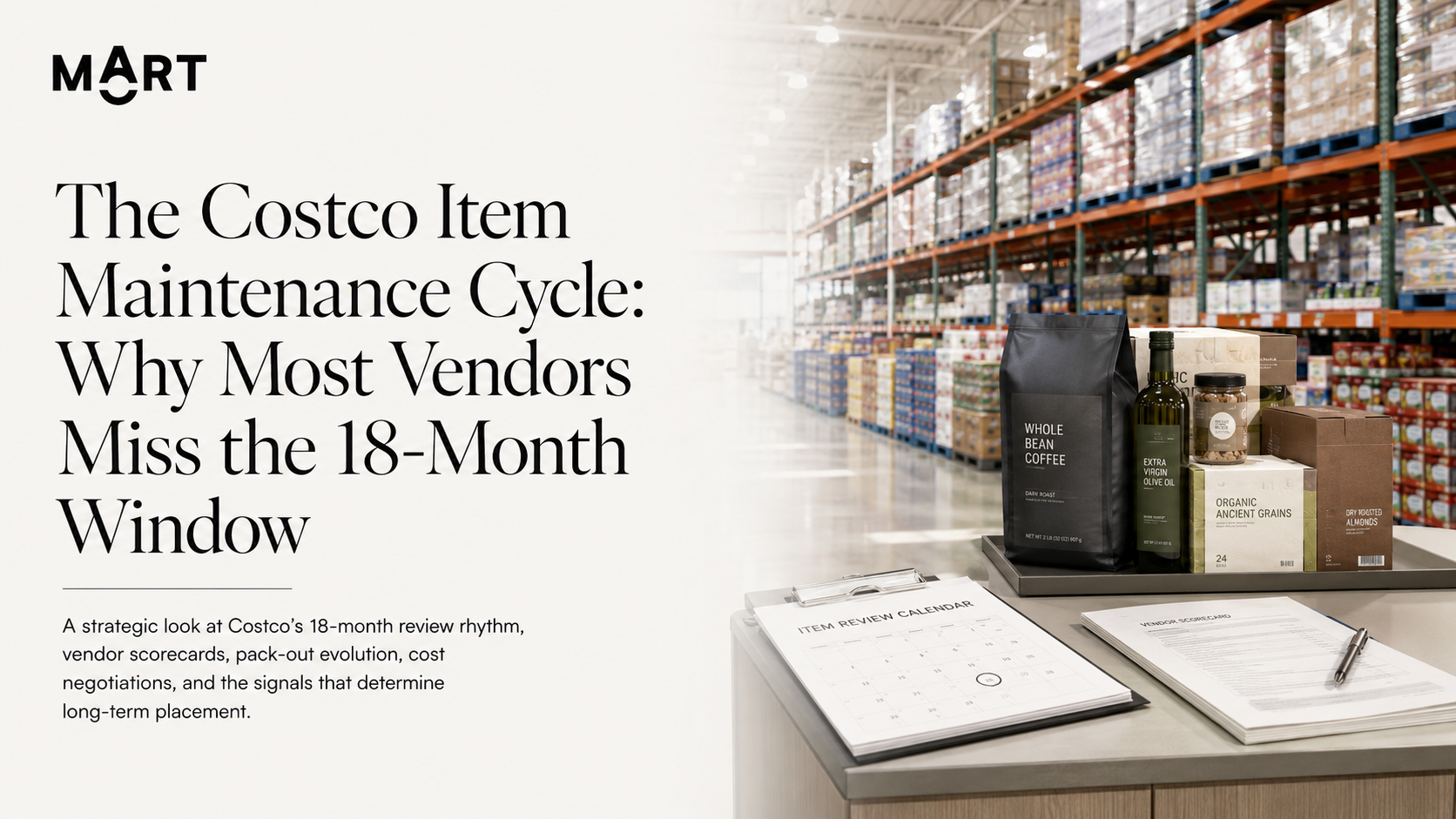
Costco evaluates every SKU on a roughly 18 month cycle. The cycle is not a formal published calendar, but the rhythm is consistent across categories and predictable to vendors who pay attention. The vendors who plan their item refresh, packaging update, cost negotiation, and merchandising support against this cycle keep their placements. The vendors who treat each year as a renewal of last year are the vendors who get displaced quietly when a new item or a Kirkland alternative becomes the better answer.
What the buyer is evaluating. Five dimensions, in priority order. Member value, measured by member feedback, return rates, and the buyer's sense of whether the item still delivers a meaningfully better value than the alternative on the market. Velocity, measured by units per warehouse per week relative to the category and the seasonal pattern. Operational performance, measured by EDI compliance, OTIF, chargeback frequency, and the brand team's responsiveness. Cost position, evaluated against private label alternatives, competing branded alternatives, and the buyer's view of where the category economics should land. Strategic fit, an unmeasured but consequential dimension reflecting the buyer's confidence in the brand's roadmap and the relationship's trajectory.
Typical item review cycle~18 monthsVendor scorecard inputsvelocity, OTIF, chargebacks, EDI compliance, member feedbackCost renegotiation frequencytypically annualPack out evolution cycletypically every 18 to 24 monthsPackaging refresh expectationtypically every 24 to 36 months
The 18 month preparation calendar. Months 1 to 6 after placement: launch execution, in stock validation, demo and roadshow follow up. Months 7 to 12: first cost negotiation, evaluation of pack out optimization, planning for member engagement programs. Months 13 to 18: pre review preparation, item refresh consideration, packaging update planning, narrative for next cycle continuation. The vendors who win at Costco are doing the next cycle preparation while the current cycle is still running.
The Kirkland alternative pressure. The buyer always has the Kirkland alternative in the back of the mind. When a national brand's cost rises faster than the buyer's view of member willingness to pay, or when the brand's operational performance slips, the buyer will at least price out a Kirkland alternative. The brands that prepare for this pressure with disciplined cost positioning and consistent operational performance rarely lose to Kirkland. The brands that let costs rise without justification or let operational performance slip frequently lose the placement.
The merchandising signals to read. Three signals indicate the buyer's view of the placement. The frequency of reorders relative to forecast. The depth of in club merchandising support (end caps, roadshow opportunities, online placement). The buyer's communication pattern (responsive engagement versus distant communication). Brands that read these signals correctly can address relationship issues before they become item discontinuation conversations.
MOART perspective. Costco rewards vendors who treat the relationship as a continuous program with disciplined milestones. The brands that survive multiple 18 month cycles at Costco are the brands that prepared for each cycle while the prior cycle was still running. For international brands considering Costco as a long term partner, the operating model should be designed around the 18 month rhythm from day one, not adapted to it after a near miss.