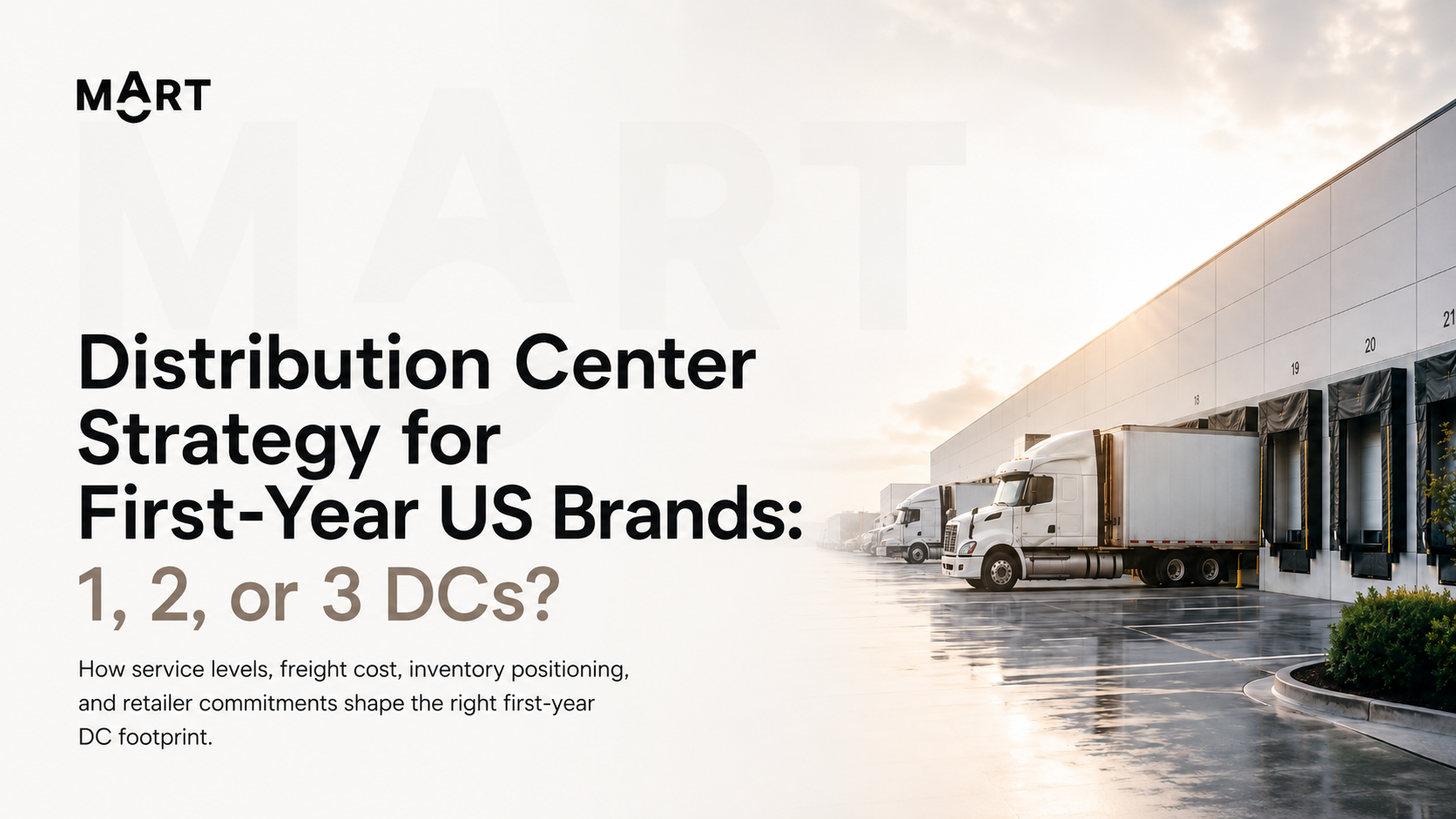
First year US brands face the distribution center (DC) strategy decision early in the operating build out, and the right answer is not obvious. The choice between operating 1, 2, or 3 distribution centers in the first year shapes service levels, freight cost, working capital tied up in inventory, and the brand's ability to support retailer commitments across multiple distribution centers. The wrong choice in either direction creates predictable operational stress in the first 18 months of US operations.
The 1 DC strategy. A single distribution center, typically located centrally (Memphis, Indianapolis, Columbus, or Reno are common choices) or on the East Coast (Pennsylvania, New Jersey), provides the simplest operating posture. Inventory is consolidated, fulfillment operations are simpler, and the team is smaller. The tradeoffs include longer lead times to the farthest geographic markets, higher freight cost to deliver to retailer DCs in distant regions, and the operational risk of a single point of failure if the DC has any operational issue.
1 DC: typical first year operating cost~$1 million to $3 million depending on volume1 DC: typical lead time to farthest market5 to 7 days transit2 DC: typical first year operating cost~$2 million to $5 million2 DC: typical lead time improvement2 to 3 days reduction to farther markets3 DC: typical first year operating cost~$3 million to $7 million3 DC: typical lead time to most US markets1 to 3 days transitWorking capital implication (vs single DC)typically 15 to 30 percent more inventory required for 3 DC
The 2 DC strategy. A two DC strategy, typically with one East Coast and one West Coast location, balances lead time across the US geography with operational simplicity. The most common configuration is a Pennsylvania or New Jersey DC for East Coast service combined with a California or Nevada DC for West Coast service. The tradeoffs include higher fixed operating cost than a single DC, additional working capital tied up in inventory at the second location, and the team coordination required across two operations.
The 3 DC strategy. A three DC strategy adds a Central US location (Texas, Missouri, or Tennessee) to the East and West Coast positions, providing the fastest delivery to most US markets and the strongest operational resilience. The tradeoffs include the highest first year operating cost, the highest working capital requirement, and the most complex team coordination. For most first year brands, the 3 DC strategy is premature.
The decision framework. Three factors should drive the decision. First, retailer commitments and the lead time and OTIF expectations that the largest customers carry. If the largest customers operate distribution centers across multiple regions, the brand may need multi DC presence to meet OTIF requirements at acceptable freight cost. Second, the brand's first year volume and the operating leverage at scale. Below approximately $25 million in first year US revenue, a single DC is usually sufficient and the freight cost premium to distant markets is manageable. Third, the brand's working capital position and the implications of multiple DC inventory pools on the cash conversion cycle.
The 3PL versus owned facility question. Most first year brands should use 3PL (third party logistics) providers rather than building owned facilities. The 3PL model allows the brand to scale up or down without capital commitment, leverages established carrier relationships and routing guide expertise, and avoids the management distraction of operating warehouses while building the broader business. The decision to bring fulfillment in house is typically a year two or year three decision, made when volume justifies the operating leverage.
The geographic concentration consideration. Brands launching at specific retailers should consider those retailers' DC geography in the brand's DC location decision. Walmart's DC network is heavily concentrated in the Southeast and Midwest, so an Eastern brand DC strategy is often appropriate. Costco's DC network is more geographically distributed, which can support either single or dual DC strategies. Target operates a broader DC network with significant West Coast presence. The right brand DC strategy aligns with the retailer DC geography for the relevant customers.
MOART perspective. For most first year US brands, the right answer is one DC, located to serve the most important retailer commitments efficiently, operated through a 3PL relationship. The 2 DC strategy becomes appropriate as volume scales to the high seven figures and as the geographic distribution of retailer commitments requires it. The 3 DC strategy is typically a year three decision rather than a year one decision. The discipline of starting simple and adding DC presence as the business case justifies prevents the most common first year operating mistake: over investing in operational infrastructure before the business has scaled to support it.