Home Depot reported Q1 FY2026 revenue of approximately $40 billion, with comparable sales modestly positive after a sequence of softer quarters tied to the housing turnover slowdown. The quarter's most consequential disclosure was not the headline comp number, it was the continuing acceleration of the Pro customer business and the operating cost of the strategy that supports it.
The Pro customer trajectory. The Pro customer segment, the professional contractor and trades buyer, now represents approximately 50 percent of Home Depot's revenue and continues to grow share within the mix. The Pro customer transacts at higher average ticket, more frequent visit cadence, and meaningfully higher annual loyalty than the DIY customer. The strategic question for the company is not whether to invest behind the Pro customer, that question is answered, but how much investment translates to durable share gain versus how much investment is required simply to defend the position.
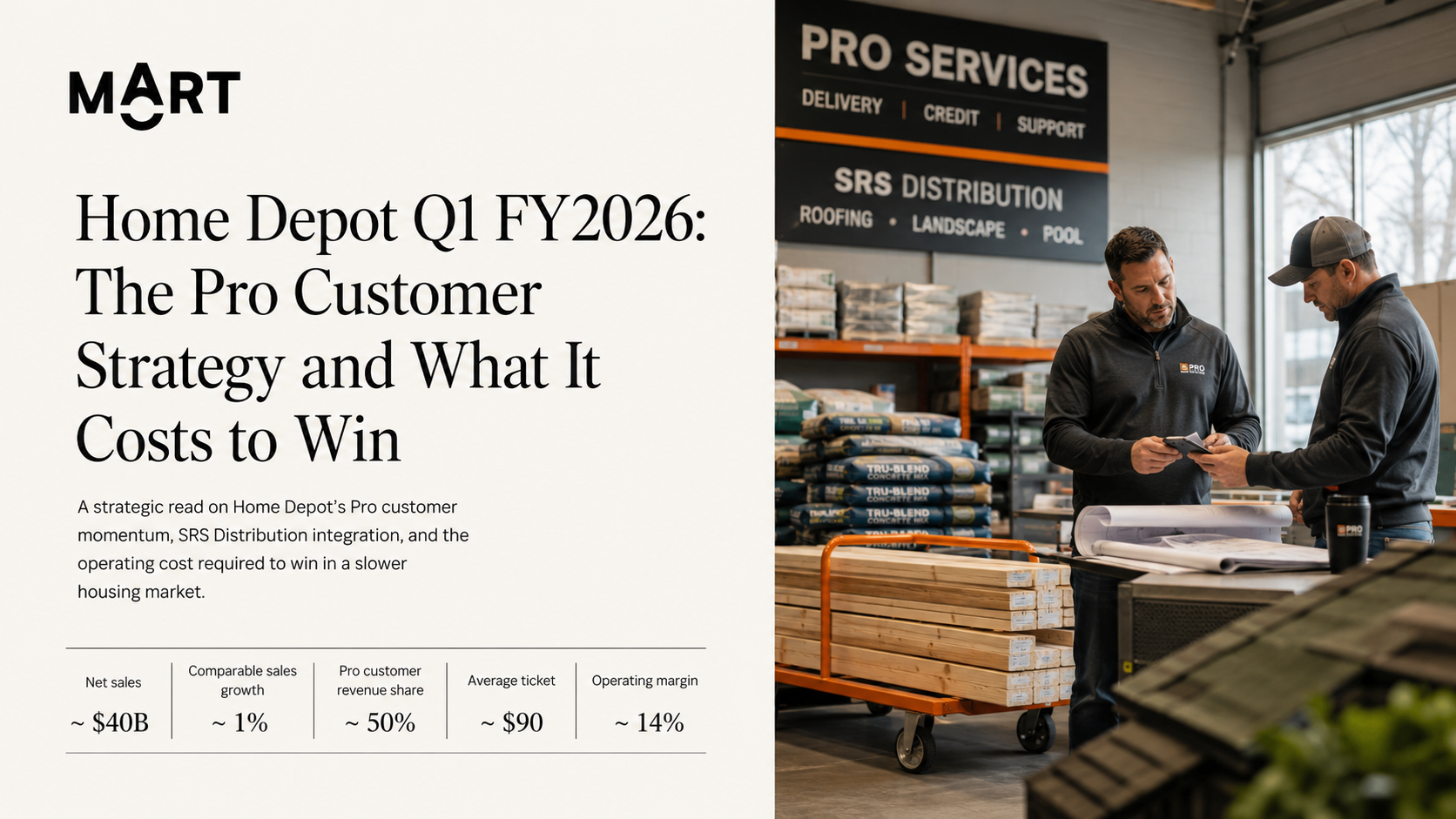
Net sales~$40 billionComparable sales growth~1 percentPro customer revenue share~50 percentAverage ticket~$90Operating margin~14 percentSRS Distribution contribution (full year run rate)several billion in revenue
The SRS Distribution integration. The acquisition of SRS Distribution, which closed in the prior year, continues to integrate into the Home Depot ecosystem. SRS adds depth in roofing, landscape, and pool distribution that the Home Depot Pro customer base values. For brands selling roofing, landscape, or pool adjacent categories, the SRS distribution path is now a second meaningful route inside the Home Depot ecosystem, alongside the traditional Home Depot Pro Desk and Online Pro programs.
The vendor implications of the Pro strategy. Three things matter. First, Pro customer assortment requires deeper SKU breadth and more reliable in-stock performance than DIY assortment, which means vendors selling into Pro programs must be operationally capable of supporting just-in-time replenishment to high-volume stores. Second, the Pro customer is more sensitive to brand reliability and product performance than the DIY customer, which means brands with weak quality records or inconsistent supply do not win Pro shelf even at attractive pricing. Third, the Pro program ecosystem includes services and credit components that vendors should engage with as part of the brand-retailer conversation, not as separate Home Depot programs that the brand can ignore.
The housing turnover context. The housing turnover environment in 2025 remains comparatively soft. Existing home sales remain below the pre-pandemic average, which dampens the natural lift to home improvement spend that follows turnover. The implication for vendors is that aggressive promotional activity is unlikely to drive incremental category growth in this environment, and the share story matters more than the category story for most discretionary categories.
MOART perspective. Home Depot Q1 FY2026 is a slow-and-deliberate quarter in a multi-year strategic position. The Pro customer strategy is working, the SRS acquisition is integrating on plan, and the financial discipline that the company demonstrated through the soft housing environment positions it well for the eventual housing turnover recovery. For brands considering Home Depot as a North American retail entry in the second half of FY2026, the conversation should center on Pro customer relevance, SRS distribution fit where applicable, and operational readiness to support the Pro replenishment cadence.