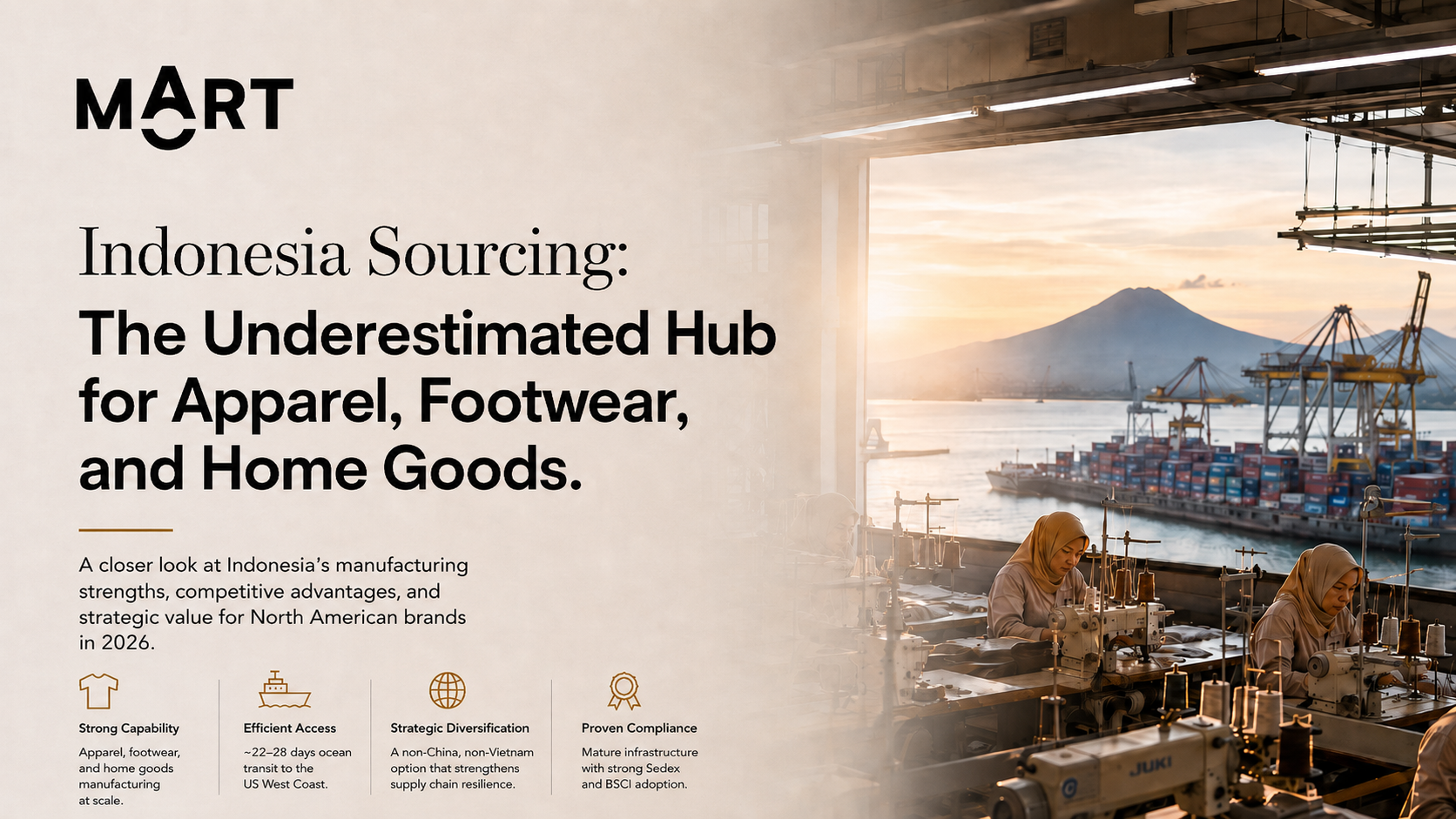
Indonesia is one of the more underestimated Asian sourcing destinations for North American brands. The country has a substantial manufacturing base across apparel, footwear, home goods, and select consumer hard goods, with capability that often matches or exceeds the more famous destinations for specific category and product profiles. The trade relationship with the US, the geographic diversification value, and the competitive cost positions all support Indonesia's case as a serious sourcing option in 2026.
The manufacturing landscape. Indonesia's manufacturing base is concentrated around Jakarta and the surrounding industrial corridor, plus Surabaya, Bandung, and selected regional centers. Apparel manufacturing capability is strong, with depth in knit and woven products and a growing capability in technical apparel. Footwear manufacturing has scale particularly in athletic and casual footwear, with some of the largest global athletic brands operating significant Indonesian production. Home goods including furniture, textiles, and accessories represent a meaningful manufacturing capability that complements the apparel and footwear base.
Apparel manufacturing capabilityStrong, particularly knit and wovenAthletic and casual footwearMajor global brand presence, world class capabilityHome goods (furniture, textiles)Meaningful capability and export experienceLead time to US West Coast~22 to 28 days ocean transitTypical apparel MOQ~3,000 to 10,000 units per SKUCompliance infrastructureMature, with strong Sedex and BSCI adoption
The strategic advantages. Indonesia offers four meaningful advantages for North American brands. First, the geographic diversification value as a non China non Vietnam destination supports the broader supply chain diversification thesis. Second, the labor cost remains competitive with comparable Southeast Asian destinations and meaningfully below China for labor intensive categories. Third, the major global brand presence (athletic footwear, technical apparel) has built mature export infrastructure and management talent that benefits smaller brand programs. Fourth, the Indonesia US trade relationship has been comparatively stable, with predictable rules and reasonable cooperation between trade authorities.
The friction points to plan for. Lead times from Indonesia to the US run longer than from Vietnam, typically 22 to 28 days for ocean transit to West Coast and longer to East Coast. The logistics infrastructure in Indonesia is generally good but variable, with port congestion at peak periods adding to lead time variability. The cultural and operational rhythm in Indonesian factories tends to be more relationship driven than transactional, which rewards brand teams who invest in long term relationships and discounts opportunistic engagement.
The manufacturer selection framework. Brands evaluating Indonesian manufacturers should focus on the same fundamental dimensions that apply to any Asian sourcing decision (physical capability, capacity, compliance, financial stability, communication, references) with particular attention to two Indonesia specific considerations. First, the manufacturer's experience with North American brands and the specific category requirements that come with US retail customers. Second, the manufacturer's export logistics capability and the established relationships with freight forwarders serving the US trade lanes.
The category specific guidance. For athletic and outdoor footwear, Indonesia is among the strongest destinations globally, with mature capability and competitive cost positions. For knit apparel basics, Indonesia is competitive with Vietnam for many product profiles, with the choice often coming down to specific manufacturer relationships and capacity availability. For home goods, Indonesia offers credible capability with particular strength in wood furniture, certain textile categories, and accessories. For technical apparel, Indonesia is developing capability that often does not yet match Vietnam for the most demanding technical products.
The diversification posture. For brands building diversified Asian sourcing footprints in 2026, Indonesia deserves serious consideration alongside Vietnam, India, and Bangladesh as a primary or secondary sourcing destination. The country's manufacturing depth and export infrastructure support meaningful programs, and the geographic diversification value adds resilience to the overall sourcing strategy.
MOART perspective. Indonesia in 2026 is more capable than the broader sourcing diversification narrative gives it credit for. For North American brands evaluating Asian sourcing decisions in apparel, footwear, and home goods, Indonesia deserves explicit category specific evaluation rather than dismissal as a secondary destination. The brands that build durable Indonesian programs treat the country with the same operational discipline that applies to leading destinations, and they often discover capability and cost positions that exceed initial expectations.