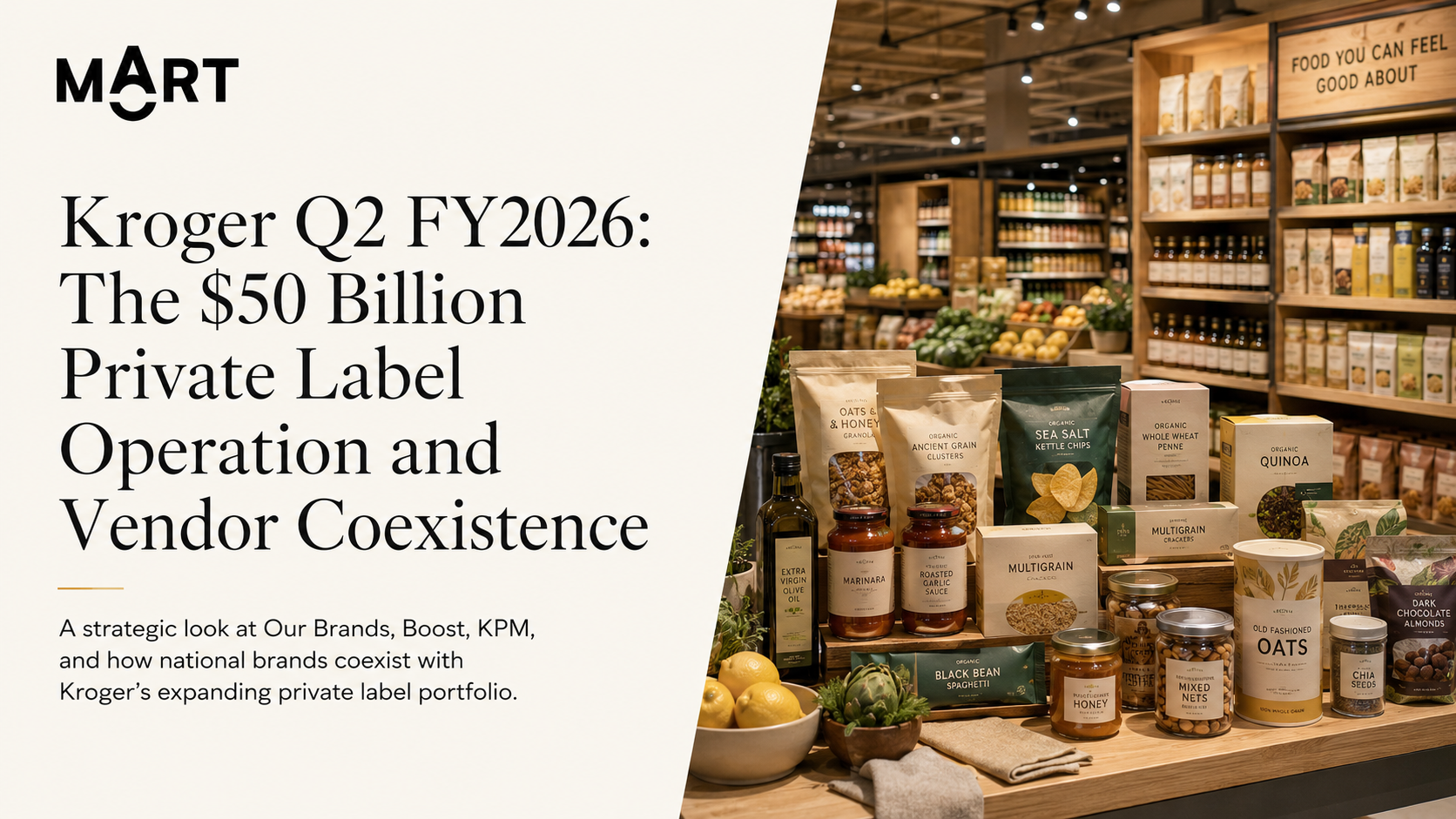
Kroger reported Q2 FY2026 net sales of approximately $34 billion, with the company continuing to extend the Our Brands private label portfolio into adjacent and premium tiers. The Our Brands portfolio now generates over $30 billion in annual revenue across the Kroger family of banners, with Private Selection (premium), Simple Truth (natural and organic), Heritage Farm (regional sourcing), and a portfolio of value tier brands collectively forming one of the largest private label operations in North American grocery.
The Our Brands portfolio architecture. Kroger's private label portfolio is structured to compete with national brands across every tier and category. Private Selection competes with premium and specialty national brands across categories from sauces to seafood to baked goods. Simple Truth competes with natural and organic specialty brands. Heritage Farm targets regional sourcing and natural protein. Kroger Brand serves the value tier. The portfolio's category coverage and tier depth give the Kroger buyer the ability to substitute private label for national brand at almost any price point.
Net sales~$34 billionIdentical sales growth (ex fuel)low single digitsOur Brands portfolio annual revenue~$30 billion+Our Brands share of total revenue~25 to 30 percent across categoriesBoost membership growthstrong double digitsKroger Precision Marketing revenue growthover 20 percent year over year
The vendor coexistence framework at Kroger. Three positions work for national brands selling at Kroger. First, the premium tier above Private Selection, with a defensible price premium and ingredient or brand equity differentiation. Second, the adjacent assortment where Our Brands does not directly compete, providing breadth that complements the private label. Third, the seasonal or promotional tier that drives shopper trip frequency that the private label assortment alone cannot sustain. The position that consistently loses is the mid tier brand at near price parity with Private Selection, which the buyer struggles to defend in category review.
The Boost membership dynamics. Kroger Boost (the membership subscription) continues to grow membership and drive incremental shopper engagement. Boost members shop more frequently, spend more per trip, and convert more reliably across categories than non members. The Boost data infrastructure provides Kroger with shopper behavior insight that the company increasingly uses in vendor conversations, particularly around new item introduction and category strategy.
Kroger Precision Marketing as a vendor required investment. Kroger Precision Marketing (KPM) is one of the larger and more sophisticated retail media networks in grocery, with capabilities spanning sponsored placements, in store activation, and audience targeting through 84.51 (Kroger's data subsidiary). KPM revenue grew over 20 percent in Q2 FY2026, and the platform increasingly informs the buyer's view of brand engagement at Kroger. National brands selling at Kroger should plan KPM investment as a coordinated part of the trade plan, not as a separate marketing line.
The Kroger plus Albertsons merger context. The proposed Kroger plus Albertsons merger ultimately did not consummate, and Kroger continues to operate as the standalone largest pure play grocer in the US. The strategic implications for vendors are that Kroger's category authority continues to consolidate organically through banner additions and digital platform extension, rather than through inorganic expansion. The buyer organization remains stable and well established.
MOART perspective. Kroger Q2 FY2026 reinforces the company's position as the most consequential national grocery customer that operates outside of mass channel. For national brands considering Kroger as a North American grocery entry, the strategy should account for the Our Brands portfolio context, the KPM investment requirement, and the increasingly data driven category review process. The brands that win at Kroger position themselves clearly above or adjacent to Our Brands and invest in the marketing infrastructure the company expects of serious vendor partners.