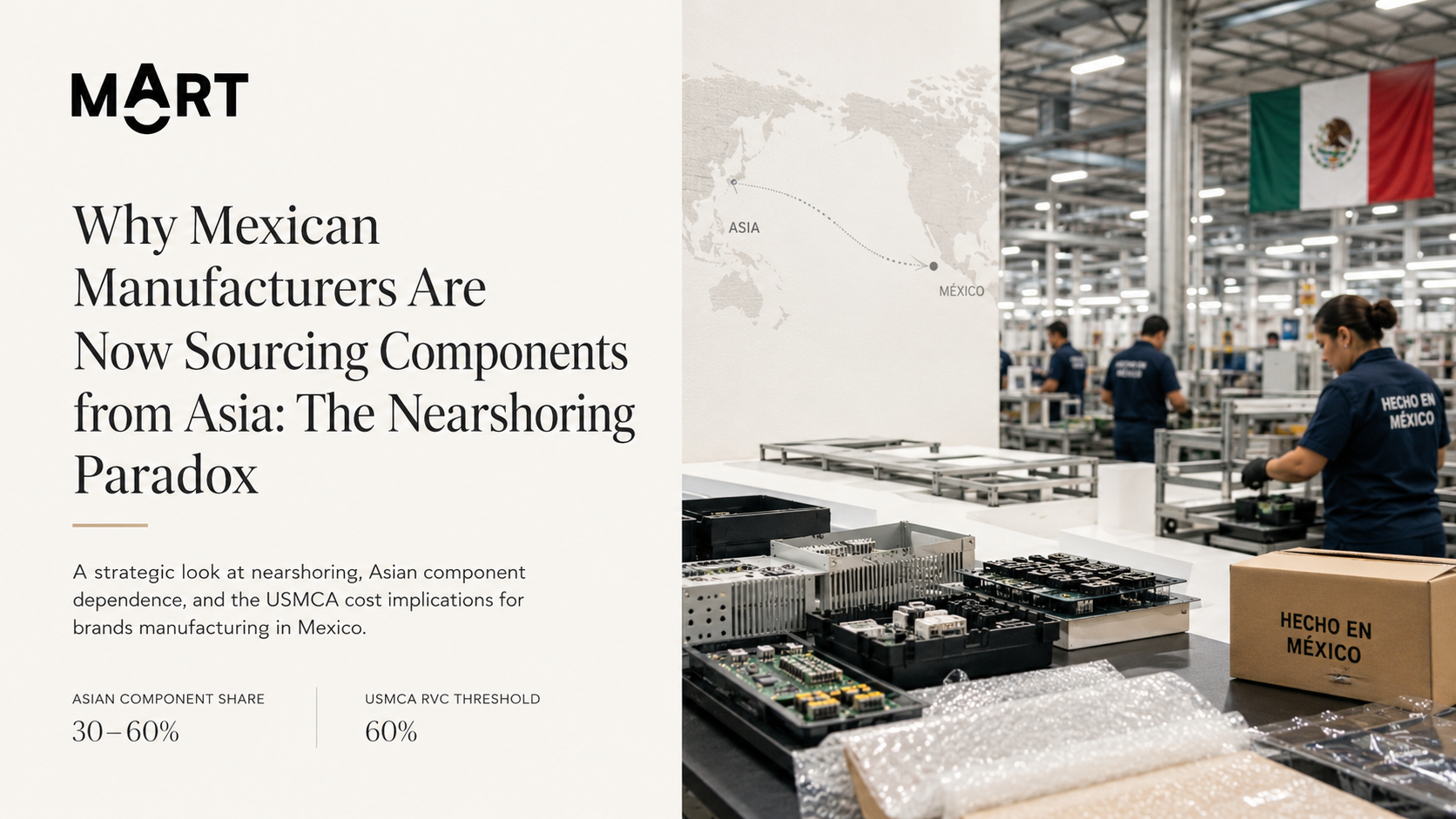
The nearshoring to Mexico narrative dominated the trade conversation in 2024 and continues to drive substantial capital investment in northern Mexico in 2025. The reality on the ground is more nuanced than the headline. Mexican factories serving the US market are increasingly sourcing components and sub-assemblies from Asia, which means the goods finished in Mexico often carry meaningful non-originating content. The implications for USMCA preferential treatment and for brand cost models are not trivial.
The component sourcing reality. Mexico has built strong assembly and finished goods capability in electronics, automotive, appliances, and certain apparel categories. The depth of upstream component manufacturing in Mexico, particularly for higher technology categories, has not kept pace with the assembly investment. Electronic components, advanced materials, certain plastics and metals, and specialized sub-assemblies are still substantially imported from Asia, particularly from China, Vietnam, Taiwan, and South Korea. This means a product assembled in Mexico for the US market may have 30 to 60 percent of its material cost originating outside the USMCA region, depending on the category.
Electronics: typical share of Asian component cost~50 to 70 percent of material costAppliances: typical share of Asian component cost~30 to 50 percent of material costApparel: typical share of Asian fabric and trim~40 to 70 percent of material costAutomotive parts: typical share of Asian componentsvariable, often 20 to 40 percentUSMCA RVC threshold (default build down)60 percent
The USMCA preferential treatment exposure. For a brand finishing goods in Mexico and claiming USMCA preferential treatment for export to the US, the regional value content calculation is the key compliance question. If the qualifying RVC threshold is not met after accounting for the actual Asian component content, the goods do not qualify for preferential treatment, and the importer must pay MFN duty rates. Brands that built their cost models assuming USMCA preferential treatment without verifying the component sourcing reality often discover the gap at the customs entry stage rather than the planning stage.
The strategic options for brands. Three options exist. First, accept the MFN duty cost and price the product to absorb it, which is rarely workable in price competitive categories. Second, redesign the bill of materials to increase USMCA originating content, which may mean substituting Asian components with North American suppliers at higher unit cost but lower duty exposure. Third, work with a Mexican manufacturer that has invested in upstream sourcing relationships with North American component suppliers, which often comes at a slight unit cost premium that is offset by the duty savings.
The nearshoring narrative versus the operational reality. The headline nearshoring narrative emphasizes the capital investment flowing into Mexico, particularly into industrial parks in Nuevo Leon, Coahuila, Chihuahua, and Baja California. The on the ground reality is that the investment is heavily weighted toward assembly and finishing operations, with substantially less capital flowing into the upstream component manufacturing base that would be required to achieve high USMCA originating content across categories. The expectation should be that this gap closes over five to ten years, not in the next two years.
MOART recommendation. For brands considering Mexico as a USMCA preferential treatment play, the bill of materials and component sourcing analysis should be conducted before the manufacturing partner selection is finalized, not after. The right Mexican manufacturer for a USMCA play is the manufacturer who has invested in North American component relationships, even if the unit price is slightly higher than a Mexican manufacturer who relies more heavily on Asian sourcing. The math typically favors the higher quality USMCA position once duty exposure is included in the analysis.