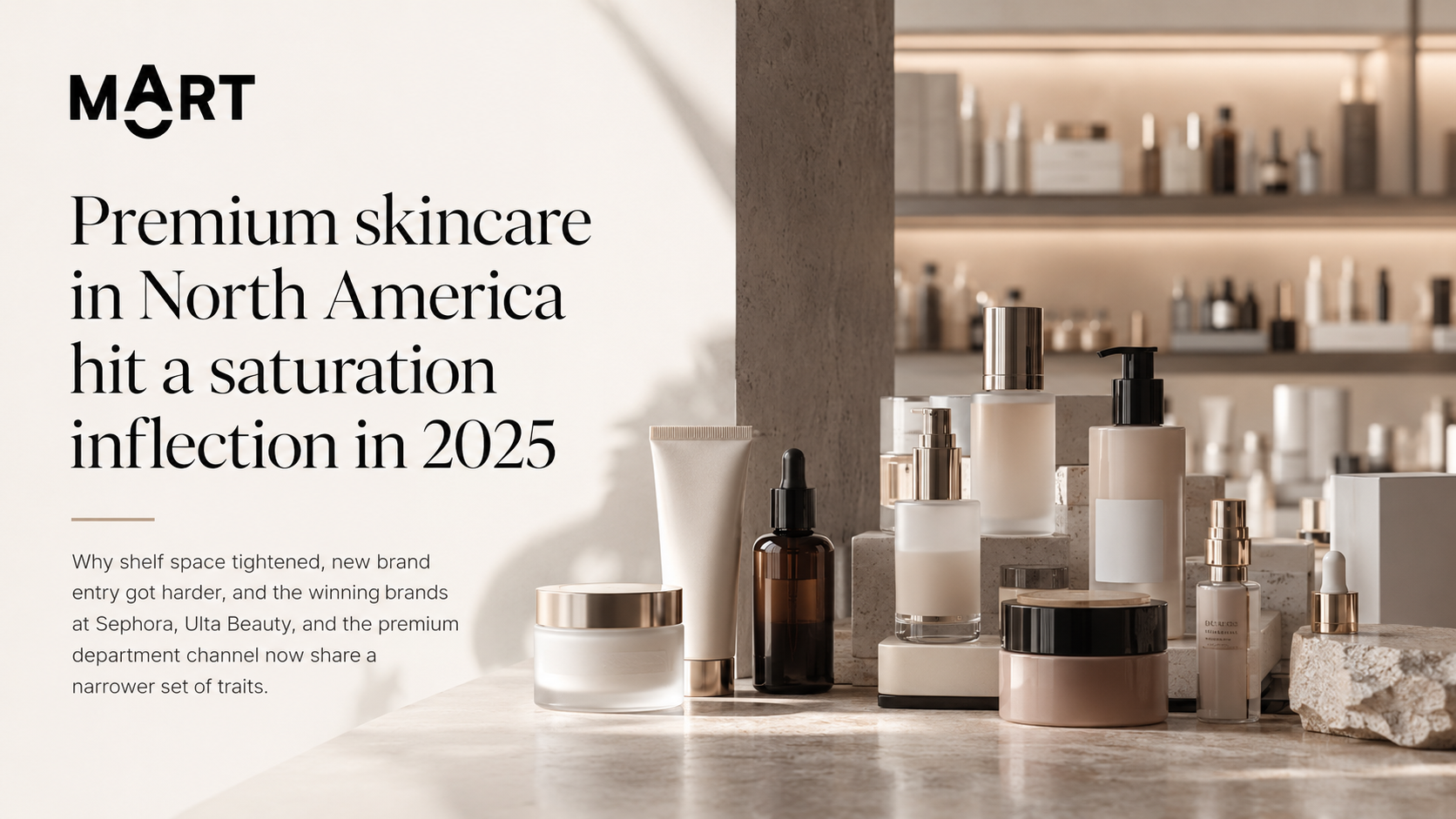
Premium skincare in North America hit a saturation inflection in 2025. After a decade of accelerating brand creation, the category's category-level growth rate slowed materially, retailer planogram availability tightened, and the bar for new brand entry rose sharply. The brands still winning shelf at Sephora, Ulta Beauty, and the premium department channel share a small and predictable set of attributes, and the brands struggling to renew their shelf positions share a similar set of vulnerabilities.
The category math in 2025. Premium skincare category growth in North American specialty channels slowed from double-digit to mid single-digit growth in 2025, with the average winning brand growing at category rate or slower and the top quintile of brands growing meaningfully faster. Retailer planogram capacity has not grown to match the brand pipeline, which means buyer decisions about which brand stays and which brand leaves are getting harder and more consequential.
North American specialty channel category growth, 2025mid single digitsNumber of premium skincare brands at Sephora USover 200 brandsNumber of premium skincare brands at Ulta prestigeover 150 brandsMedian first year revenue of a new brand entryunder $5 millionBrands churned out per year at the major specialty retailerstypically 15 to 25 per retailer per year
What the winning brands share. Five attributes consistently. A defensible scientific story behind the formulation, validated by a credible clinical study or by a recognized formulator with a long track record. A digital and content engine that drives shopper preference before the shopper enters the store. A founder or founding team narrative that can carry editor and PR conversations across the launch and post-launch cycles. A pricing architecture that makes sense relative to comparable brands without leaning on aggressive discounting that erodes the premium positioning. A retailer relationship discipline that respects the buyer's category logic and does not bypass the buyer to senior retailer contacts.
What the struggling brands share. Three patterns. Heavy dependence on a single hero SKU that has run its growth curve. Margin compression from rising customer acquisition costs and rising trade spend, with the brand caught between the two cost lines. A digital storefront and content strategy that has not evolved beyond the launch playbook, leaving the brand unable to refresh editor interest or shopper attention.
The Sephora and Ulta divergence. Sephora continues to operate the prestige-first curation model with deliberate brand selection and concentrated marketing support for a smaller number of brands. Ulta Beauty operates a broader portfolio across prestige and mass tiers with more competitive intensity and faster shelf turnover. For a premium skincare brand considering specialty channel entry in 2025, the Sephora path is harder to start, harder to maintain, and more valuable when achieved. The Ulta prestige path is somewhat more accessible to start and offers a faster path to scale, with the tradeoff of more intense ongoing competition for the shelf position.
What MOART recommends to brands entering premium skincare specialty in 2025. Three actions. First, validate the scientific and formulation story with a credible third party before approaching the buyer; the buyer's bar on this dimension has risen materially. Second, build the content and digital engine before the launch, not after, so that the launch supports an existing audience rather than trying to create the audience post-launch. Third, plan the post-launch trade spend and media spend as a single coordinated commitment, not as two separate budgets, because the brands that win in 2025 are the brands that integrate these spends around shopper marketing outcomes that the buyer can validate.