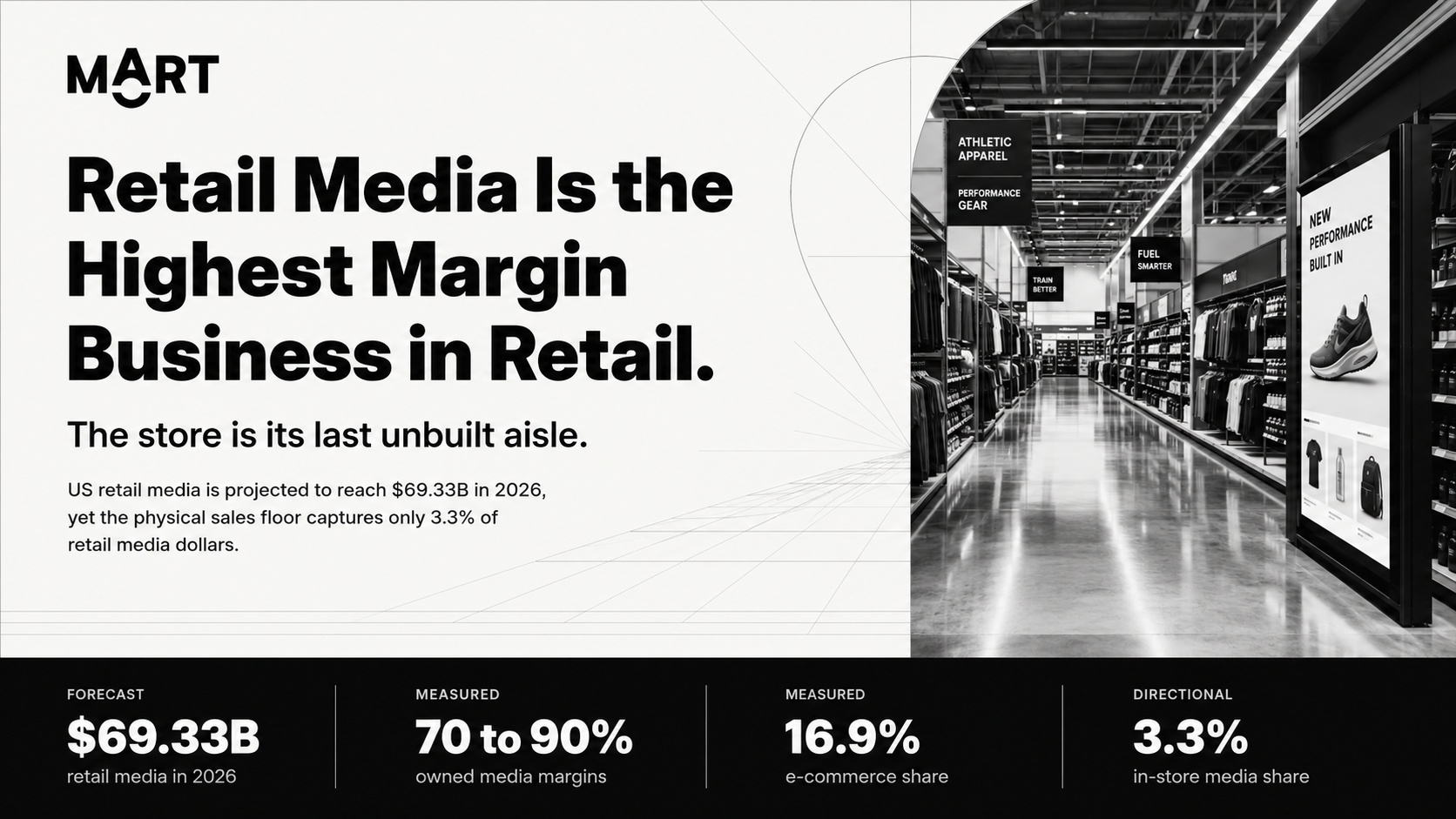
Retail media networks crossed a maturation threshold in 2025. The conversation inside brand marketing teams has shifted from whether to spend with the retailer's media platform to how much, across which platforms, and against which measurable outcome. The shift is not subtle. Five years ago, retail media was a small line in the trade budget. In 2025, retail media for many brands is the second or third largest line in the marketing budget, behind only digital search and equal to or exceeding traditional media.
The platform landscape, in 2025. Three retail media networks have reached genuine scale: Amazon Advertising, Walmart Connect, and Target Roundel. A second tier of mid-scale platforms includes Kroger Precision Marketing, Best Buy Ads, and emerging platforms at Sam's Club, Macy's Media Network, and Albertsons Media Collective. A third tier of platforms is still building, but the trajectory suggests they will be relevant within twelve to eighteen months.
Amazon Advertising annualized revenueover $60 billionWalmart Connect annualized revenueover $5 billion, growing ~30 percent YoYTarget Roundel annualized revenueover $2 billion, growing ~25 percent YoYKroger Precision Marketing growthover 20 percent YoYBrand allocation of marketing budget to retail mediatypically 15 to 25 percent in CPG
The decision framework brands should use. Retail media allocation should be driven by three inputs: where your sales are concentrated, where your category growth is concentrated, and where the platform measurement infrastructure can produce a credible incrementality read. The platforms that produce credible measurement deserve a disproportionate share of the budget. The platforms that produce sponsored placement only, without measurement, deserve a smaller share until the measurement matures.
Where the cost is heading. CPMs and cost per click rates on the major platforms are rising in 2025 in the high single digits to low double digits year over year. The rise is not uniform. Categories with high competitive intensity (CPG center store, beauty, electronics) are pricing fastest. Categories with lighter competition or limited retail media inventory (home, hardlines, specialty) remain relatively reasonable. The brand-side implication is that mid-size brands with growing share are in the best position to invest, while late entrants face higher costs to achieve comparable visibility.
The measurement question. The single most consequential question a brand should ask its retail media platform partner in 2025 is how the platform measures incrementality versus base. The serious platforms have moved beyond return on ad spend metrics and into incrementality measurement using control groups, geo experiments, or panel-based methods. Brands accepting return on ad spend as the sole measure are likely overpaying for sales that would have happened anyway.
What MOART recommends. Three actions for brands evaluating retail media spend allocation for the second half of 2025. First, prioritize platforms with credible incrementality measurement, even if the headline ROAS appears lower. Second, allocate a small reserve, five to ten percent of the retail media budget, to experimental tier two platforms where category share is meaningful but the platform has not yet hit major scale. Third, build the in-house team or partner relationship that can manage the multi-platform retail media operation, because the right answer is no longer to outsource to a single agency that runs the same playbook across all platforms.