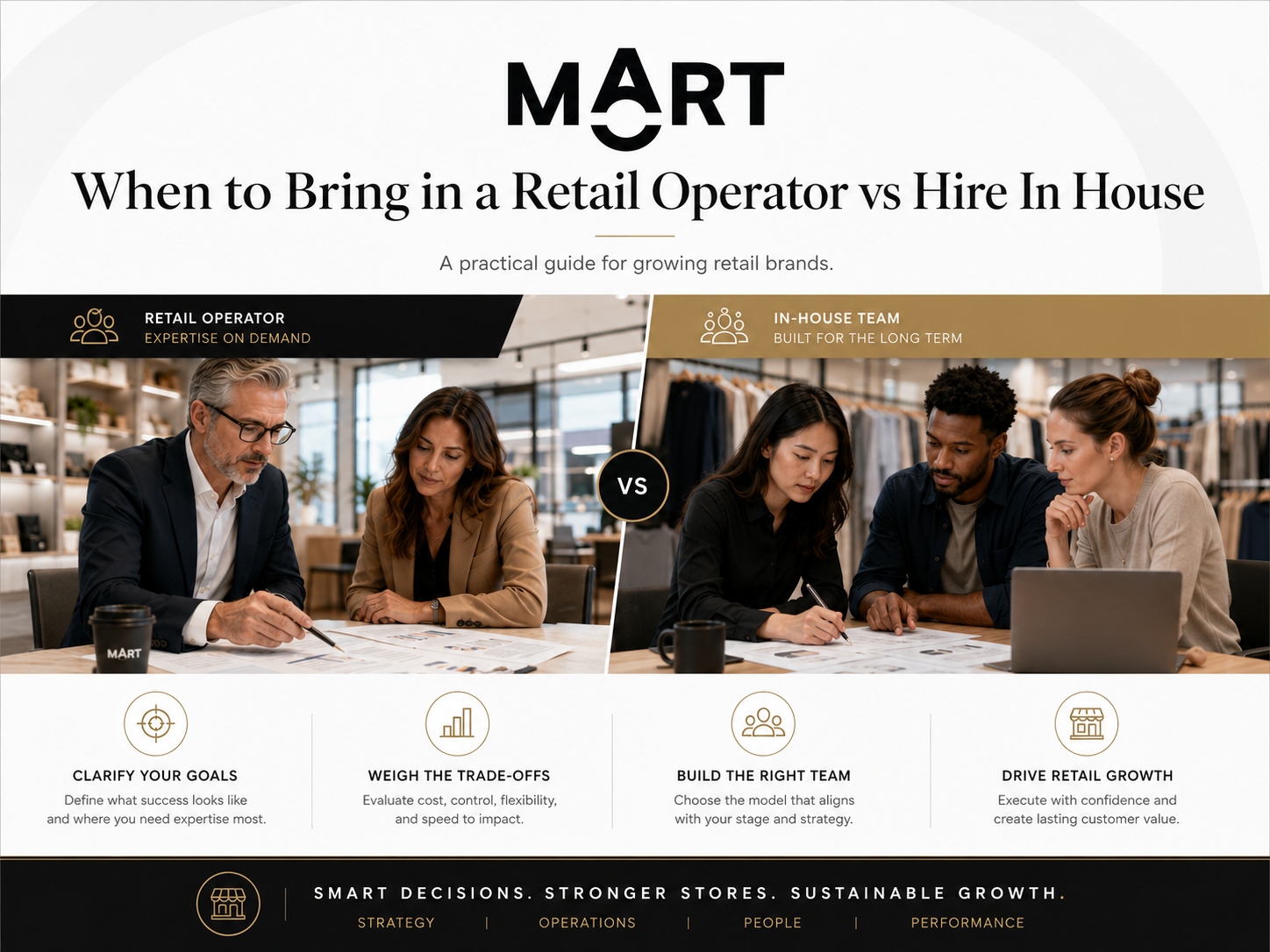
One of the most consequential strategic decisions for an international brand entering the United States is the build versus partner question. Build a US retail team in house, hire the experienced retail professionals, take on the overhead and the management complexity, and own the capability long term. Or work with an outside retail operator that brings the existing relationships, the operational infrastructure, and the track record without the brand having to build it from scratch.
Both paths can work. The right answer depends on a small number of factors that brands should evaluate explicitly rather than default into.
The first factor is the time to market. Building a US retail team in house typically takes twelve to eighteen months before the team is genuinely productive. Hiring the right leader, building out the supporting roles, establishing the operational systems, and developing the buyer relationships that the team will need all take time. A brand that is ready to launch within the next six months cannot afford the build timeline. An outside retail operator with existing relationships can shorten the time to first shelf placement to a quarter, sometimes less.
The second factor is the financial structure. An in house team carries fixed cost that scales with headcount and tenure. A retail operator partnership typically carries variable cost that scales with results, structured as a combination of monthly retainer and performance compensation. For brands at smaller revenue scales, the variable cost structure preserves cash and aligns incentives. For brands at larger revenue scales, the fixed cost structure can be more efficient over time.
The third factor is the depth of relationships required. If the brand needs broad coverage across many retailers in many categories, an outside retail operator with established relationships across the field is faster to deploy than a single in house team building those relationships one buyer at a time. If the brand needs deep concentration in one or two key accounts, an in house team focused on those accounts may build deeper relationships than an outside operator who is dividing attention across many clients.
The fourth factor is the long term strategy. A brand that plans to be in the United States indefinitely will eventually want owned capability, even if the early years use outside partners. A brand that is testing the market or supporting a parent company strategy may not need to build an owned team at all. The decision is a function of how committed the brand is to building the US business as a standalone unit over five to ten years.
The most common pattern for brands that get this right is to partner with an experienced retail operator for the first two to four years, use the partnership to establish the brand and learn the market, and then transition to an in house team once the business has scale and the strategic commitment is fully formed. The partnership accelerates the early years. The in house transition preserves the long term capability. Both paths have a place, and the sequence often matters more than the choice itself.