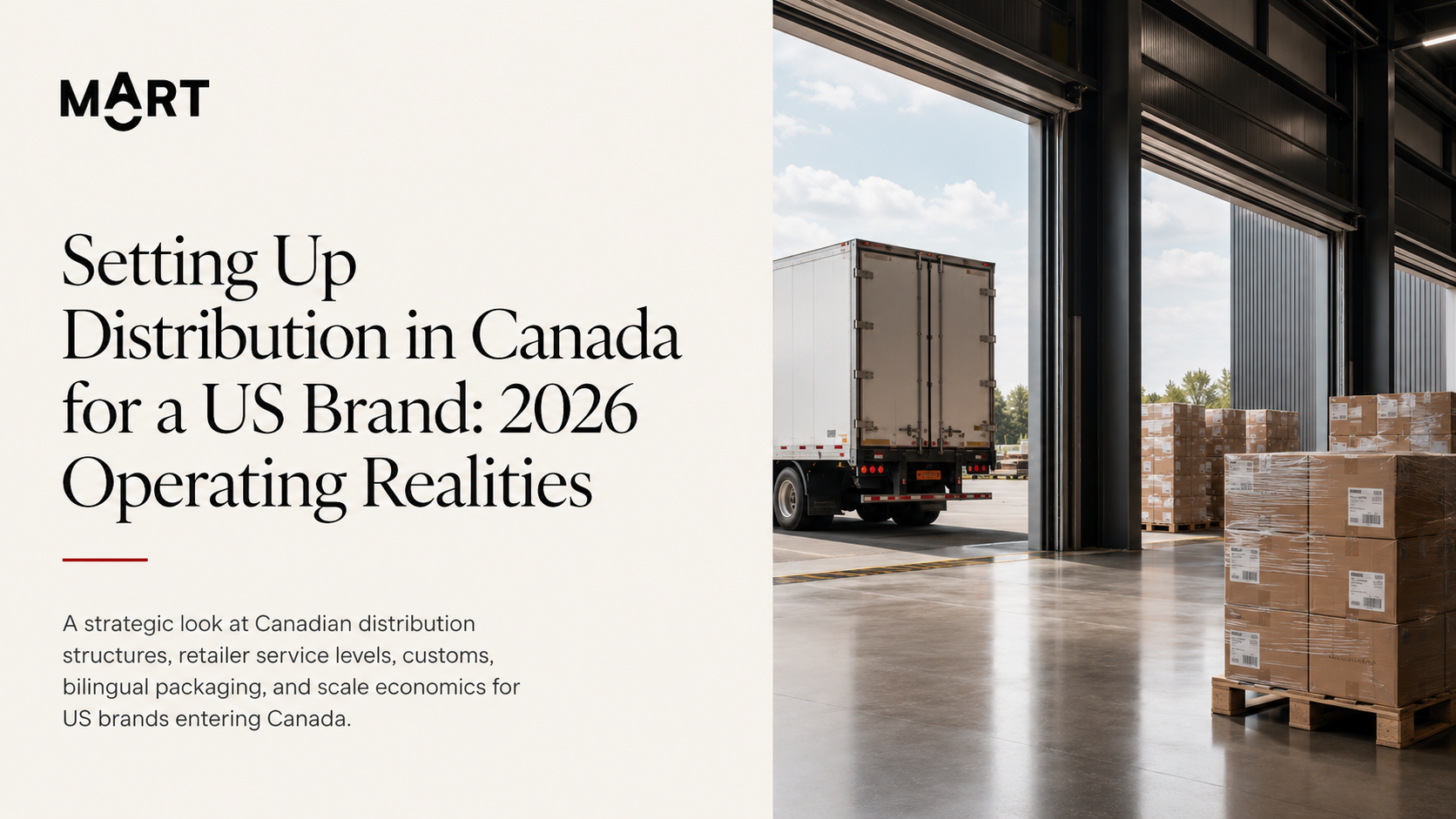
US brands entering the Canadian market face distribution decisions that materially affect operating economics, retailer service levels, and the brand's ability to scale across the country. The 2026 operating realities include several considerations that brands extending from US operations need to understand explicitly, with the wrong distribution structure often producing both higher operating cost and weaker retailer relationships than the alternatives the brand had available.
The distribution option set. US brands considering Canadian distribution typically evaluate three primary options. Option one: ship to Canadian retailers from US distribution centers, paying duty at the border and managing customs documentation for each shipment. Option two: establish a Canadian 3PL relationship with a single distribution center, typically in the Greater Toronto Area or Greater Vancouver Area, importing bulk inventory and distributing within Canada. Option three: establish a dual Canadian DC structure (typically Toronto plus Vancouver) for faster service across the country, with the additional operating cost the multi DC structure carries.
Option 1: Ship from US DCsLowest fixed cost, highest variable cost per orderOption 2: Single Canadian DC (Toronto or Vancouver)Moderate fixed cost, lower variable cost, balanced serviceOption 3: Dual Canadian DC structureHighest fixed cost, best service across countryTypical 3PL pick and pack rates (Canada)comparable to US 3PL pricingTypical lead time within Canada from single DC1 to 4 days depending on geographyTypical lead time within Canada from dual DC1 to 2 days for most geography
The retailer service requirements. Major Canadian retailers (Loblaw, Walmart Canada, Costco Canada, Shoppers Drug Mart, Sobeys) operate with service level expectations that influence the distribution structure decision. OTIF expectations at the major Canadian retailers typically run in the mid 90 percent range or higher. Lead time expectations from order to delivery typically range from 5 to 10 business days. Brands shipping from US DCs often find these expectations difficult to meet consistently because of the customs and cross border transit time variability. Brands operating Canadian DCs typically meet expectations more reliably.
The customs and tax structure considerations. US brands operating in Canada face several customs and tax considerations. GST and HST registration is required for sales above the de minimis threshold. Customs and import documentation requires either a Canadian business number or a non resident importer (NRI) registration. The bilingual labeling requirements for products sold in Canada (French and English) affect packaging and inventory management. The Quebec specific requirements add additional consideration for products sold in Quebec.
The Canadian business number versus NRI decision. US brands operating in Canada can either register a Canadian business number (BN) and operate as a Canadian importer or operate as a non resident importer (NRI) shipping from US operations. The BN structure provides a Canadian operating presence with potential advantages in retailer relationships, tax structure, and operational visibility. The NRI structure is operationally simpler but may face limitations in some retailer relationships and creates different customs and tax positions.
The 3PL partner selection. Canadian 3PL providers vary in capability across the major markets. The Greater Toronto Area has the most concentrated 3PL infrastructure, with options ranging from small specialist providers to large multi national 3PL operators. The Greater Vancouver Area has fewer options but solid infrastructure for West Coast service. Selection criteria include retailer experience (3PLs that already serve Costco Canada, Walmart Canada, Loblaw, and other major customers offer operational advantages), technology infrastructure, financial stability, and the specific category capabilities relevant to the brand.
The bilingual packaging operational implications. Bilingual packaging affects more than the labeling work. The brand needs SKU level decisions about whether the same SKU is sold across both English Canada and Quebec or whether Quebec specific SKUs are required. The bilingual packaging often requires US specific SKUs and Canada specific SKUs to be inventoried and managed separately, which has implications for inventory levels, forecasting accuracy, and operational complexity.
The growth and scale considerations. The right distribution structure for a US brand entering Canada depends on the expected Canadian revenue trajectory. Brands with limited expected Canadian volume (under $5 million in first three years) often find the US DC shipping model sufficient. Brands with meaningful Canadian volume (over $10 million) typically benefit from at least a single Canadian DC structure. Brands with significant Canadian volume (over $30 million) typically benefit from dual DC structures for service quality reasons.
MOART perspective. Setting up distribution in Canada deserves explicit planning rather than incremental adjustment to US operations. For US brands entering Canada in 2026, the right approach is to evaluate the distribution options against expected revenue trajectory, retailer service requirements, and the operational capability the brand can bring to the new market. The brands that build appropriate Canadian distribution structures from launch typically scale faster and more profitably than brands that defer the decision until distribution problems emerge.