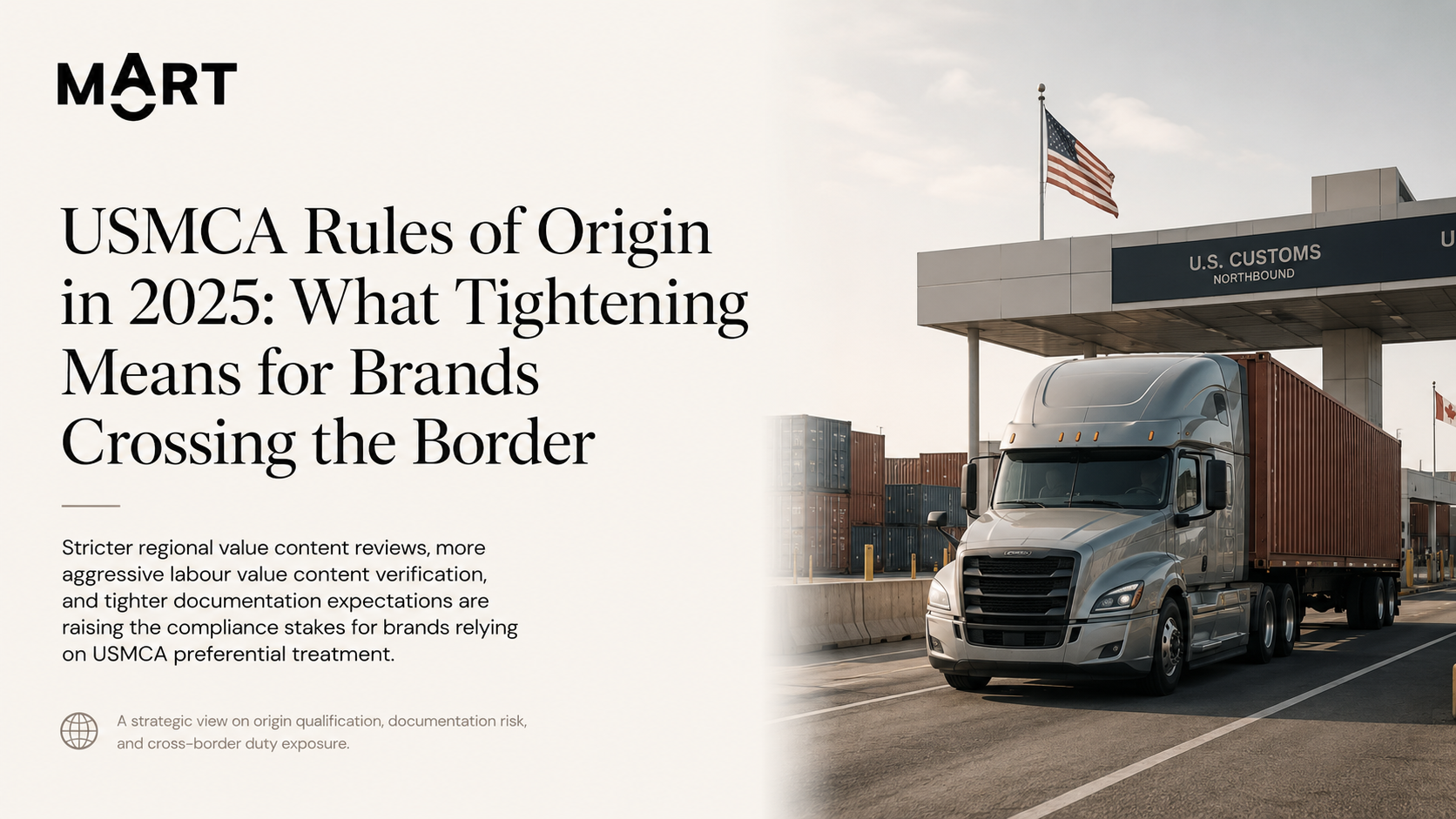
USMCA preferential treatment continues to be one of the most valuable trade structures available to North American brands, but the interpretation and enforcement of the rules of origin has tightened materially in 2025. Brands that built their cost models around USMCA preferential treatment three years ago need to re verify that their current sourcing, manufacturing, and certification posture still qualifies under the current interpretive environment. The cost of getting this wrong is not theoretical: a goods classification challenge by customs authorities can convert preferential duty to MFN duty retroactively, with interest, across multiple years of import history.
What changed in 2025 specifically. Three things. First, the regional value content calculations are being audited more rigorously, particularly the build down calculations that have historically been used for assemblies with mixed origin components. Second, the labour value content provisions for automotive and applicable industrial categories are being verified more aggressively, including documentation of the wages paid at upstream component suppliers, not just the final assembly facility. Third, the certification documentation expectations have evolved: a simple certification of origin without supporting documentation is no longer sufficient for higher value or higher risk classifications, and importers are being asked to produce supplier declarations and substantiating cost build ups within tight response windows.
Default regional value content threshold (build down method)60 percentDefault regional value content threshold (build up method)50 percentAutomotive light vehicle RVC threshold75 percent (phased in)Automotive labour value content requirement40 to 45 percent at $16 per hour (passenger vehicles)Textile and apparel rules of originYarn forward, with limited cumulationCertification of origin formatNo prescribed form, but specific data elements requiredRecord retention requirement5 years minimum
The brands most exposed to the tightening. Brands sourcing components from Asia, performing limited assembly or finishing work in Mexico or Canada, and claiming USMCA preferential treatment for the finished good are the most exposed to the current interpretive environment. The transformation test and the tariff shift test have specific requirements that limited finishing work often does not satisfy, and the regional value content calculations require honest accounting of non originating content at material cost. Brands that have been using a generic certification of origin template across all SKUs should plan an internal compliance review in the next two quarters.
Practical steps to reduce exposure. Five recommendations. First, conduct a sample audit of the top twenty SKUs by import value, walking through the rules of origin analysis with current supplier documentation. Second, refresh the supplier declarations from upstream component suppliers, particularly for components sourced outside the USMCA region. Third, formalize the certification of origin process with a single internal owner accountable for the documentation. Fourth, engage customs brokerage and trade counsel for any new sourcing changes that affect the regional value content calculation. Fifth, build a customs ruling request strategy for any high volume SKUs where the classification or the rules of origin analysis is ambiguous.
The cost benefit analysis for a brand currently claiming USMCA. The preferential treatment is usually still worth pursuing, even with the increased compliance burden. The duty savings on a typical consumer good can range from a few percent to fifteen percent or more of landed cost, depending on the HS classification, and the compliance cost is a fixed cost that scales well as volume grows. The brands that get into trouble are the ones treating USMCA as a free benefit rather than as a compliance program with documentation and audit requirements.
The USMCA review on the horizon. The agreement is up for joint review in 2026, with sunset provisions that take effect if any party does not affirm continuation. Brands should not assume the agreement continues unchanged. Investment decisions with five to ten year horizons should be stress tested against scenarios where USMCA evolves or where individual provisions are renegotiated.
MOART recommendation. For any brand with annual imports under USMCA in excess of five million dollars, an internal compliance review in 2025 is overdue. The cost of the review is small. The cost of a customs challenge with retroactive duty plus interest is large. For brands considering market entry into the US or Canada that will rely on USMCA, the entry plan should include the compliance program as a first day operating commitment, not as a second year improvement.