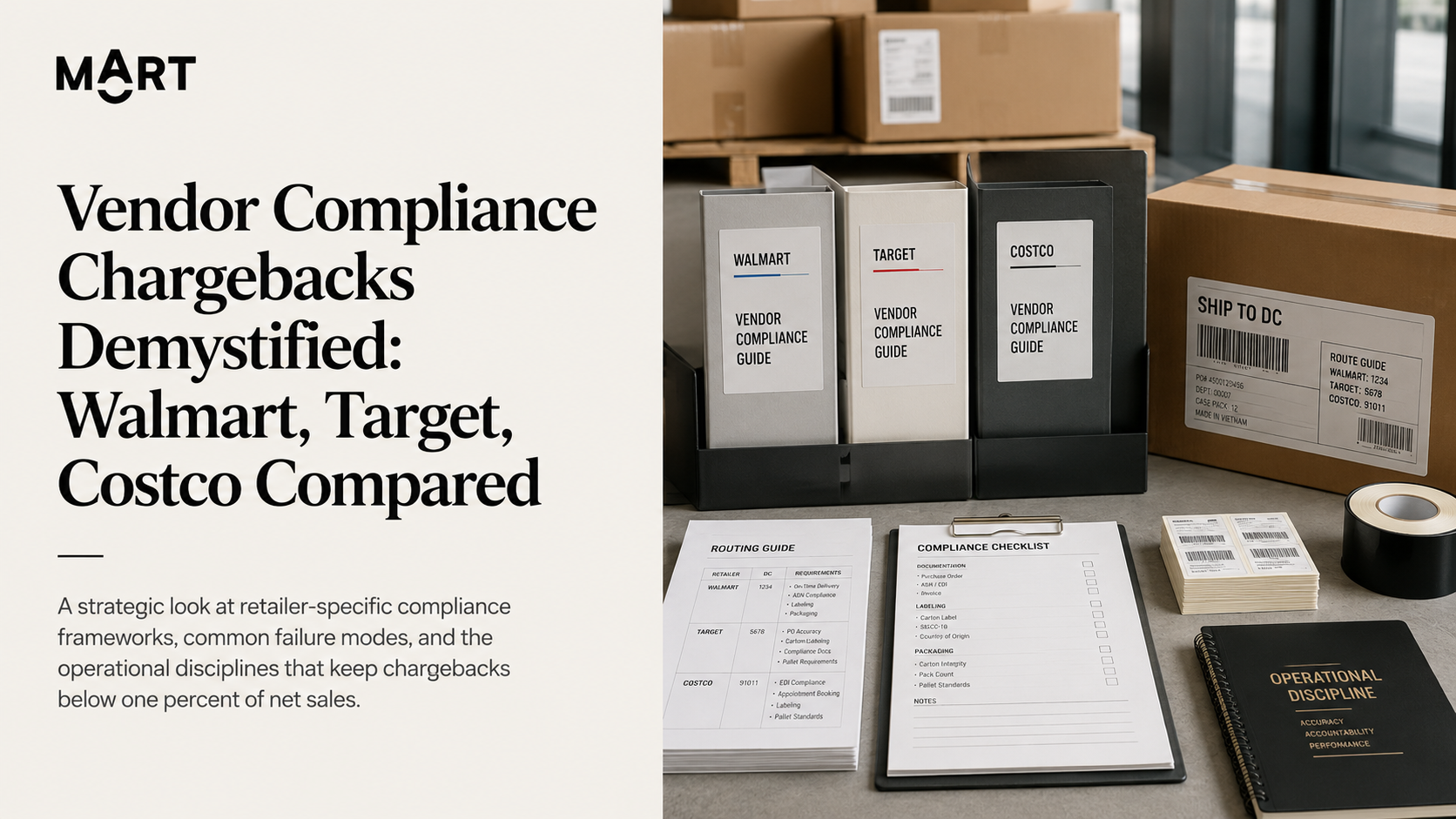
Vendor compliance chargebacks are one of the most consistent margin pressures on brands selling at major US retailers, and the rules differ meaningfully across Walmart, Target, and Costco. A brand operating across multiple retailers needs to understand each retailer's specific framework, common failure modes, and the operational discipline that materially reduces chargeback exposure. Brands that treat chargebacks as an inevitable cost of doing business often pay several percentage points of net sales in chargebacks; brands that treat chargebacks as a manageable operational metric typically reduce that exposure to a fraction of one percent.
Walmart's chargeback framework. Walmart's chargeback structure spans EDI compliance, packaging compliance, on time in full delivery, labeling and barcode quality, and routing guide compliance. The Supplier OnePager and OTIF program create transparency around expectations, but the chargebacks themselves can accumulate quickly for vendors with weak compliance posture. Walmart enforces consistently, and the chargeback amounts reflect the operational cost the retailer experiences when vendors fail to comply.
Walmart typical chargeback rate (well prepared vendor)under 0.5 percent of net salesWalmart typical chargeback rate (poorly prepared vendor)2 to 3 percent of net salesTarget typical chargeback rate (well prepared vendor)under 0.5 percent of net salesTarget typical chargeback rate (poorly prepared vendor)1 to 2 percent of net salesCostco typical chargeback rate (well prepared vendor)typically minimalCostco typical chargeback rate (poor compliance)can result in placement review rather than chargeback
Target's chargeback framework. Target's chargeback structure shares many categories with Walmart (EDI, packaging, delivery, labeling) but with different specific rules and rates. The Supplier Scorecard is the primary visibility mechanism, and the Total Vendor Performance score increasingly influences buyer decisions on assortment continuation. Target's enforcement is somewhat less mechanical than Walmart's but the cumulative pressure on poor performers is similar over time.
Costco's compliance framework. Costco's approach to vendor compliance is distinct from Walmart and Target. Rather than monetizing operational failures through chargebacks, Costco tends to address operational issues through buyer relationship pressure and, ultimately, through item discontinuation. A vendor that fails operationally at Costco typically does not see a chargeback line item on the remittance; the vendor sees a buyer email asking for a meeting, and if the operational issues persist, the vendor sees the item discontinuation conversation. The financial exposure can be larger than Walmart or Target chargebacks because the loss of the placement entirely is more consequential than chargeback amounts.
The operational disciplines that reduce chargeback exposure. Five disciplines consistently. EDI capability that is correctly mapped and tested for each retailer's specific data requirements. Routing guide compliance that includes correct carrier selection, palletization, and labeling for each retailer's specific guides. OTIF performance that exceeds the retailer's minimum threshold by a meaningful margin, not just barely meets it. Packaging compliance that has been pre validated against each retailer's requirements before the first PO ships. A dedicated internal owner of the compliance function who reviews scorecards weekly and addresses issues before they accumulate.
The chargeback dispute process. Chargebacks at all three retailers can be disputed, but the process is administrative work that consumes vendor resources. Brands with strong documentation and clear records often successfully dispute a meaningful share of chargebacks, but the time and energy required to dispute often outweighs the recovered amount. The better strategy is preventing chargebacks rather than disputing them after the fact.
MOART perspective. Vendor compliance chargebacks are a manageable cost when treated as an operational metric and an unmanaged cost when treated as background noise. For brands operating across multiple US retailers, the right approach combines a dedicated compliance function, retailer specific operational playbooks, and weekly scorecard review. The brands that operate this discipline consistently keep chargebacks under one percent of net sales across the major retailers and avoid the deeper relationship damage that accumulated compliance failures can create over time.