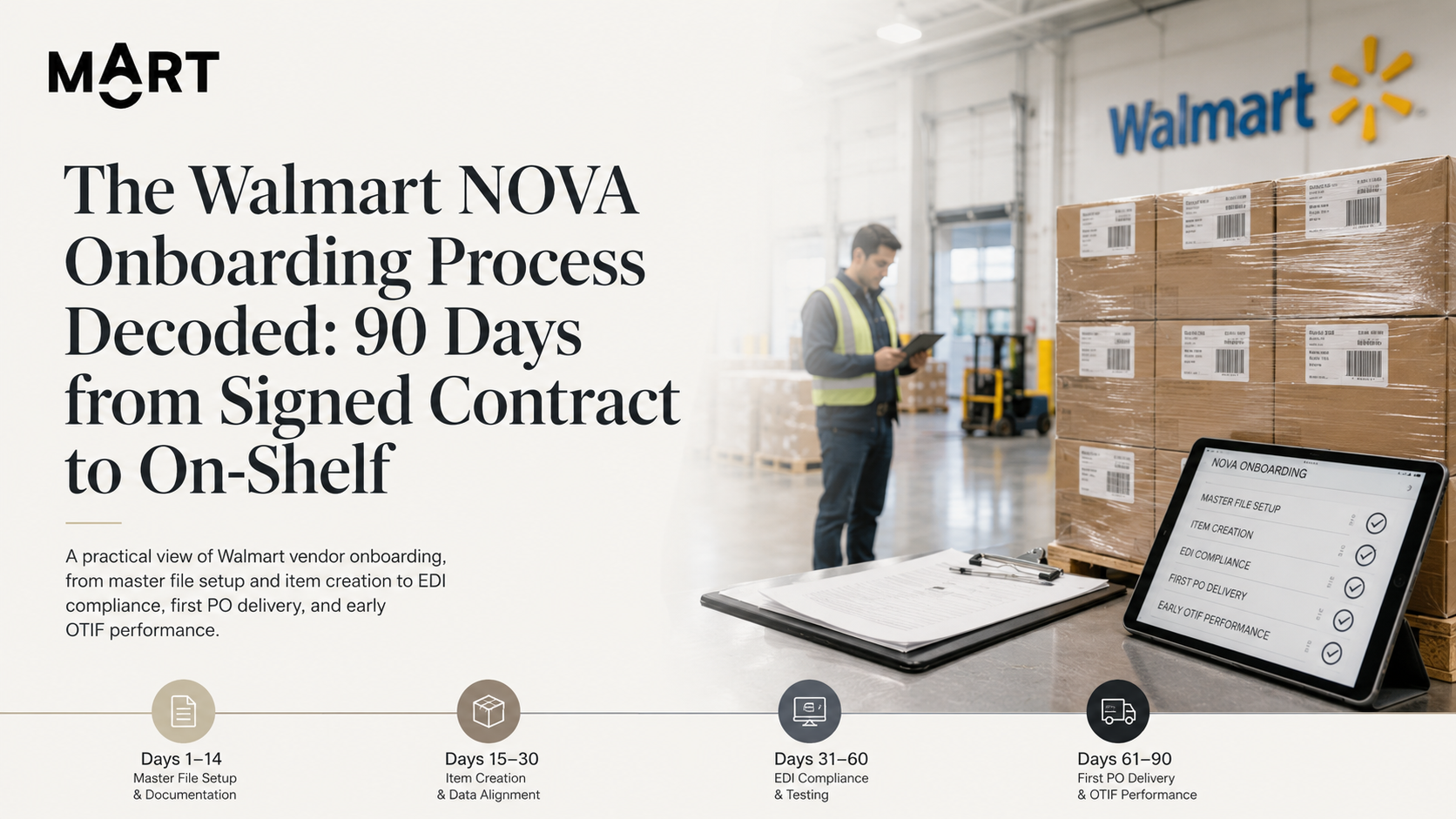
The Walmart NOVA vendor onboarding process is one of the most disciplined and best documented vendor onboarding programs in mass retail. From signed contract to first delivery to a Walmart distribution center, the process runs approximately 90 days when the brand prepares thoroughly and approximately 150 to 180 days when the brand learns the requirements as it goes. The cost of the unprepared timeline is real: a missed launch window often pushes the brand's first replenishment cycle into the next category review, which can mean a six to nine month delay in revenue.
The 90 day milestone calendar. Days 1 to 14: vendor master file setup, banking and tax documentation, supplier onboarding portal completion. Days 15 to 30: item setup in Walmart's item maintenance system (IMS or NOVA), GTIN registration, packaging artwork submission. Days 31 to 60: EDI testing, order acknowledgment workflow validation, shipping and routing guide compliance verification. Days 61 to 90: production planning to meet first PO, delivery to assigned distribution center, in stock validation at the store level for the targeted launch window.
Vendor master file setupDays 1 to 14Item setup in NOVADays 15 to 30EDI compliance testingDays 31 to 60First PO production and deliveryDays 61 to 90OTIF (On Time In Full) baseline expectationtypically 95 percent or higherChargeback risk for missed compliancetypically 1 to 3 percent of net sales
The five most common failure points. First, GTIN and item setup errors that require re-submission, often caused by inconsistent dimensions between the packaging artwork and the case configuration. Second, EDI mapping errors between the brand's ERP and Walmart's EDI standards, typically discovered during testing and requiring engineering work to resolve. Third, routing guide non compliance on the first shipment, particularly around carrier selection, palletization, and labelling, which generates chargebacks and damages the new vendor's compliance scorecard. Fourth, packaging artwork that does not match Walmart's barcode and label placement requirements, requiring rework and shipment delays. Fifth, the underestimation of inventory required to support the launch window across multiple distribution centers, which results in out of stock conditions in the first 60 days at shelf.
The preparation work that compresses the timeline. Three things meaningfully accelerate the 90 day process. Pre-built EDI capability or a vetted EDI partner relationship before the contract is signed. Packaging artwork that has been pre-validated against Walmart's packaging requirements (case quantity, master pack, barcode placement, dimensional requirements). A 3PL or distribution partner who has experience shipping to Walmart distribution centers, with established routing relationships and chargeback management capability.
The post launch first 90 days. Once on shelf, the next 90 days establish the brand's relationship with the Walmart buyer and the operational scorecard. Weekly sales velocity reads, in stock performance, OTIF, and chargeback frequency all feed the vendor scorecard that the buyer uses to evaluate the relationship at the next category review. Brands that hit launch but stumble in the first 90 days on shelf often find the second purchase order is smaller or delayed, which is the first signal that the buyer is reconsidering the placement.
MOART recommendation. For brands entering Walmart in 2025, the right approach is to begin the operational preparation three to six months before the buyer conversation reaches contract stage. The brands that win in the first 90 days are the brands that walked into the buyer's office already operationally ready to launch, not the brands that learned the requirements after the contract was signed.