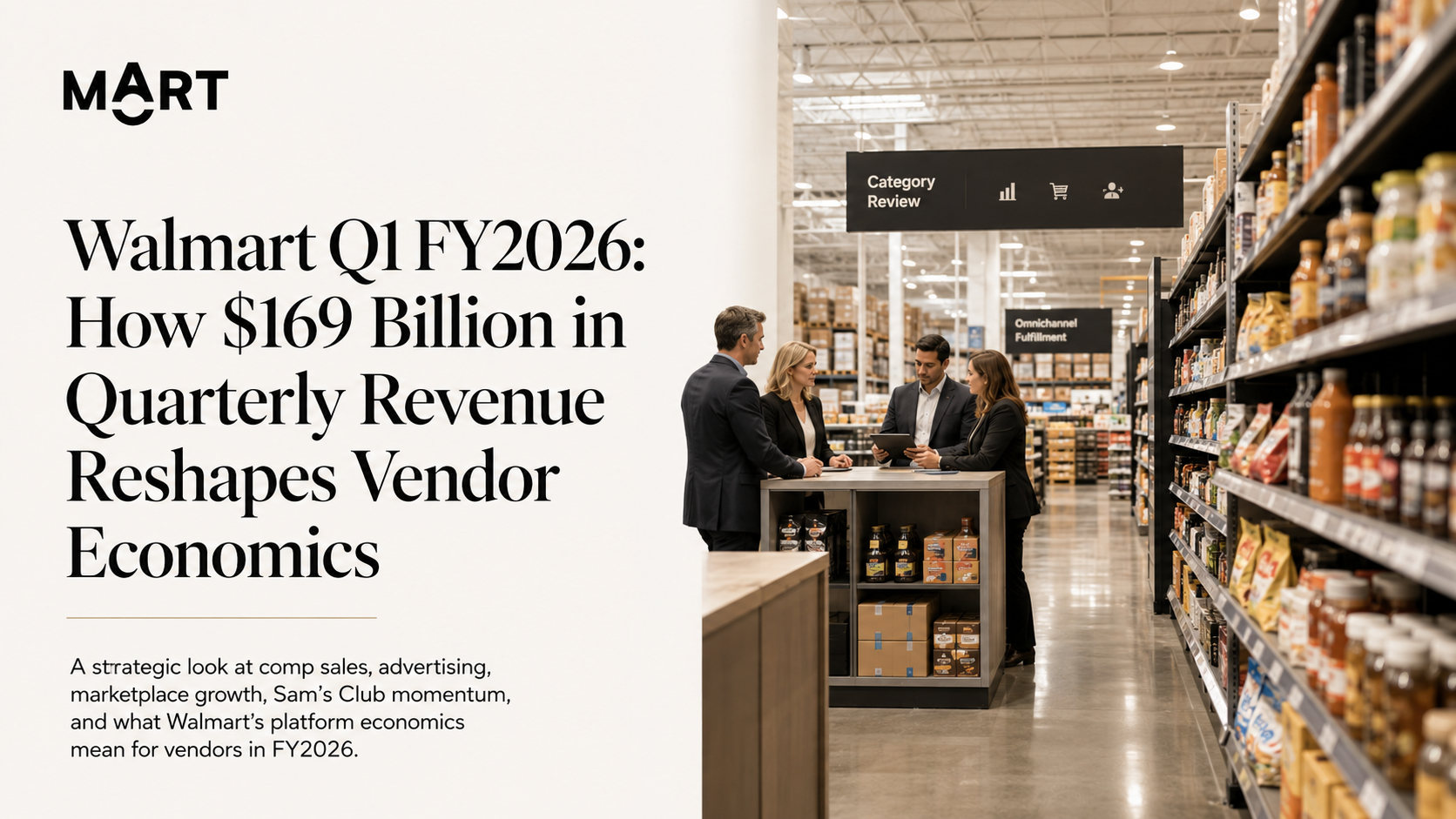
Walmart reported Q1 FY2026 revenue of approximately $169 billion, with US comparable sales growing in the mid-single digits and the alternative-revenue businesses, advertising and marketplace, growing meaningfully faster than the retail core. For brands selling at Walmart US, the quarter accelerates a structural shift that has been underway for three years: the retailer is no longer a pure trade negotiation, it is a media buy plus a marketplace ranking plus a shelf placement, all priced separately and increasingly priced higher each year.
The headline numbers, in context. Walmart US delivered comparable sales growth of approximately five percent, transactions growing and ticket modestly positive. Sam's Club continued to outperform with comp growth in the high single digits, and Walmart International posted constant currency growth in the low double digits. Consolidated operating income grew faster than revenue, reflecting the margin contribution of the alternative-revenue streams the company is now reporting as separate disclosures.
Walmart US net sales~$114 billionWalmart US comp sales growth~5 percentSam's Club net sales (US, ex fuel)~$22 billionWalmart International net sales~$30 billionWalmart Connect (advertising)growing ~30 percent year over yearMarketplace GMV growthgrowing ~25 percent year over yearConsolidated operating income growth~10 percent
Why the alternative revenue lines matter to vendors. Walmart Connect, the retailer's advertising business, is now meaningful enough that any brand selling in Walmart US and not buying retail media is effectively donating shelf and search position to brands that are. The Q1 disclosures indicate Connect grew approximately thirty percent year over year, on a base that is already in the multiple billions of dollars annually. That growth is funded by vendors. A new brand entering Walmart with a media budget below five percent of forecast first year revenue should expect minimal sponsored placement, weak detail page traffic on Walmart.com, and slower velocity ramp than the comparable brand spending closer to ten percent.
The marketplace pressure on first party brands. Marketplace GMV grew approximately twenty five percent in the quarter, and Walmart continues to invest in onboarding international and domestic third party sellers to widen assortment without taking 1P inventory risk. For a brand selling to Walmart 1P, the implication is two fold. First, the assortment a buyer can offer at any given category review is now substantially larger than the planogram, meaning competition for shelf is structurally tighter. Second, the buyer's success metric increasingly includes 3P category revenue, which means the buyer cares less about your 1P performance in isolation and more about how the entire category performs across the channel.
The Sam's Club outperformance and what it tells brands. Sam's continued to deliver the strongest comp growth in the portfolio, and the club channel's membership renewal rate remains in the mid ninety percent range. For brands that fit the club channel pack out and price architecture, Sam's is now the most attractive volume opportunity inside the Walmart Inc. portfolio. Member transaction frequency is rising and Plus member penetration continues to grow, which strengthens the case for brands building club specific SKUs and committing to roadshow and demo programs.
The vendor implications, summarized. Walmart Q1 FY2026 is not a retail story, it is a platform story. The mid single digit comp number that headlines the press release masks the more important shift: Walmart's most profitable growth is in businesses that bill vendors, not businesses that fulfill them. Brands need to budget for advertising, marketplace participation, and category data tools as first class line items, not as marketing optional spend.
MOART recommends three actions for international and cross border brands at Walmart for the remainder of FY2026. First, formalize a Walmart Connect spend plan that grows in line with category share goals, not last year's spend. Second, evaluate 3P seller posture for adjacent assortment that does not fit the 1P box but extends category presence. Third, treat Sam's Club as a distinct go to market with its own pack, price, and activation calendar, not as a downstream of the Walmart US plan.