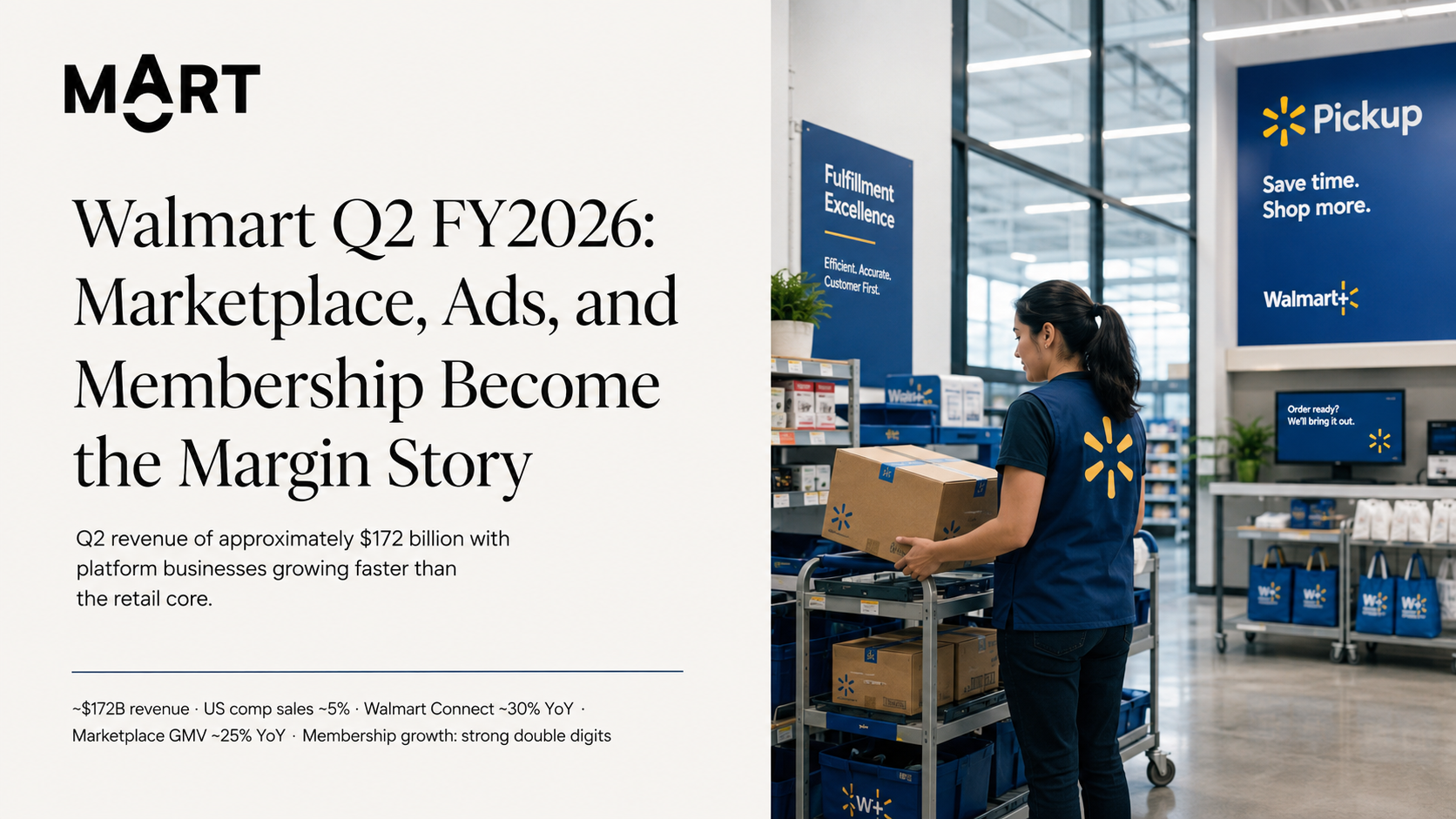
Walmart reported Q2 FY2026 revenue of approximately $172 billion, with comparable sales growing in the mid single digits in the US and the alternative revenue businesses (marketplace, advertising, membership) continuing to grow meaningfully faster than the retail core. The quarter reinforced the structural shift that the past several quarters have signaled: Walmart's most profitable growth is no longer in retail itself, it is in the platform businesses that bill vendors and members for value the platform provides.
The headline composition. Walmart US comparable sales growth was approximately five percent, with transactions modestly positive and ticket modestly positive. Sam's Club continued to outperform with comp growth in the high single digits. Walmart International posted constant currency growth in the low double digits. Consolidated operating income grew faster than revenue, with the margin contribution skewed toward the alternative revenue lines.
Total revenue~$172 billionWalmart US comp sales growth~5 percentWalmart Connect (advertising) growth~30 percent year over yearMarketplace GMV growth~25 percent year over yearWalmart Plus membership growthstrong double digitsInternational constant currency growth~low double digitsOperating income growth~10 percent
The marketplace expansion implications. Marketplace GMV continued to grow at approximately twenty five percent, with the seller base expanding domestically and internationally. The implication for 1P vendors is that the buyer's category planogram now sits within a much larger total assortment that includes 3P. Buyers are increasingly evaluating category performance across 1P and 3P together, which means a 1P vendor's success depends not only on its own performance but on how its placement contributes to the category's total channel revenue including 3P alternatives.
The Walmart Connect trajectory. Walmart Connect grew approximately thirty percent in the quarter, on a base that is now in the multiple billions of dollars annually. The growth is high quality, driven by both increasing CPMs and increasing advertiser adoption. The platform's measurement infrastructure continues to mature, with stronger incrementality measurement and better attribution across the funnel. Vendors that invest seriously in Walmart Connect generally see better detail page traffic, better sponsored placement, and better shelf velocity than vendors that under invest.
The Walmart Plus membership context. Walmart Plus membership continued to grow in Q2 FY2026, with member spending materially higher than non member spending and member trip frequency growing. The membership data infrastructure is increasingly informing the buyer's view of category strategy, particularly for categories with high member relevance (grocery essentials, household supplies, prepared foods). For vendors, the Walmart Plus member shopper preferences are a real input to the assortment conversation.
The vendor implications summarized. Three actions for brands at Walmart for the remainder of FY2026. First, treat Walmart Connect as a required investment that scales with category share goals, not as an optional marketing line. Second, evaluate marketplace participation for adjacent assortment that does not fit the 1P box but extends category presence. Third, build the operational capability that Sam's Club rewards (pack out discipline, roadshow execution, member value math) as a distinct go to market with its own activation calendar.
The international growth context. Walmart International continued to deliver constant currency growth in the low double digits, with particular strength in Mexico (Walmex), India (Flipkart and PhonePe), and select other markets. The international growth provides incremental scale and brand exposure that benefits the global vendor relationships.
MOART perspective. Walmart Q2 FY2026 confirms the platform business story that Q1 outlined. Marketplace, advertising, and membership are now the structural margin growth drivers, and the brands that build their Walmart strategy around the platform context outperform brands that treat Walmart as a traditional mass channel customer. For international brands considering Walmart entry, the platform investment requirements should be planned as core operating commitments from day one, not as optional second year additions.