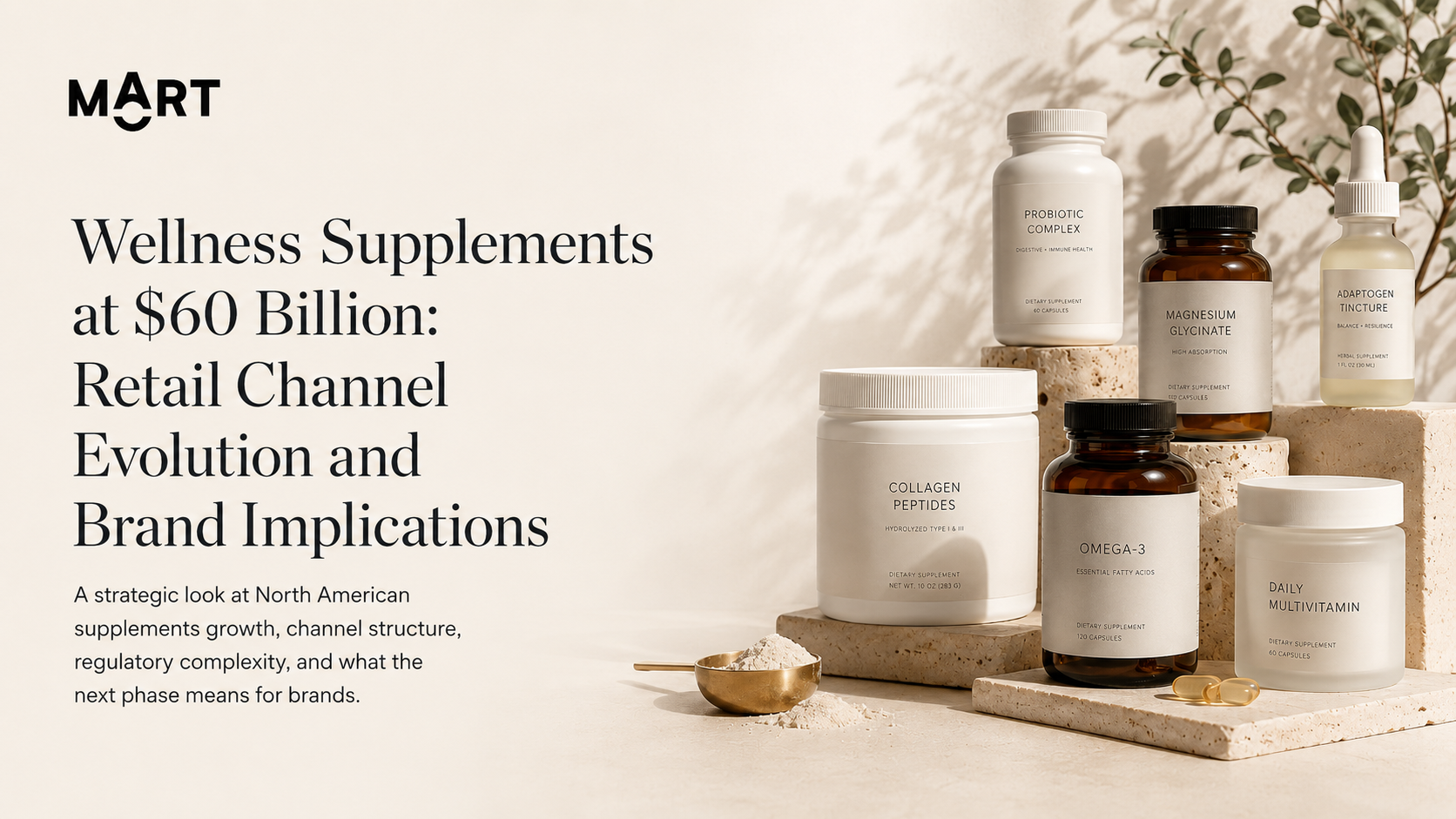
The North American wellness supplements category has scaled to approximately $60 billion in retail value, with continued growth across vitamins, minerals, herbal supplements, sports nutrition, functional ingredients, and the expanding categories of beauty supplements, recovery supplements, and longevity supplements. The category's channel structure has evolved meaningfully in the past five years, with implications for brand strategy that differ substantially from the historical playbook.
The category structure in 2025. Mass channel (Walmart, Target, mass drug, club) represents the largest single channel for established supplement brands by revenue. Natural specialty (Whole Foods, Sprouts, independent natural) remains the validation channel for premium and natural focused brands. Direct to consumer and subscription channels have grown to meaningful scale for digital first brands. Amazon represents a distinct channel that overlaps with all three of the above and operates under its own competitive dynamics. Specialty health and fitness channels (GNC, Vitamin Shoppe) continue to serve a defined shopper segment that values expertise driven recommendations.
North American supplements category total~$60 billion annuallyMass channel share~35 to 40 percentNatural specialty channel share~15 to 20 percentDirect to consumer and subscription~15 to 20 percent and growingAmazon channel share~10 to 15 percentSpecialty health and fitness channel share~10 to 15 percentBeauty and longevity adjacent supplement growthstrong double digits
The fastest growing sub categories. Three sub categories continue to grow at outsized rates. Beauty supplements, including collagen, hyaluronic acid, and skin focused formulations, continue to outperform driven by the shopper preference for ingestible beauty solutions. Recovery and sleep supplements, including magnesium, melatonin, and adaptogen blends, grow on the back of the sleep optimization category broadly. Longevity adjacent supplements, including NAD precursors, resveratrol, and the broader healthy aging set, attract early adopter shopper interest and meaningful brand investment.
The regulatory context. The US dietary supplement regulatory environment under DSHEA continues to operate with comparatively light pre market regulation, but FDA enforcement around specific claims, adverse event reporting, and good manufacturing practice (GMP) compliance has tightened. The Canadian regulatory environment under the Natural Health Products Regulations requires pre market license approval (NPN registration), which adds time and complexity to Canadian market entry. Brands considering Canadian launch should plan the NPN registration work six to twelve months ahead of intended launch.
The brand operating implications. Three patterns characterize the brands gaining share. First, clear scientific substantiation for the specific claims the brand makes, supported by third party clinical data where appropriate. Second, brand presentation and packaging that elevates the supplement category from the historical clinical aesthetic to something closer to premium beauty or premium food categories. Third, multi channel distribution sequencing that builds credibility through natural specialty and DTC before scaling to mass channel.
The Amazon channel dynamics. Amazon is uniquely consequential for supplements because the shopper category research often happens on Amazon (read reviews, compare brands, evaluate price) even when the eventual purchase happens elsewhere. Brands without strong Amazon presence often find that the Amazon reputation shapes shopper preference at every other channel. The implication is that Amazon should not be treated as an optional channel for supplement brands serious about growth.
MOART perspective. Wellness supplements at $60 billion remains one of the most attractive categories in consumer health and wellness. For international brands considering North American supplement entry, the channel sequencing matters more than the channel selection: build credibility through natural specialty and digital channels first, scale to mass channel after the brand's credibility is established, and treat Amazon as a category presence requirement rather than an optional addition. The brands that follow this sequence build durable category positions; the brands that lead with mass channel often discover the velocity does not justify the placement.