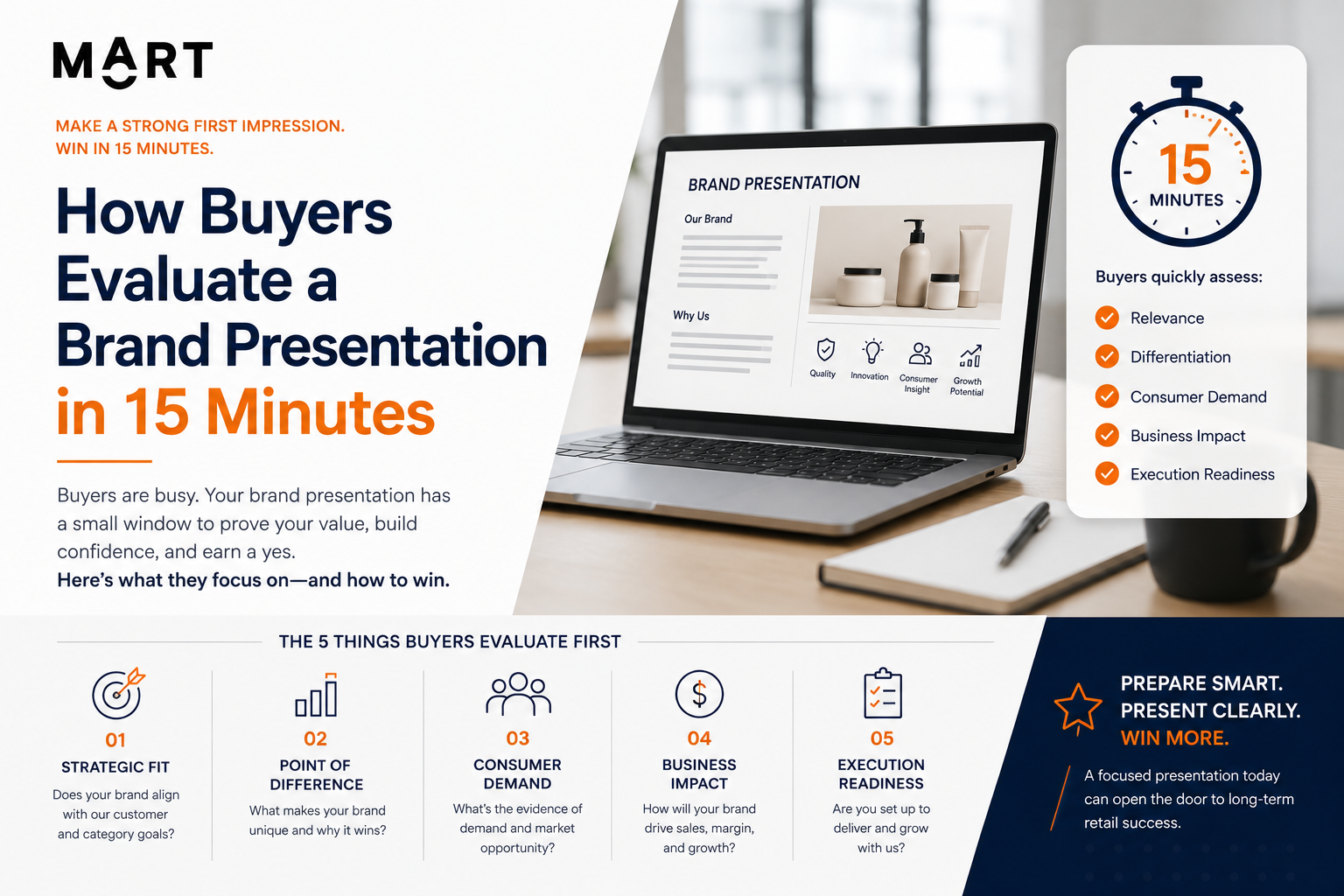
The first buyer meeting an international brand has at a major US retailer rarely runs more than thirty minutes. The buyer makes their preliminary assessment in the first fifteen, and the rest of the meeting is spent confirming or correcting that assessment. Understanding how buyers actually evaluate a presentation in that compressed window is the difference between a brand that earns a second meeting and a brand that does not.
Buyers evaluate four dimensions in the first fifteen minutes, in roughly this sequence.
The first is brand credibility. In the first minute, the buyer is asking whether this brand looks like a real company. Production quality of the deck, professionalism of the team, command of the category data, and signals of operational maturity all factor in. A brand that arrives with a polished presentation, knows its category cold, and presents with confidence clears this gate. A brand that arrives with placeholder slides, fuzzy data, or visible nervousness about basic questions does not.
The second is product fit. In minutes two through six, the buyer is matching your product against the retailer's current assortment, the categorical white space they have identified, and the recent trends they are tracking. A product that fits a known white space or a tracked trend has the buyer's attention immediately. A product that does not fit either has to overcome the buyer's lack of immediate hook to bring it through assortment review.
The third is the operational story. In minutes seven through ten, the buyer is asking whether this brand can actually deliver. What manufacturing capacity exists. What inventory you can ship. What lead times look like. Whether you have experience shipping to retailers at this scale. The buyer is not looking for perfect answers. They are looking for evidence that you understand what operating with this retailer requires.
The fourth is the financial frame. In minutes eleven through fifteen, the buyer is checking that your wholesale pricing, MSRP, gross margin contribution, and trade investment commitments all map to numbers the retailer can accept. Brands that arrive with financials that are out of range get filtered here. Brands that arrive with financials in range move to the second half of the meeting, where the buyer starts to imagine what an actual program would look like.
The fix is to design the first fifteen minutes deliberately. Open with credibility signals. Lead the product narrative with fit to a documented retailer need. Demonstrate operational competence before the buyer asks. Have financials ready that map to the retailer's expectations. The structure of the opening determines whether you spend the second half of the meeting building toward a program or defending why you deserve another conversation.