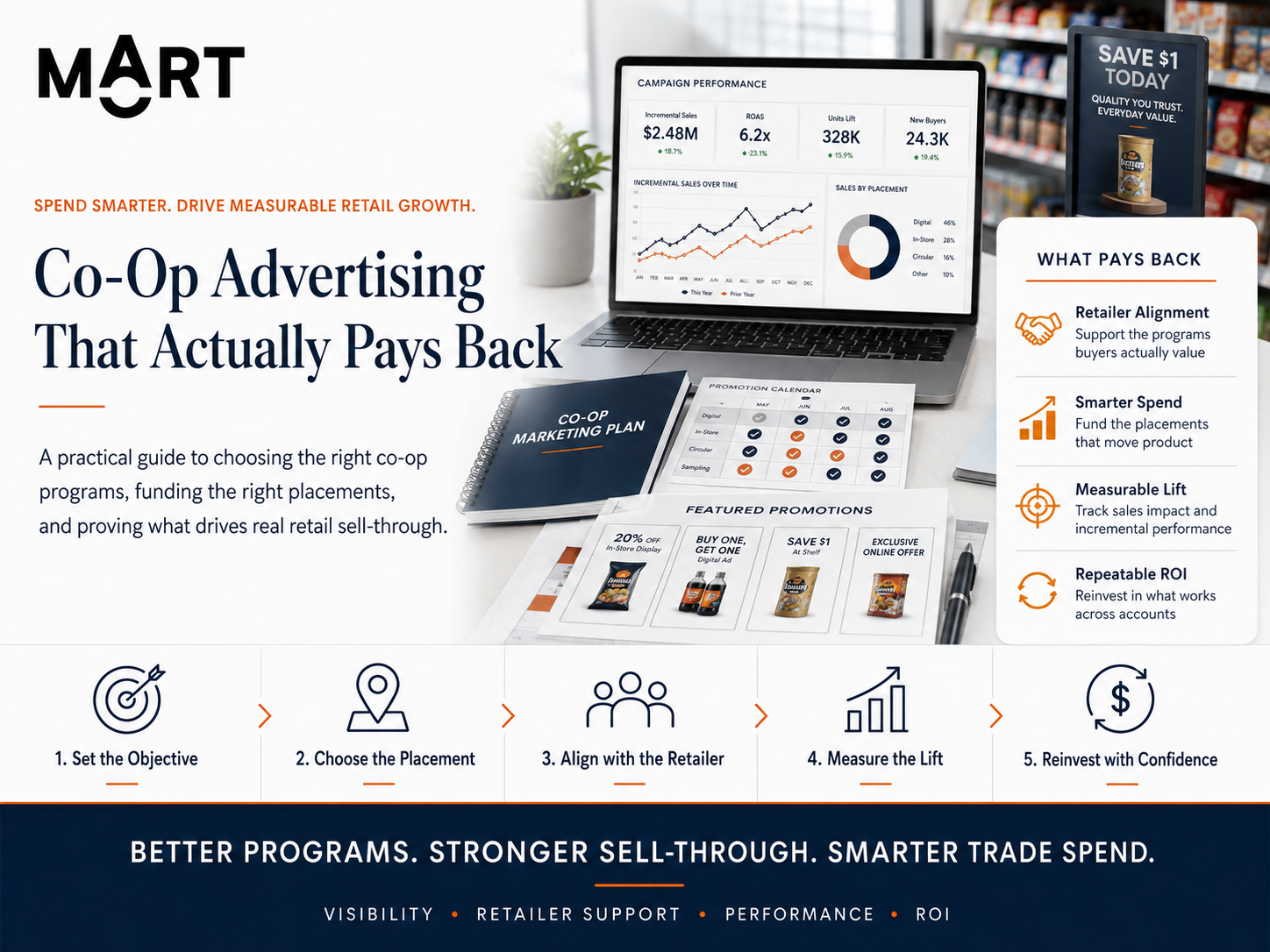
Cooperative advertising programs are a standard component of retail vendor relationships, and they are also one of the most consistently misallocated marketing dollars in retail. Brands commit to co-op spend as part of the vendor agreement, then accept whatever programs the retailer offers, then find that the trade spend produces nothing measurable. The brands that get this right treat co-op as a discretionary marketing investment that needs to earn its return, not as a tax on the relationship.
The starting point is understanding what co-op actually pays for. The traditional definition is shared advertising spend, where the retailer features your brand in their advertising and you contribute to the cost. In modern practice, co-op encompasses a much broader range of trade marketing investments. Circular features, digital placements, end cap fees, demo programs, loyalty rewards funding, and in store signage are all funded through co-op budgets at various retailers.
The programs that consistently produce measurable lift are programs that put your product in front of shoppers who are already in the buying mindset for your category. A circular feature in the week of a category traffic peak. A digital placement on the retailer's app for shoppers searching the category. An end cap during a relevant holiday or seasonal window. These programs convert at meaningfully higher rates than general brand awareness programs funded through co-op.
The programs that consistently underperform are programs that put your product in front of shoppers who are not in the buying mindset for your category. A general brand awareness placement. A coupon offer that does not align with your shopper's price sensitivity. A demo on a low traffic weekday. These programs absorb co-op spend without producing the lift that justifies the investment.
The brands that maximize co-op return measure every program and reallocate spend based on what works. The retailer will not do this for you. The retailer's incentive is to spend the co-op budget, not to optimize it. Your incentive is to make every co-op dollar earn its return. Build a measurement framework that tracks sell through lift by program, retain the data across multiple cycles, and negotiate your co-op allocation each year based on what produced results in the prior year.