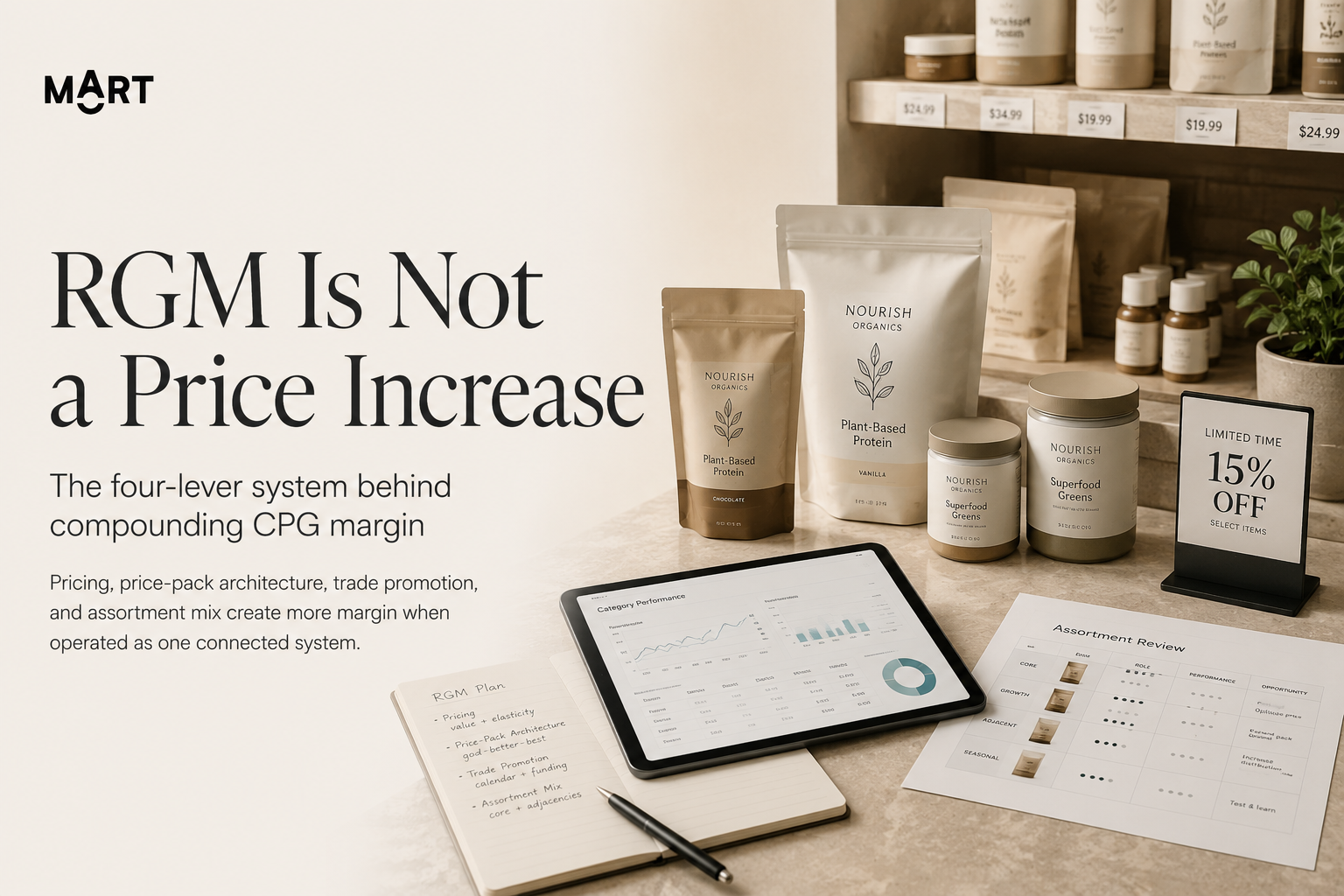
When a CPG finance team says it is "doing RGM," it usually means one thing: a price increase. A list price moves up two or three points, the deck gets presented, and everyone moves on. The problem is that pricing is only one of four levers, and the brands that compound margin year after year operate all four as a single connected system, not four disconnected projects owned by four different people.
The four levers are pricing, price-pack architecture, trade promotion, and assortment mix. Each one moves gross margin through a different mechanism, and the reason a pricing-only approach underdelivers is simple: a list price increase is the most visible lever to the shopper and the easiest for a retailer to resist. The other three move profit while staying largely invisible at the shelf.
Pricing changes the per-unit revenue line directly, but it carries the highest elasticity risk and the highest scrutiny in a joint business plan. Price-pack architecture changes the price the shopper sees without changing the price per ounce you defend, by engineering the right sizes into the right channels. Trade promotion is where the largest uncontrolled spend usually sits, and where the fastest margin recovery is available. Mix is the quiet compounder: shifting volume toward higher-margin SKUs lifts blended margin with no price change at all.
LeverPrimary mechanismTypical gross margin impactTime to realizePricingPer-unit revenue1.5 to 3.0 pts1 to 2 quartersPrice-pack architecturePack-channel fit1.0 to 2.5 pts2 to 4 quartersTrade promotionSpend efficiency2.0 to 4.0 pts1 to 3 quartersMix / assortmentBlended margin shift0.5 to 1.5 pts2 to 3 quarters
Read that table the way a CFO would. A team that only pulls pricing caps its realistic annual upside at roughly three points of gross margin and absorbs the full elasticity risk to get there. A team that sequences all four can realistically target five to eight points over a planning horizon, with the risk spread across mechanisms that do not all hit the shopper at once.
The levers interact, which is exactly why running them in separate workstreams destroys value. A list price increase taken without adjusting pack architecture pushes shoppers toward the large value pack, which is often the lowest-margin item in the portfolio, so the price gain leaks straight back through mix. A promotion calendar built without reference to price-pack architecture discounts the very pack you just engineered to protect margin. The interactions are not edge cases. They are the normal failure mode.
The operating discipline that fixes this is governance, not analytics. One owner holds the connected P&L view across all four levers. Every pricing move is checked against pack architecture, every promotion against mix, every assortment decision against the price ladder. The math is not the hard part. The hard part is making sure the four decisions are made in the same room with the same number.
Treating RGM as a pricing exercise is the single most common reason mid-market CPG margin stalls. The four levers are not a menu to pick from, they are a system to operate together. The brands that win do not take the biggest price increase. They take the smallest one they need, because pack architecture, trade efficiency, and mix are quietly doing the rest of the work. That is the difference between a price hike and a margin program.