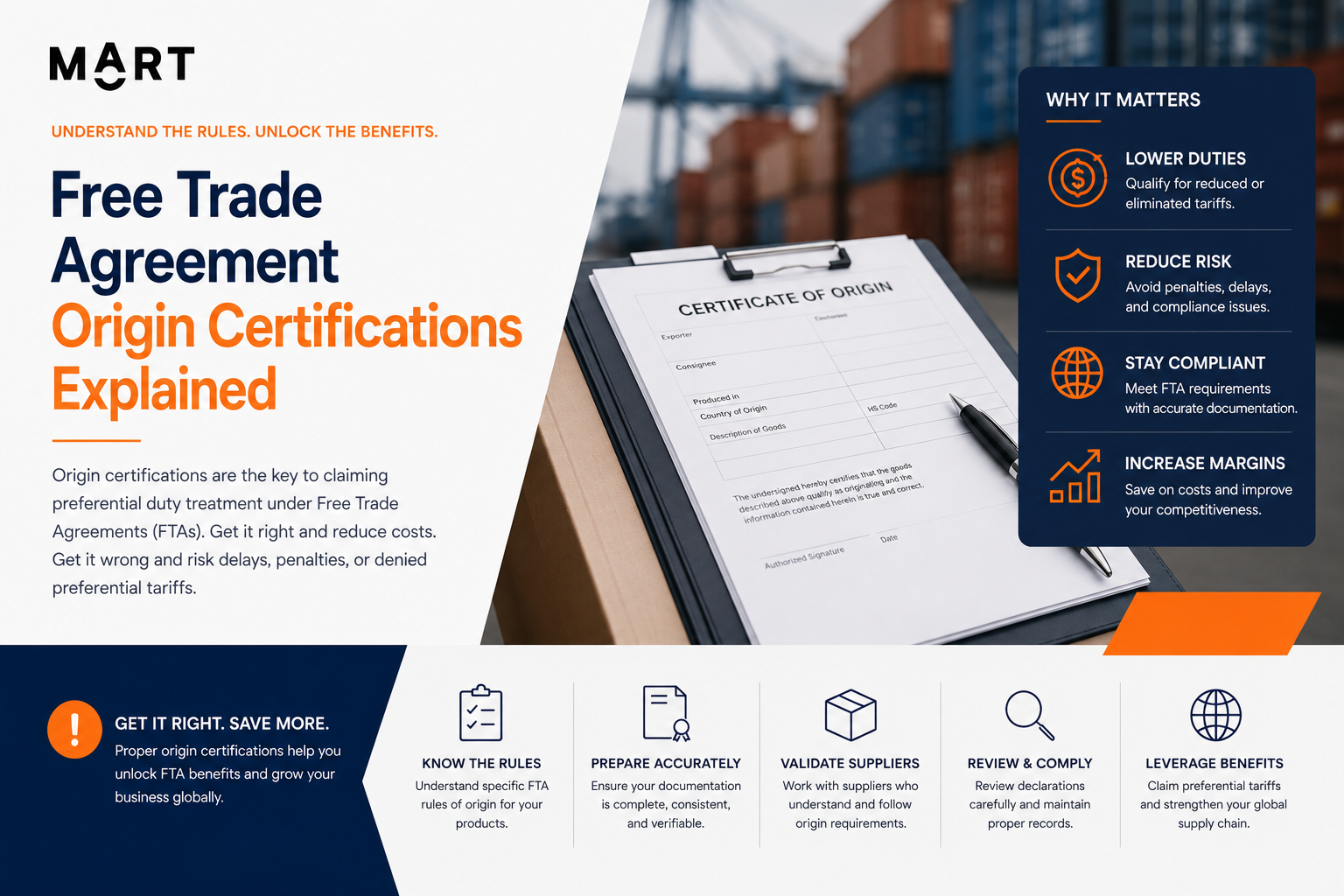
Free trade agreements are one of the most underused tools available to international brands selling into the United States. A product that qualifies for FTA preferential treatment can enter duty free or at substantially reduced duty rates, and the savings over the life of a product line can be material. The brands that take advantage of FTA benefits are not the ones with the best products. They are the ones with the best documentation.
The most relevant agreement for North American brands is USMCA, the successor to NAFTA. USMCA provides preferential treatment for goods that qualify as originating in the United States, Canada, or Mexico. The qualification rules are detailed, and they vary by product category. For some products, the rule is a regional value content test. For others, it is a tariff shift test. For others, it is a combination of both.
For brands manufacturing in Korea, KORUS provides similar duty benefits for qualifying products. For brands manufacturing in Australia, AUSFTA applies. Each agreement has its own qualification rules, its own certification format, and its own documentation requirements. A product that qualifies under one agreement does not automatically qualify under another.
The practical workflow for capturing FTA benefits has four steps. The first is determining whether the product qualifies under the applicable rules. This requires analyzing the bill of materials, the country of origin of each component, and the manufacturing process. A product assembled in Mexico from components mostly sourced in Asia may not qualify under USMCA, even though the final assembly occurs in the qualifying region.
The second is preparing the certification of origin. The certification is a standardized document that the importer relies on to claim FTA treatment. For USMCA, the certification can be issued by the exporter, the producer, or the importer, but it must include specific data elements and certifications.
The third is maintaining the supporting documentation. The certification is a representation, but the supporting documentation is what defends the claim during a customs audit. Bills of materials, supplier certifications, manufacturing records, and origin attestations must all be retained for the audit period defined by each agreement, typically five years.
The fourth is post-entry processing. Some FTA claims are made at entry. Others can be made within twelve months of entry through a post-entry adjustment, recovering duties paid on shipments that should have been duty free. Brands that discover FTA eligibility after launch should still pursue post-entry recovery for shipments within the recovery window.