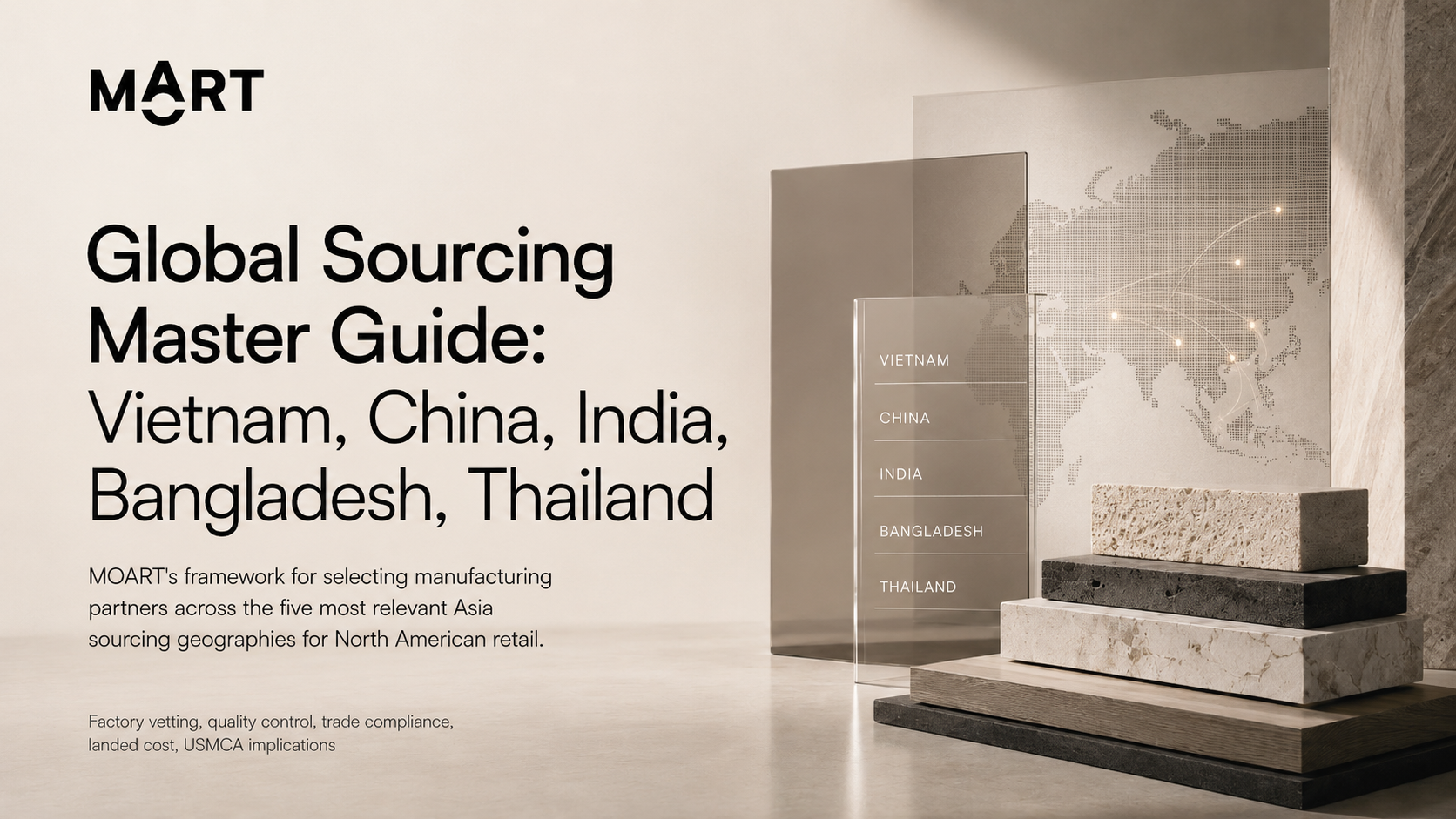
Global sourcing for North American brands has become more complex post-USMCA reinterpretation. This master guide covers MOART's framework for selecting manufacturing partners across Vietnam, China, India, Bangladesh, and Thailand. The five most relevant Asia sourcing geographies for brands selling at North American retailers.
Where you manufacture determines your landed cost, your USMCA qualification, your trade compliance exposure, your category margin at major retailers, and your supply chain resilience. Brands that treat sourcing as a procurement decision separate from retail strategy consistently end up with cost structures that do not work at Walmart, Target, or Costco margin requirements.
The five primary Asia sourcing geographies for North American brands, with MOART's read on each:
The fastest-growing alternative to China for soft goods, electronics assembly, and emerging consumer categories. Lower labor costs than coastal China, improving infrastructure, USMCA-relevant supply chain diversification. Best for: apparel, footwear, consumer electronics assembly, furniture, home goods.
Still the largest manufacturing base globally with deepest supplier ecosystem, highest quality control maturity, and broadest category coverage. Trade compliance complexity has increased materially post-2024. Tariff exposure and Section 301 considerations affect costing. Best for: complex electronics, beauty packaging, specialty manufacturing requiring deep supplier networks.
Strong in textiles, apparel, beauty raw materials, and emerging in consumer electronics. Lower labor costs than China, growing infrastructure, English-language commercial communication. Best for: textiles, beauty and personal care, supplements, certain electronics.
Garment manufacturing scale equivalent to or exceeding China for certain categories. Cost-competitive, but quality variance and labor compliance complexity require sophisticated vendor management. Best for: apparel and accessories at scale with proper compliance oversight.
Specialized strengths in automotive parts, certain food and beverage categories, electronics assembly. Higher labor costs than Vietnam but lower than coastal China. Best for: food and beverage processing, automotive accessories, specialty consumer electronics.
MOART's factory vetting framework covers six dimensions: capacity verification (can they actually ship at your volume), quality systems maturity (ISO certifications, internal QC processes), trade compliance posture (export documentation, customs experience), financial stability (years operating, customer base diversity, no concentration risk), labor compliance (audit history, certifications like SA8000), and IP protection posture (history of disputes, contractual practices).
USMCA reinterpretation in 2026 has changed the calculus on Asia sourcing for North American brands. Goods qualifying as USMCA-originating face zero tariff between US, Canada, and Mexico. Asia-sourced goods face the standard tariff schedule plus any Section 301 surcharges. For some categories, the USMCA differential is significant enough that nearshoring (Mexico) becomes cost-competitive with Asia sourcing.
For Asia-sourced goods entering North American retail, quality control operations must include: pre-production sample approval, in-process QC at the factory, pre-shipment QC inspection, container-level random sampling, and post-arrival sample testing at North American DC. Brands skipping any of these layers see quality failures at retail that trigger chargebacks and damage retailer relationships.
MOART's Guangzhou office anchors our Asia sourcing operations. Our team has factory relationships across Vietnam, China, India, Bangladesh, and Thailand. We run factory vetting, supplier negotiation, quality control programs, and trade compliance for North American brand clients. For sourcing engagement: moartgrp.com/contact.