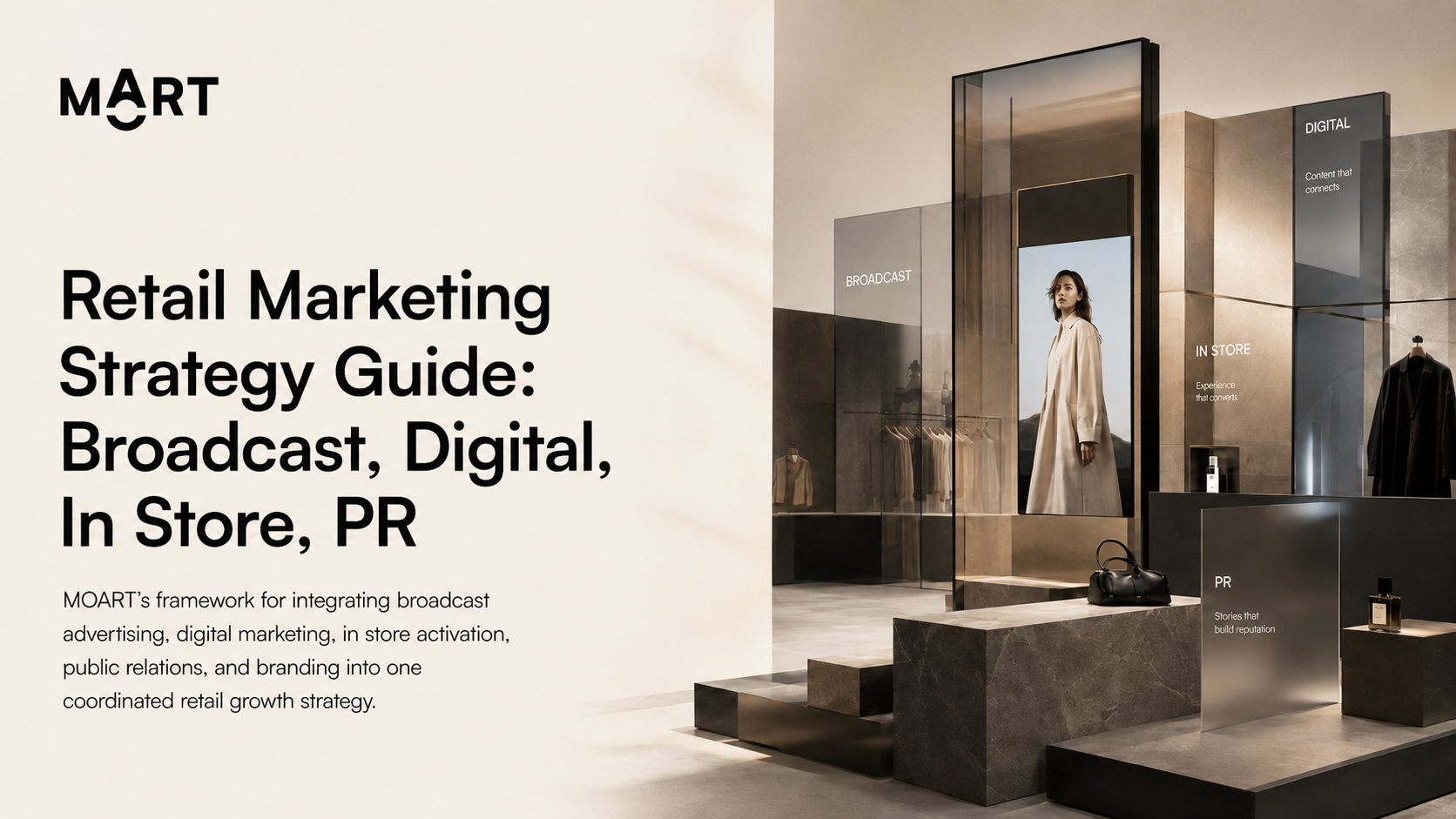
Retail marketing is not a single discipline. It is a coordinated mix of broadcast advertising, digital marketing, in-store activation, public relations, and branding that must work together to drive sell-through at retail. This guide covers MOART's framework for retail marketing and links to deeper reads on each channel.
The 2026 retail marketing mix for cross-border brands typically allocates: 30-40 percent in-store activation (end caps, demos, retail media co-op), 25-35 percent digital marketing (paid search, social, retail media digital), 15-25 percent public relations and earned media, 10-20 percent broadcast (linear TV plus connected TV) for brands at scale, and 5-10 percent branding and design investment.
Broadcast advertising remains the highest-cost marketing investment a consumer brand will make. MOART's framework for when broadcast pays back: legacy CPG launching in mass retail, regulated categories where digital is restricted, and premium consumer categories where brand-building is the actual product. The 2026 linear-vs-connected-TV split: 60-70 percent connected TV for targeting and measurement, 30-40 percent linear for reach efficiency. Full analysis: Broadcast Advertising for Cross-Border Brands.
Digital marketing for retail-distributed brands has shifted toward retail media networks (Walmart Connect, Target Roundel, Sam's Club MAP, Sephora Beauty Insider) as the highest-ROI channel for sell-through driving. Traditional Google paid search and social media remain important but secondary to retail media for brands with established retailer relationships.
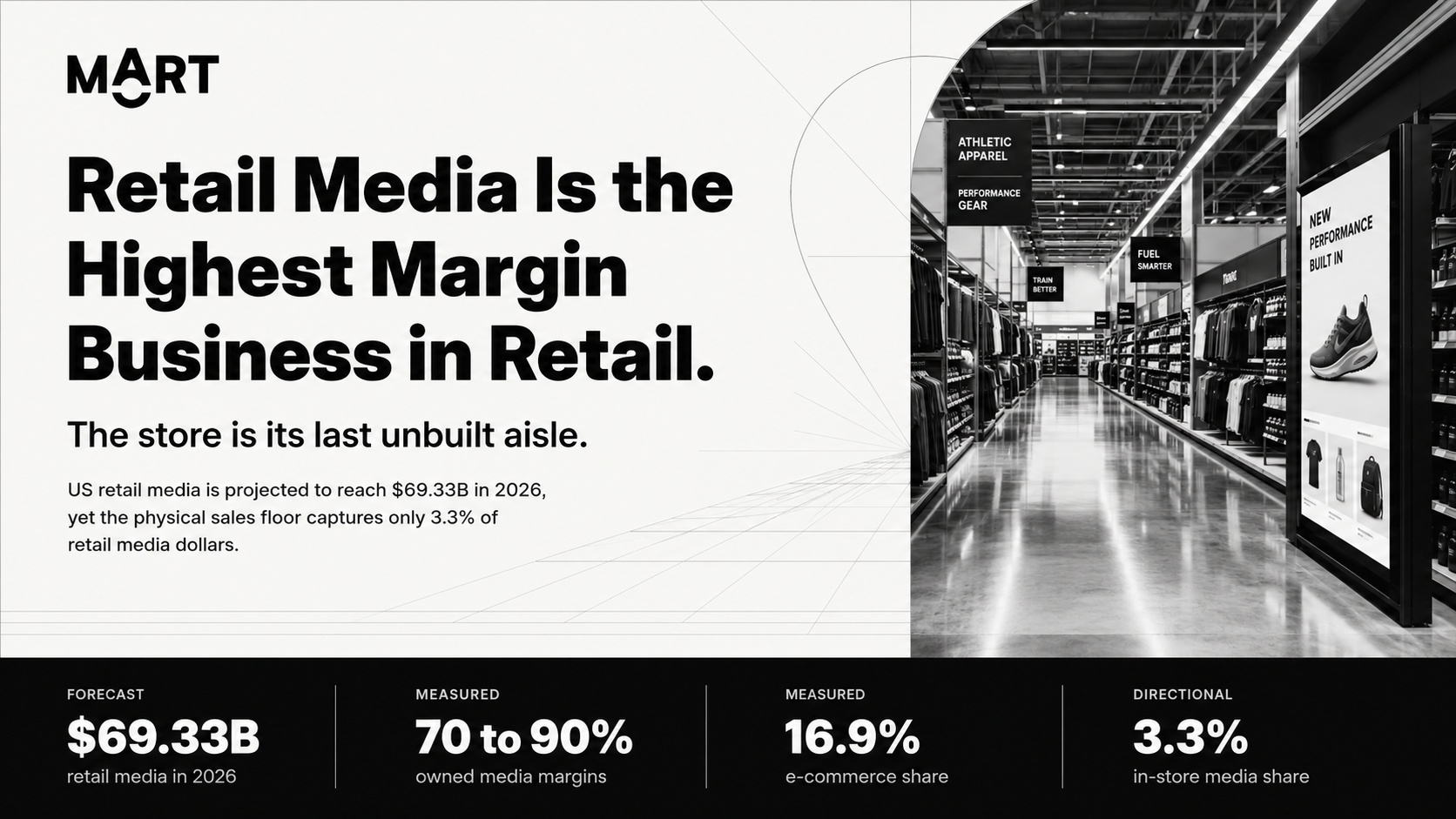
In-store activation is the highest-impact marketing investment for retail-distributed brands. End cap programs, demos, roadshow staffing (especially Costco. See the Costco Playbook for current ROI data), seasonal merchandising calendars, and retail media co-op all drive sell-through that converts retail listings into renewals.
Public relations for retail brands works at three levels: trade press (Retail Dive, Modern Retail, Consumer Goods Technology) for B2B credibility, consumer press (Forbes, Inc., category-specific publications) for end-consumer awareness, and brand-driven content marketing for SEO and demand generation.
Brand identity work for retail-distributed brands has to satisfy two audiences simultaneously: the retailer buyer (signals professional, scaled operation) and the shopper at shelf (drives selection in a 3-second decision moment). Packaging design choices that satisfy one and not the other consistently underperform.
The marketing mix that drives sell-through is integrated, not siloed. Broadcast drives awareness that lifts digital conversion, digital nurtures consideration that brings shoppers to retail, in-store activation closes the sale, and PR builds the credibility that compounds across all channels. Brands operating each channel as a separate function with separate budgets and separate measurement consistently underperform brands that integrate.
Marketing investment at retailer-specific channels (Walmart Connect, Target Roundel, Sam's Club MAP) directly affects buyer relationship quality. Brands that invest in retailer media programs are favored at category review. Brands that try to drive sell-through through external channels alone are perceived as not committed to the retailer partnership.
Combined online-and-offline channel presence consistently produces higher brand trust than single-channel presence. MOART's read: Why Combining Online and Offline Sales Boosts Brand Trust.
MOART operates retail marketing programs for international brands across all five channels. Broadcast advertising and TV commercial production, digital marketing including retail media network optimization, in-store activation including Costco roadshow programs, public relations and trade media placement, and branding and design support. Three offices in Montreal, Rye Brook NY, and Guangzhou.
To discuss retail marketing strategy for your brand: moartgrp.com/contact or info@moartgrp.com.