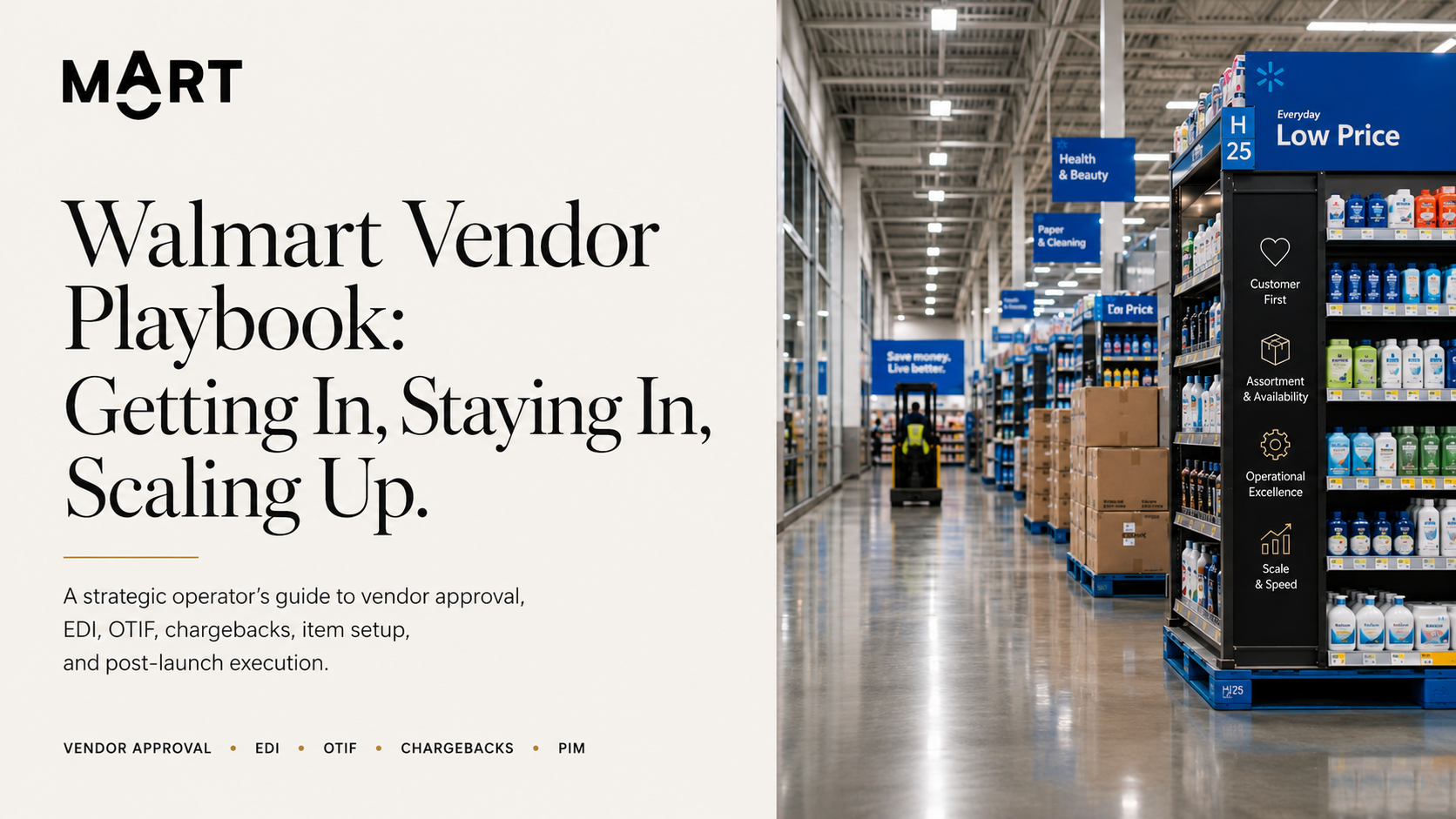
Walmart is the largest single retailer in North America and the highest-leverage vendor relationship in the industry. A successful Walmart listing unlocks 4,700 store distribution. A failed Walmart pitch can lock a brand out for years. This playbook covers what MOART has learned about operating at Walmart from 16 years of vendor programs.
Walmart runs the strictest vendor compliance regime in North American retail. The combination of scale, margin discipline, and operational rigor means that brands either succeed at Walmart through systematic operational investment or fail visibly. There is no middle ground at Walmart. Half-built programs get discontinued at the annual category review.
Becoming a Walmart vendor requires application through the Retail Link supplier portal, vendor compliance certification, EDI capability, financial verification, insurance documentation, and a buyer relationship. The vendor application typically takes 4 to 8 weeks of administrative work. The buyer relationship typically takes 6 to 12 months to establish unless you have a broker introduction or proven traction at a smaller retailer that Walmart pays attention to. See the headquarter sales playbook for the full meeting prep methodology.
The single most underestimated operational requirement at Walmart is EDI (Electronic Data Interchange) setup. Brands assume EDI is plug-and-play. It is not. Walmart EDI runs 4 to 8 weeks of setup work covering 850 purchase orders, 856 advance ship notices, 810 invoices, 820 payment remittance advice, and several Walmart-specific transaction sets. Brands that compress EDI into 30 days launch with errors that cause chargebacks within the first month.
Walmart's OTIF (on-time-in-full) program requires vendors to maintain fill rates above thresholds that vary by category, typically 94 to 98 percent. Vendors who fall below OTIF face automatic chargebacks of 3 percent of invoice value. Vendors who fall below repeatedly face listing reviews. Most cross-border brands underestimate true OTIF. They assume 95+ percent and discover at the annual review they were at 85 percent because of inbound logistics issues, retailer DC routing changes, or item setup errors causing scan failures.
Chargeback exposure at Walmart runs 2 to 4 percent of invoice value across the typical vendor base. The chargeback categories include OTIF, item setup errors, routing guide violations, advance ship notice errors, EDI compliance failures, and PIM data quality issues. Brands without active dispute operations recover 0 to 15 percent of chargebacks. Brands with active dispute operations recover 60 to 80 percent. On a 10 million dollar Walmart relationship, the recovery gap is 200,000 to 400,000 dollars per year.
Walmart's PIM (Product Information Management) system requires precise item setup. UPC, dimensions, weight, packaging hierarchy, retail price, vendor cost, category assignment, and dozens of additional attributes. Item setup errors cause stock-outs (item won't scan), planogram failures (item placed in wrong section), and the most expensive failure mode: item removed from active assortment because Walmart's system flags it as non-compliant. PIM data quality below 92 percent accuracy is the leading silent driver of vendor churn at annual category reviews.
Getting the first Walmart PO is the start of the relationship, not the end. The 12 months after first PO determine whether the brand stays on shelf or gets discontinued at the annual category review. Operational work in those 12 months: OTIF above threshold, chargeback dispute management to recover bad deductions, item setup quality monitoring, planogram compliance for endcap and promotional placements, and in-store activation programs to drive sell-through.
Walmart's in-store activation programs include endcap placements, action alleys, Walmart Connect retail media, demo programs, and seasonal merchandising calendars. Brands that hit OTIF, recover chargebacks, AND invest in in-store activation almost always renew at the annual category review. Brands that hit OTIF but skip activation see weaker sell-through and get discontinued at year 1 or year 2 review.
MOART's Q2 2026 Vendor Sentiment Index found that 73 percent of Walmart vendors report 200+ basis points of margin compression vs the same period in 2025. The driver: Walmart's continued private label expansion. Brands selling at Walmart in 2026 should expect to defend their category position against private label alternatives. The Q2 2026 VSI data details the implications across 12 categories.
MOART runs Walmart vendor programs for international brands across multiple categories. The work spans buyer relationship management at Walmart Bentonville, EDI setup and PIM integration, vendor compliance training and routing guide implementation, chargeback dispute operations recovering 60 to 80 percent of deductions, financial and banking setup, and in-store activation including endcap programs and Walmart Connect retail media.
To discuss Walmart vendor operations, contact MOART at info@moartgrp.com or visit moartgrp.com/contact.