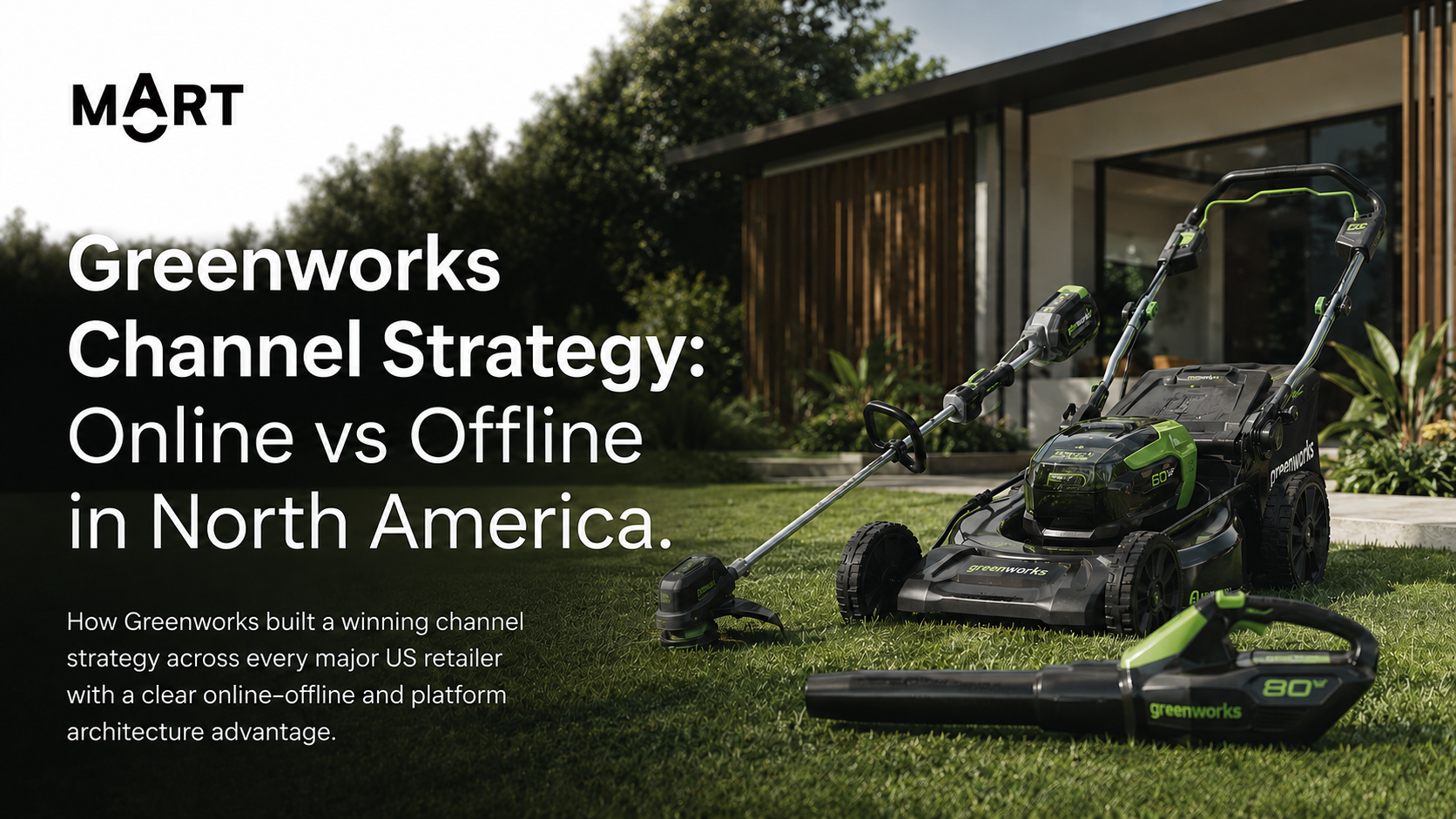
Greenworks built one of the most-studied channel strategies in North American outdoor power equipment, splitting battery platforms across consumer and commercial channels while running parallel online and offline distribution at every major US retailer. For brand operators studying how Chinese-founded brands scale in North American retail, Greenworks is the clearest case study available. This article breaks down how the channel architecture actually works and what other brands can learn from it.
Greenworks sells through every major US channel for outdoor power equipment. The offline footprint is anchored at Lowe's, Home Depot, Costco, Tractor Supply, Walmart, Best Buy, Menards, and NorthernTool. The online footprint covers all of those plus Amazon, Target.com, and the brand's own DTC site at greenworkstools.com. Lowe's is the deepest brick-and-mortar partnership, with assortment depth that includes the full 40V and 60V consumer ladders plus seasonal merchandising programs.
The channel split is not random. Consumer 24V, 40V, and 60V battery platforms anchor the mass retail and DIY channels (Lowe's, Home Depot, Costco). The 80V platform is positioned as the premium consumer flagship and gets selective placement, often featured in Costco roadshow programs and premium endcap positions at Lowe's. The 82V Commercial platform is a separate go-to-market entirely, sold through commercial dealers and direct-to-landscaper sales, not the DIY mass channel. This three-tier channel architecture is the single most important pattern in the brand.
Most brands treat product platforms and channel strategy as separate decisions. Greenworks treats them as the same decision. The 80V consumer and 82V commercial tools look similar to a casual observer but use different physical battery connectors specifically to prevent cross-channel cannibalization. A homeowner cannot use a commercial battery in a consumer tool and vice versa. This architectural choice protects the commercial channel's price integrity and the consumer channel's accessibility at the same time.
The practical implication for brand operators: when you design a channel strategy for North America, design the product architecture to enforce the channel boundaries. Greenworks could have unified at one platform and let pricing do the segmentation. They chose physical incompatibility instead, and the result is durable channel margin protection.
Greenworks has invested in greenworkstools.com as a strategic counterweight to retailer dependence. The DTC channel sells the full line, runs brand-controlled promotions, and gathers first-party customer data the retailer partnerships do not surface. This is the playbook every cross-border brand should be running: retailer partnerships drive scale, but the DTC channel preserves brand independence and gives the brand leverage in retailer negotiations.
The DTC site also serves as the platform for brand storytelling that retailer shelf space cannot accommodate. Battery platform comparison guides, professional landscaper case studies, and warranty registration flows all live on greenworkstools.com and create a brand relationship beyond the transaction.
Costco's roadshow program is a particularly effective channel for outdoor power equipment because Costco members buy seasonal items in bulk and respond well to live demonstrations. Greenworks has used Costco roadshow placements to launch new battery platform tools (most recently 60V product extensions) with member-pricing programs that drive trial. The roadshow channel functions as a discovery mechanism that the year-round in-line assortment cannot replicate.
The economics matter: Costco roadshow programs typically run 2 to 3 weeks per location and require the brand to staff demonstrators and provide member-exclusive bundles. Brands that can deploy demonstrators and absorb the bundle economics see meaningful sell-through; brands that try to use roadshow as a passive listing rarely see the returns.
Greenworks treats Lowe's as the anchor retailer relationship in North America. The assortment depth, seasonal merchandising commitments, and joint marketing programs at Lowe's are deeper than at any other channel partner. This is the right call for the OPE category because Lowe's Pro customers (the smaller commercial landscapers who buy through Lowe's rather than a commercial dealer) are a uniquely valuable cohort: they spend more than DIY consumers and convert at higher rates on premium battery platforms.
The lesson for other brands: not all retailer relationships should be equally deep. Pick one or two anchor partners where the relationship gets disproportionate investment, and treat the rest as scale channels. For outdoor power equipment in North America, Lowe's plus Costco is the highest-leverage two-account combination.
The Amazon channel is the highest-volume online channel for Greenworks but also the lowest-margin and the hardest to brand-control. Greenworks ships SKUs to Amazon Vendor Central (1P) for the core product lines and runs a 3P seller program for accessories. The trade-off is well-understood: Amazon delivers volume the DTC site cannot match, but the brand experience and pricing are largely outside the brand's control.
The MOART read on this tension: most international brands lean too heavily on Amazon in the first 18 months of US entry because it delivers fast revenue without the operational lift of a Lowe's or Home Depot listing. The right approach is to use Amazon as a launch mechanism but invest in retailer relationships and DTC simultaneously, so by year 2 the channel mix has rebalanced.
Design product architecture to enforce channel boundaries. The 80V vs 82V battery incompatibility is a channel strategy decision dressed as a product decision. If a homeowner can buy your commercial product at a consumer channel, your channel margin protection is broken before you start.
Pick anchor retailer relationships and invest disproportionately. Greenworks at Lowe's is structurally deeper than Greenworks at Walmart. Not every retailer relationship should be equal.
Build the DTC channel as a strategic counterweight from day one. Retailer partnerships drive scale; the DTC channel preserves brand independence and negotiating leverage.
Use roadshow programs as discovery channels. Costco roadshow programs and similar discovery mechanisms drive trial in ways the static in-line assortment cannot. Budget for the staffing and bundle economics.
Resist Amazon channel dependence in the first 18 months. Amazon delivers fast revenue but limits brand control. Build the retailer and DTC channels in parallel so the channel mix rebalances by year 2.
MOART operates cross-border retail programs for international brands entering North America. The work spans retailer relationship building (Lowe's, Home Depot, Costco, Walmart, Target, Sephora, and specialty channels), in-store activation and roadshow program operations, DTC channel architecture, and the operational scaffolding (compliance, logistics, customer service) that turns a retailer listing into a sustainable channel relationship. For brands studying the Greenworks playbook and thinking about how to execute their own version, MOART is the operating partner that turns the strategy into a quarter-by-quarter execution plan.
To discuss a North American retail channel strategy for your brand, contact MOART at info@moartgrp.com or visit moartgrp.com/contact.