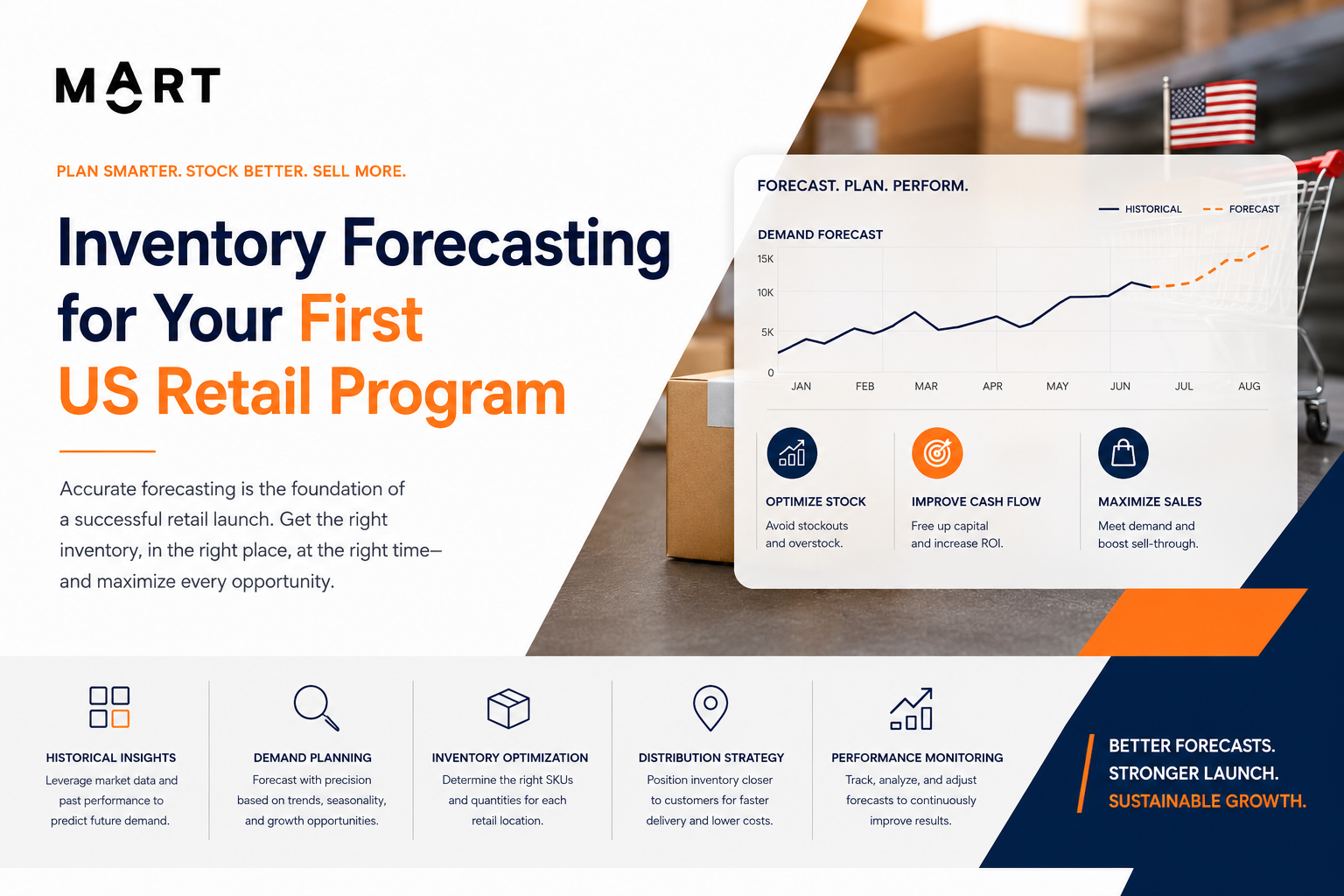
Inventory forecasting for a first US retail program is one of the most consequential planning exercises an international brand undertakes. Get the forecast right and you preserve cash, hit shelf consistently, and earn the operational credibility that supports expansion. Get it wrong and you either run out and lose your shelf placement to a competitor, or you sit on dead stock that eats into margin for the next twelve months.
The starting point is the retailer's expected sell through rate, not your own projections. Every category and every retailer has known velocity benchmarks. A new SKU in a thousand store national chain might be expected to sell two to four units per store per week in its first quarter, with sell through accelerating or declining based on early performance. Forecasting against the retailer's expected velocity is more accurate than forecasting against your own optimism.
The second input is the retailer's reorder cadence. Some retailers reorder weekly. Some reorder bi-weekly. Some reorder on a fixed schedule regardless of velocity. Understanding the cadence determines how much inventory you need at any given time. A weekly reorder retailer needs less safety stock than a bi-weekly reorder retailer.
The third input is your production lead time. Manufacturing in Asia and shipping ocean freight to the United States typically runs eight to twelve weeks from production order to warehouse delivery. If you sell through faster than expected, the next inventory might not arrive for three months. That is a long time to be out of stock at a national retailer, and the retailer's patience for out of stock situations is limited.
The fourth input is the cost of being wrong on each side. Excess inventory carries holding cost, capital cost, and eventually markdown cost. Insufficient inventory carries lost sales cost and the harder to quantify cost of operational credibility damage. The asymmetry of these costs varies by product category. Apparel has high markdown risk. Shelf stable consumables have lower markdown risk. Design your safety stock around the actual cost of being wrong in your category.
The model that works is a rolling twelve week forecast that updates weekly based on actual sell through. Compare each week's actual to the forecast. Investigate variances of more than fifteen percent. Adjust production orders for the next cycle based on the trend, not on a single week's data. Brands that build this discipline preserve cash and maintain shelf consistency through the volatile first year.