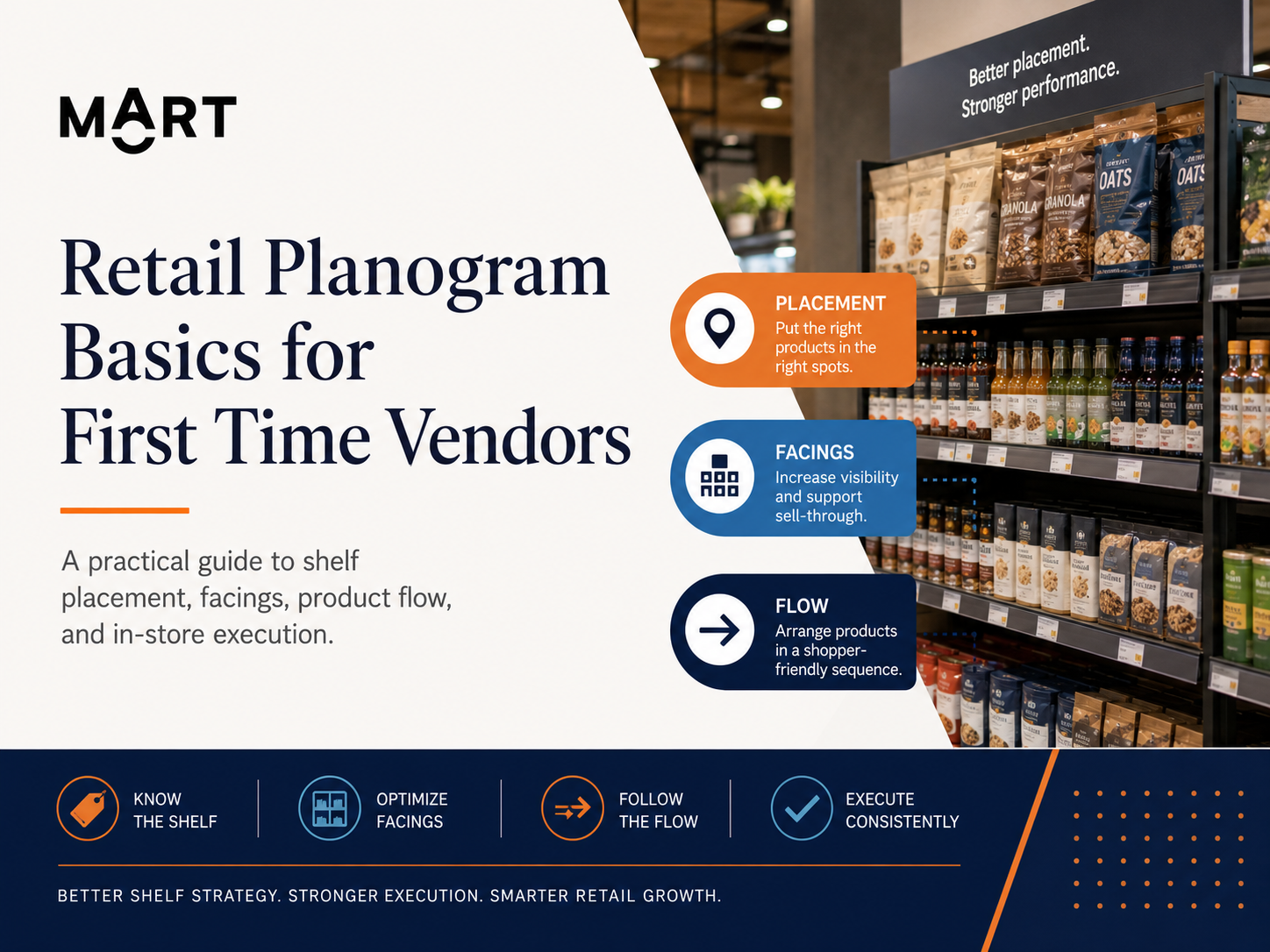
The planogram is the document that defines exactly where your product sits on the retailer's shelf, how many facings it has, how it is positioned relative to the category, and what the visual presentation looks like at store level. For brands that have not worked with major US retailers before, the planogram process can be opaque, and decisions made without understanding it tend to result in products that are technically in distribution but practically invisible to the shopper.
The first concept to understand is the planogram authority. At most major retailers, the category buyer owns the planogram for that category. The planogram is built around the category's role for the retailer, the retailer's strategy for the shopper trip, and the financial contribution each SKU makes to the category's total performance. Your product is a line item in a much larger planning exercise, not the center of attention.
The second concept is shelf position math. Every shelf has a finite number of facings, and every facing has measurable economic value. A product in eye level position with three facings will outsell the same product in bottom shelf position with one facing by multiples, not by percentages. The planogram negotiation is about facings and position more than it is about whether your product is in the planogram at all.
The third concept is the schematic itself. The planogram is a visual document showing each SKU in its position. Your product appears as a rendered image or a placeholder block in a specific location. Reviewing the planogram before launch lets you understand exactly what the shopper will see, and lets you flag merchandising issues before they materialize at store level.
The fourth concept is the reset cycle. Most retailers reset their planograms on a defined cadence, often twice per year. The reset is the window in which your product can move position, gain facings, lose facings, or be dropped from the assortment entirely. Brands that prepare for the reset with strong category data and clear performance arguments tend to improve their planogram position over time. Brands that approach the reset reactively tend to lose ground.
The fifth concept is your design for the shelf. The product needs to read clearly at shelf distance, signal its category benefit immediately, and stand out against the adjacent products that will be next to it. Brands that design packaging in isolation and then discover at the planogram stage that their product disappears on shelf have a long path back to acceptable shelf presence. Designing for the actual shelf context, with the actual adjacent products in mind, produces packaging that wins facings rather than asking to be added.