Section 301 tariffs on goods from China have reshaped the landed cost calculation for international brands manufacturing in China and selling into the United States. The tariff schedule has evolved through multiple administrations and several rounds of adjustments, and the rates in effect today are meaningfully different from the rates in effect in 2019 or 2021. Building a landed cost model that reflects current reality is essential for accurate margin planning.
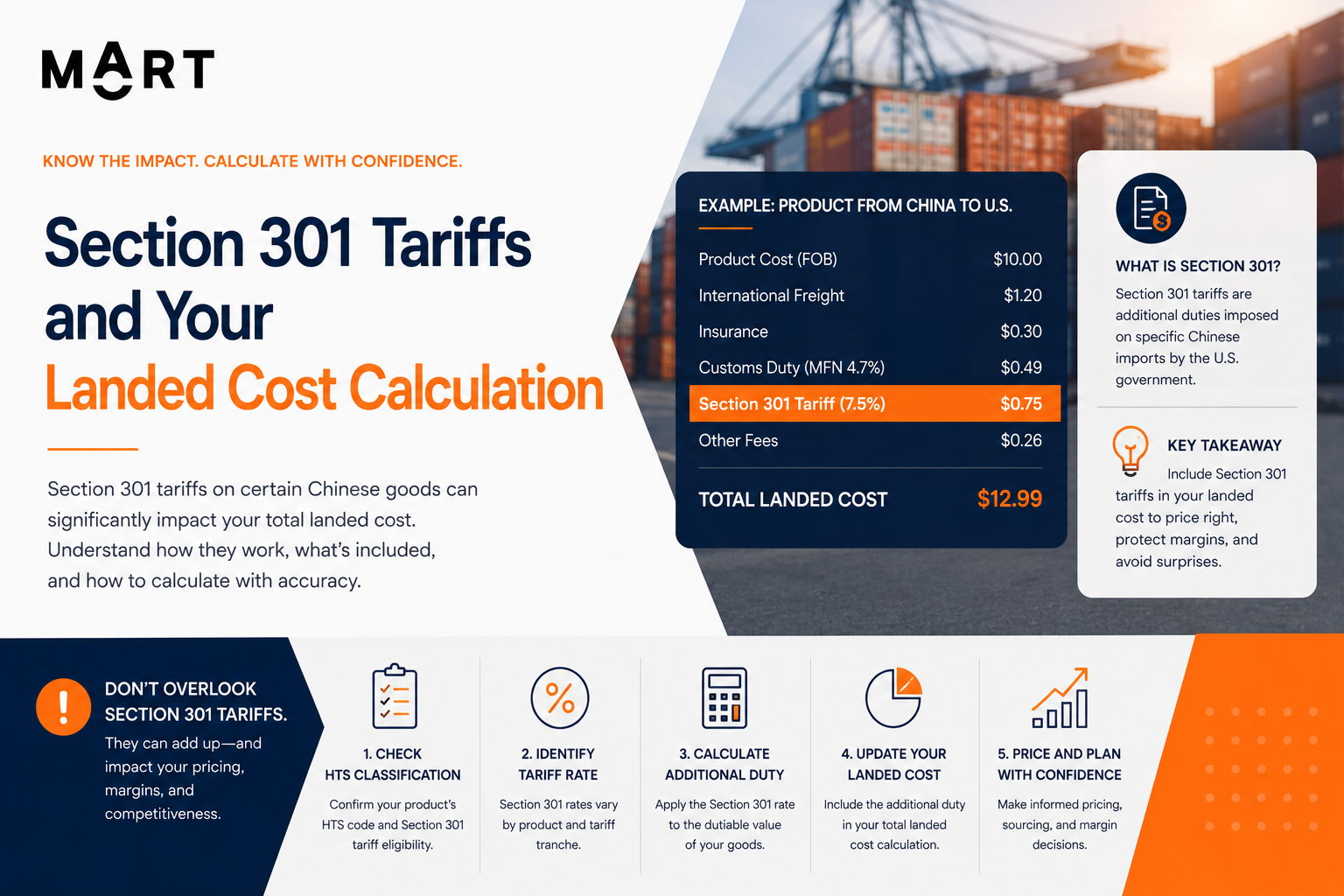
The basic structure is that goods manufactured in China and imported into the United States carry an additional duty above the standard Most Favored Nation rate. The Section 301 list categorizes products by HTS code, and the additional duty rate varies by list. List one and list two carry twenty five percent. List three carries twenty five percent after a series of adjustments. List four A carries seven and a half percent, and list four B was suspended.
For most consumer products, the practical effect is that goods from China carry a fifteen to thirty percent total duty rate after Section 301 stacking on top of the underlying MFN rate. For a product with a wholesale cost of ten dollars at the factory, the duty alone can add one dollar fifty to three dollars to the landed cost. That is a meaningful margin impact that brands need to plan for, not absorb as a surprise.
There are exclusions available for specific HTS codes in specific situations, but the exclusion process is administrative and uncertain. Building your margin model around the assumption that exclusions will be granted is a meaningful risk. Build the model around current rates, and treat any exclusion as upside.
The strategic responses available to brands fall into three categories. The first is country of origin diversification. Manufacturing in Vietnam, Thailand, India, Mexico, or other non-China origins removes the Section 301 exposure entirely, though it introduces other operational complexities. The second is value engineering at the product level. Reducing the cost basis on which duties are calculated reduces the absolute duty cost. The third is tariff engineering at the classification level. Working with customs counsel to identify classifications that legitimately reflect the product and carry lower duty rates can produce material savings.
The fix is to build a landed cost model that explicitly itemizes Section 301 duty, runs sensitivity analysis on rate changes, and tests profitability at each plausible duty scenario. Brands that build this discipline early can absorb policy changes without margin shock. Brands that ignore the line item tend to discover the problem after a tariff increase rather than before.