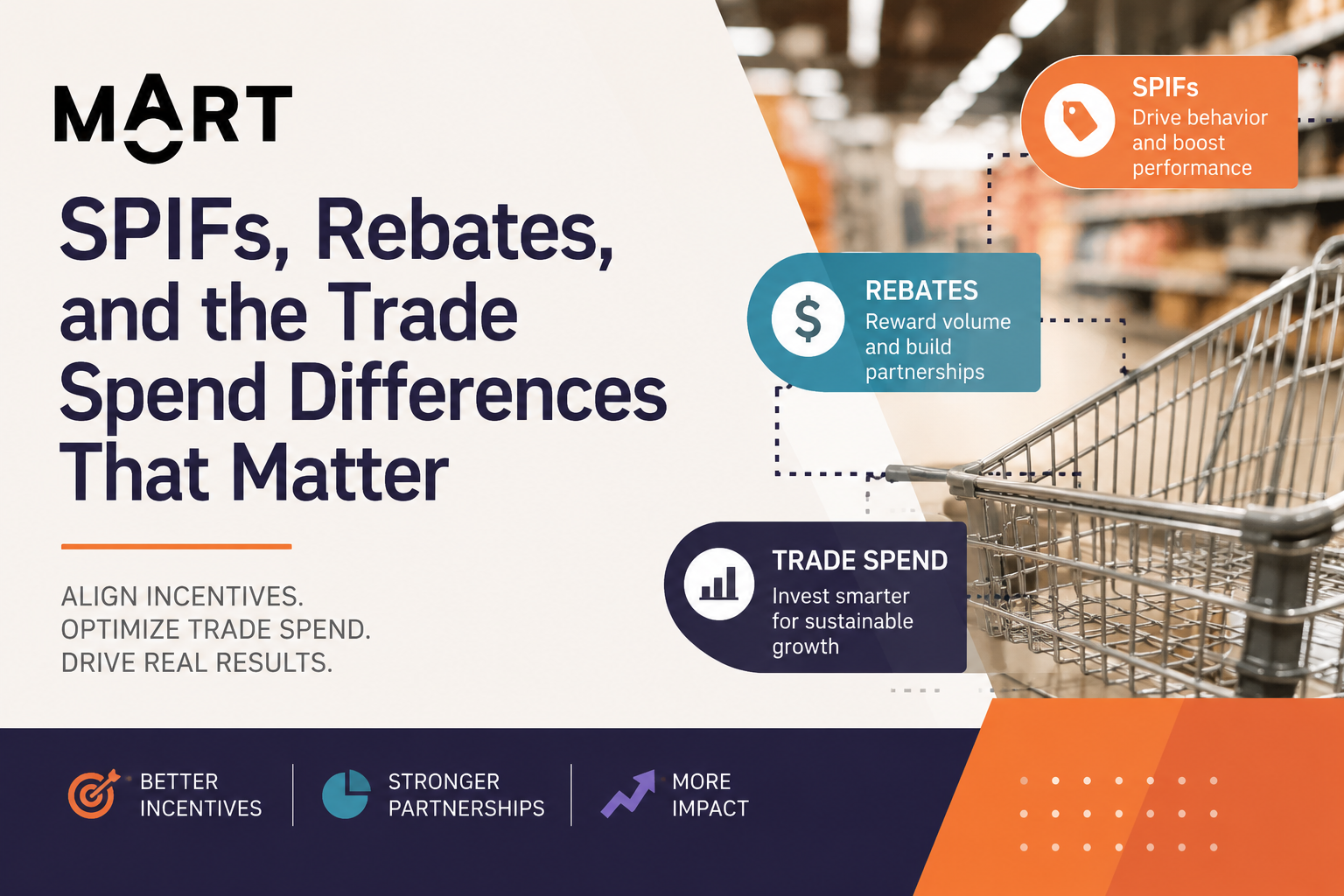
Retail trade spend comes in many forms, and brands new to US retail often treat the different structures interchangeably. SPIFs, rebates, MDF, slotting, co-op, and end cap fees are all retail spend categories, but each one targets a different outcome, motivates a different stakeholder, and produces a different kind of lift. Understanding the distinctions lets brands allocate trade spend efficiently rather than spreading it thin across categories that do not produce results.
SPIFs, or Sales Promotion Incentive Funds, are payments made to retail sales staff or floor employees to motivate them to recommend or position your product. SPIFs work in categories where the floor employee influences the shopper's choice, such as consumer electronics, mattresses, appliances, and certain specialty categories. In self service categories like grocery, SPIFs have minimal effect because the shopper is not interacting with floor employees in the purchase decision.
Rebates are payments to the retailer based on volume thresholds or specific performance metrics. The structure motivates the retailer to push your product to hit the thresholds, which can translate into better shelf positioning, more promotional support, or more inventory commitment. Rebates work best when they are structured around metrics the retailer can actually influence, not around outcomes that depend on factors outside the retailer's control.
MDF, or Market Development Funds, are payments earmarked for specific marketing activities. The retailer uses MDF to fund circular features, digital placements, in-store signage, or category specific marketing programs. MDF differs from co-op in that it is typically tied to specific committed activities, while co-op is a general fund that the retailer allocates against various activities throughout the year.
Slotting fees are upfront payments for shelf placement of new SKUs. Slotting is most prevalent in food and beverage at conventional grocery, and is less common at mass retail, club, and specialty channels.
End cap fees are payments for specific promotional placements outside the normal planogram, typically in high traffic locations and for defined periods.
The principle that ties these together is that every trade spend dollar should map to a specific outcome the brand is trying to produce. SPIFs to motivate floor staff in influence categories. Rebates to motivate retailer commitment in volume sensitive accounts. MDF to fund specific marketing activities with measurable lift. Slotting to secure new shelf placement. End cap fees to win specific high traffic moments. Brands that allocate trade spend with this discipline produce measurable returns. Brands that treat all trade spend as a single bucket tend to find that the bucket disappears without producing results.