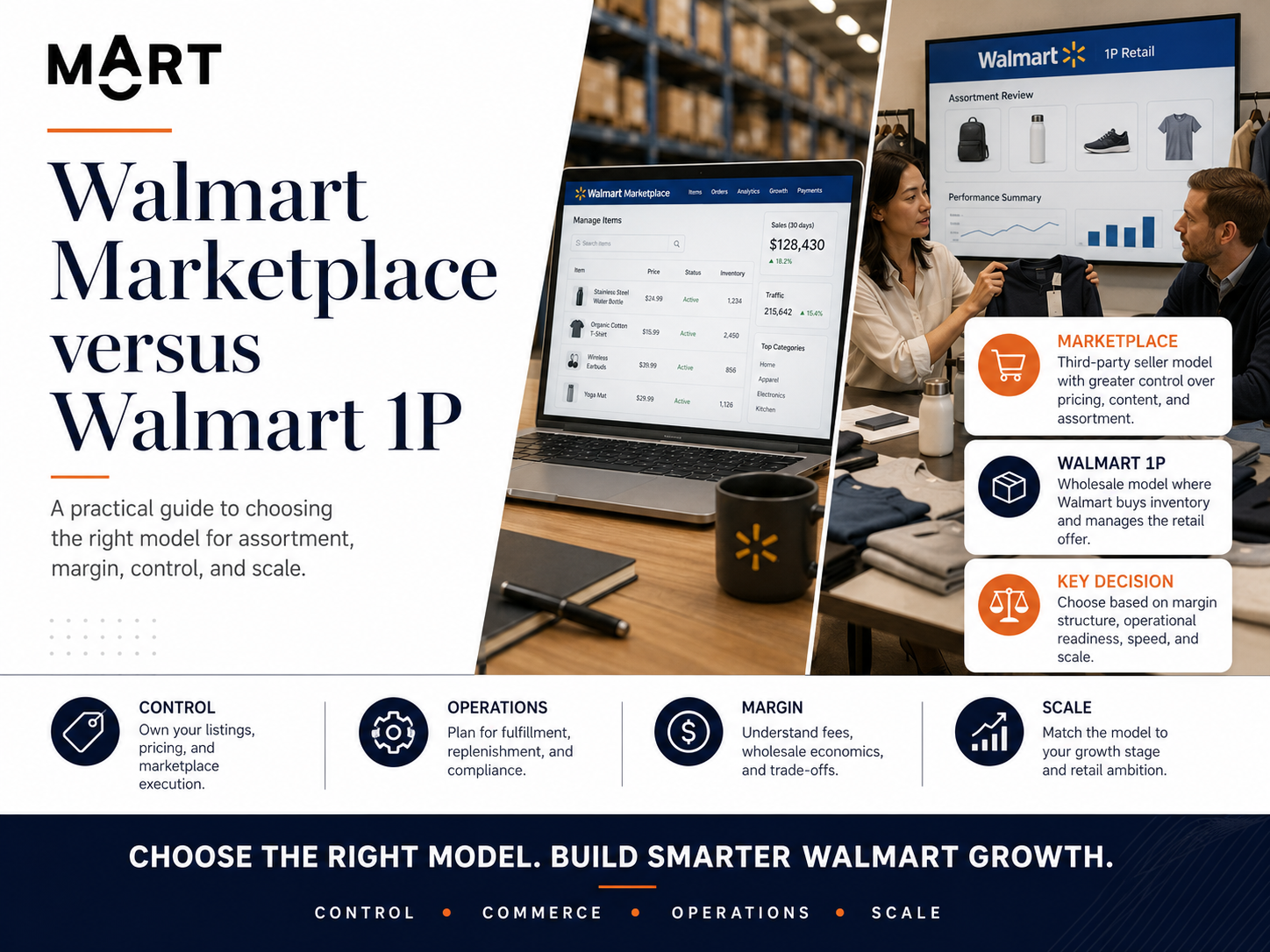
Walmart operates two distinct e-commerce channels that brands often conflate. Walmart 1P, where Walmart buys inventory from the brand and resells it through Walmart.com and Walmart stores. And Walmart Marketplace, where the brand sells directly to consumers through Walmart.com with Walmart taking a referral fee. The choice between these two channels has meaningful operational, financial, and strategic implications that brands should evaluate explicitly rather than default into.
Walmart 1P is the traditional retail relationship. The brand sells inventory wholesale to Walmart at agreed terms. Walmart manages the consumer relationship, the pricing, the merchandising, and the fulfillment. The brand collects predictable revenue based on purchase orders, with the cash flow and risk profile of a wholesale relationship. The downside is that Walmart owns the customer relationship and the data, and the brand has limited visibility into how the product is performing or how the consumer is interacting with the listing.
Walmart Marketplace is a different model. The brand sells direct to the consumer through Walmart.com, with Walmart providing the platform and traffic in exchange for a referral fee, typically ranging from eight to fifteen percent depending on category. The brand sets the price, controls the listing content, manages the fulfillment, and collects the consumer relationship data. The cash flow profile is closer to direct to consumer than to wholesale, and the brand assumes more operational responsibility.
The choice depends on three factors. The first is operational capability. Marketplace requires the brand to handle order management, fulfillment, customer service, and returns at the volume Walmart traffic can produce. Brands without that operational infrastructure should consider 1P, where Walmart handles those functions.
The second factor is margin structure. Marketplace margins are typically higher than wholesale margins because the brand captures retail markup. But marketplace also carries higher operational costs and direct exposure to platform fees and variable shipping economics. The net margin comparison depends on category and execution.
The third factor is strategic positioning. Marketplace offers more brand control, more data, and more flexibility to test pricing and merchandising. 1P offers the credibility and operational stability of a traditional retail relationship. Some brands prefer the control of Marketplace. Others prefer the stability of 1P. A few brands operate on both, using 1P for core SKUs and Marketplace for tail SKUs.
Whatever the choice, the decision should be made deliberately. Walmart's two channels reward different operational approaches, and a brand that treats them interchangeably tends to underperform on whichever channel it has not properly invested in.